Maximal Fences #
I got nerd sniped by this video and with some help from my friend Claude was able to optimize some of the existing records and set some new ones.1
Infinite Tetration #
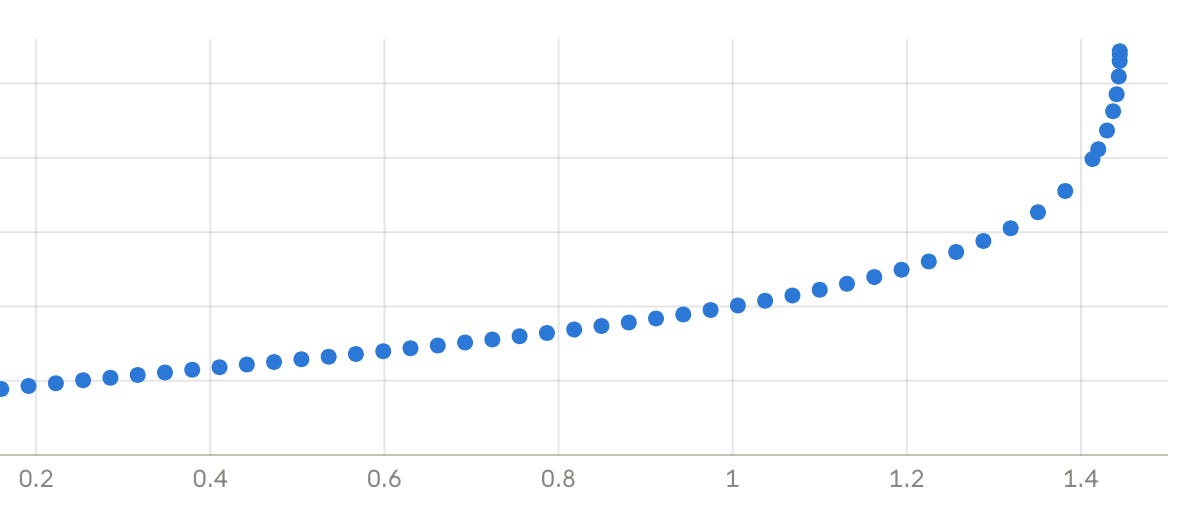
There are a bunch of videos talking about how the infinite tetration function is only defined in a specific range and strangely only hits finite values at the ends of the range, but they don’t show what it actually looks like as a function, so here it is:
You might wonder what’s going on at the end points here. On the right it’s going completely vertical. There’s nothing actually funny happening on the left, that’s just where the formula for it using the W function splits into two value. But we can make an analytic continuation of it like so:2
Since we’re defining tetration we can make the rules and there’s no reason to limit it to the happenstance constraints of W. But this still leaves the question of what’s going on on the right. It turns out it does extend, but going up, like this:
Looking at it this way raises the question of what the inverse of this function is. It turns out it’s y=x^(1/x). So the natural way of defining this stuff is to start with that function then wonder what happens if we take its inverse and wonder what happens at the points where the W function splits. But in that direction it seems like a bunch of bizarre leaps and generalizations which require justification, where if we instead work backwards from infinite tetration they’re strange phenomena which need explanation.
The big lesson to take away is that if you see W turn up you’re probably looking at the inverse of something, and being able to support that is how W has worked its way into the canon of standard functions.
Unit Distances #
After thinking about the unit distance conjecture I came to the surprising realization that for any asymptotic bound it must be possible to constrain the points to being in a ‘barbell’ of two discs exactly a unit distance apart and only take a constant factor hit based on the diameters of the discs. Writeup over here3. I was hoping that this would result in better bounds but it works out that the amount of constant factor on tightening the disc radii exactly cancels out the reduction in number of points covered by their areas. But it does seem to imply that you can find solutions whose points are within arbitrarily tight disc pairs by taking subsets of ever larger solutions. So maybe the optimal solutions all have this form and have some parameterizable epsilon how big the discs can be where any value works.
I don’t know if this observation is novel or is something obvious to people actively studying the problem and they just haven’t written it up because it hasn’t lead anywhere. But I found it interesting and surprisingand hopefully you do too.
1 It turns out Claude was taking my suggested search areas and implementing them verbatim using SLSQP which explains why nobody else had already done it with a bare prompt.
2 It’s possible to do an analytic continuation into the complex numbers which produces all kinds of interesting stuff but I’m not about to make a half hour long video with lots of 3d animations. If somebody else does that I would much appreciate it.
3 I was discussing this with Claude as I worked through it and Claude’s profound inability at geometric visualization made it not follow anything I was saying until I got to this very specific statement and then it was able to prove it immediately in a much more elegant way than I had worked out.