This post contains no AI
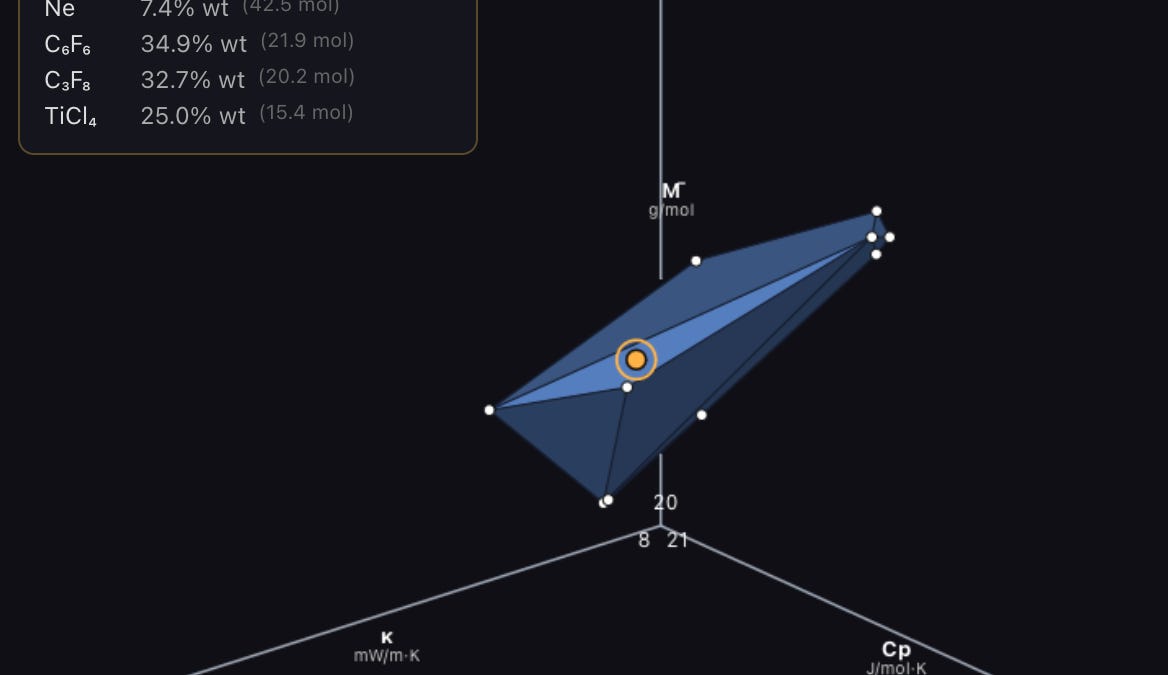
Over the years I’ve occasionally noodled on what might be a better working fluid for supercritical turbines than Carbon Dioxide. It turns out the main fixed parameter is the critical temperature, because there’s a strong nonlinearity in density with it going up rapidly as that temperature is approached. The other parameters of note are thermal conductivity, specific heat, and density, with more being better. There’s a very short list of possible fluids to mix which aren’t horribly corrosive, thermally unstable, or otherwise problematic. I’ve put together a tool to play with all the possible options here. You should go play with it. The short of it is that a mix of Neon and Perfluorobenzene tuned to the desired critical temperature is probably optimal, but if Perflueropropane’s decomposition problems aren’t too bad or Titanium Tetrachloride mixes with other things well then combining with some of those may be beneficial. This approach to visualization is probably equally applicable to conventional refrigerants but with the fixed parameter being boiling point rather than critical temperature. I don’t know if it’s standard there. If it isn’t it should be.
Years ago there was this insane academic idea that the isotope Thorium-229 might have a metastable isomer whose energy state is so close that it could be flipped into that state using a laser. In principle this worked on paper but so completely goes against the fundamentals of chemistry that it has to be assumed that it won’t work. Now it’s actually been made to work. It’s a little hard to convey how bonkers this is. A truly herculean effort was necessary to find out what the extremely precise wavelength of the laser has to be. The chemistry actually matters. The chemical which the Th-229 is embedded in matters for how precise the laser has to be. The laser is pushing on the nucleus, which is pushing on an electron, which is in turn pulling on the nucleus, which is pulling on the laser. This is not how chemistry works. But it does have directly applications to making yet even more insanely accurate clocks than we have currently, with possible applications to things like measuring fluctuations in the dark matter passing over the earth.
Here’s a crazy new idea of mine: It would be very convenient if there were some isotope which absorbed neutrons and then turned into something with an insanely high cross section similar to Xenon-135 but a half-life on the order of minutes. That could be left in a reactor core to to provide a passive negative feedback loop which operated on flux instead of temperature. Since flux is leading and temperature is trailing this could react more quickly and reliably. The downside would be losing some neutrons to the passive buffer. The funny thing is we have no idea if such unobtanium exists: The neutron cross sections of things with short half-lives are largely unknown and hard to predict. But we have some data already! If this process is already happening accidentally from something in existing nuclear reactors then there should be a resonance in the time series data for temperature measurements in them which is very precise and consistent across reactors. A lot of such data for many different reactors already exists. Checking for that would be an experiment worth doing.