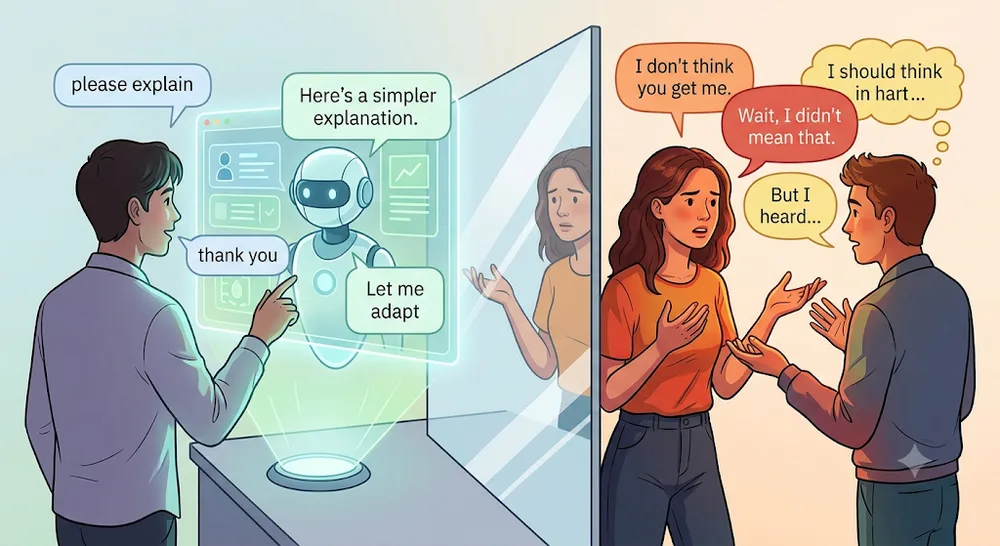
I've been testing Claude's latest iteration for weeks now, and the pattern is always the same. When I write a prompt that feels natural — like I'm explaining something to a colleague over coffee — the model either misses the point entirely or hallucinates details that sound plausible but are completely wrong. But the moment I switch to a more structured, almost mechanical style of prompting, the results improve dramatically. It's like the AI speaks a pidgin English that happens to align with my instructions, but anything beyond that shared pidgin breaks down.
This is the paradox: the better we want AI to understand us, the less human our communication has to become.
The Prompting Tightrope #
There's a spectrum in how we interact with LLMs. On one end, you've got freeform natural language — the way you'd ask a friend for advice. On the other, you've got hyper-specific, step-by-step directives that leave no room for interpretation. The irony is that the second approach gets you better results, even though it feels less like a conversation and more like writing a program.
I tried asking Claude to "help me write a blog post about AI ethics" without any structure. What I got back was generic, surface-level fluff. Then I tried: "Outline three key ethical concerns in AI development. For each concern, provide a real-world example from the past two years, a potential mitigation strategy, and a counterargument." Suddenly, the output was sharp and useful.
The problem isn't that the AI is dumb — it's that it's too literal. It doesn't infer intent the way humans do. Sarcasm, implied context, emotional subtext — these are all lost on it. So we compensate by being unnaturally explicit, which defeats the entire purpose of conversational interfaces.
Bridging the Gap #
Some researchers are experimenting with chain-of-thought prompting and few-shot examples to make interactions more fluid. Others are building middleware tools that translate casual queries into precise instructions behind the scenes. But until models genuinely understand nuance — not just mimic it — we're stuck translating our thoughts into a language that machines can reliably parse.
The real question isn't whether AI will eventually understand us better. It's whether we should keep dumbing down our language to meet them halfway, or if we should be building systems that can lift themselves up to meet ours.
What's your experience been? Do you find yourself code-switching when you prompt, or have you cracked the formula for keeping it conversational?
Next Why a 1-Megapixel Camera is the Secret Weapon for Apple's AI →