Support CleanTechnica's work througha Substack subscription,on Patreon, oron Stripe. Help us produce all of thehigh-quality, original content we publish week after weekdespite the challenges of content-scraping AI, antisocial media, inflation, and other hurdles.In reality, the battery electric heavy trucks of today have insufficient range for many applications. Even the mighty Tesla Semi (once it actually becomes widely available) will have its limitations. No matter how aerodynamic the shape of the cab or how large the battery, hauling a fully loaded semi-trailer uphill to the Eisenhower Tunnel in the Rocky Mountains will always be a challenge for battery-powered tractors. Mahle, a tier-one supplier to the automotive and trucking industry, claims to have a solution.
In a press release, the company said trucking companies face the dual challenge of reducing emissions from their operations without jeopardizing their economic viability or competitiveness. Inadequate charging infrastructure for commercial vehicles in many regions and the limited ranges of battery electric trucks are the two leading reasons why electrification of heavy-duty trucks is lagging. Flexibility and reliability are the key factors for business success in this sector.
“Time and energy are limited, valuable resources, especially in road transport business. Only operators who work economically can survive. With electrification products, MAHLE can help make heavy trucks more efficient and flexible at the same time as reducing operating expenses,” said CEO Arnd Franz. “This is what we will be demonstrating to our customers, international vehicle manufacturers, and fleet operators at this year’s IAA Transportation.”
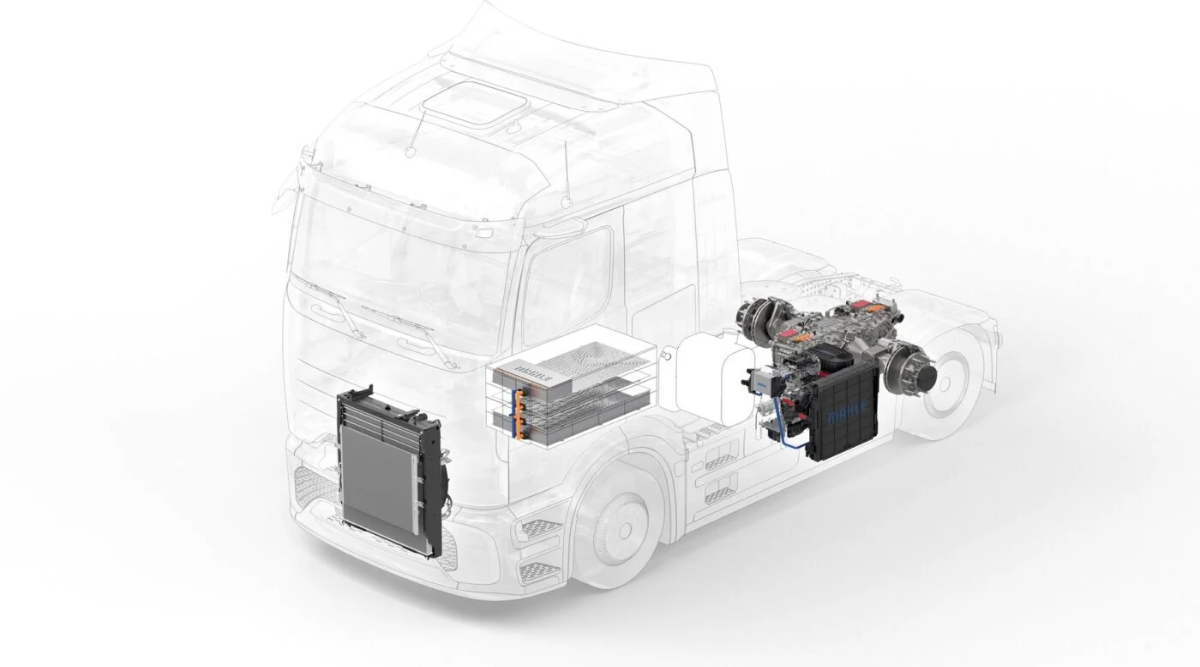
Mahle Range Extender System
At the IAA Transportation trade show in Hannover, Germany in September, Mahle will introduce a new range extender system for heavy trucks. The system provides for flexible range without any compromises and efficiency without restrictions, the company claims. “Our range extender is a smart ’emergency power unit’ that is activated at precisely the right moment and significantly increases the range available,” said Dr. Marco Warth, vice president for research and advanced engineering.
Key to the new system is an efficient high-voltage generator with a continuous output of 110 kilowatts and a peak output of up to 130 kW, driven by a compact internal combustion engine. The generator supplies reliable power to the electric drive system even on difficult trips with a full load. Its architecture can be adapted easily to the performance requirements of a variety of applications and regional markets. Thanks to its newly developed advanced oil cooling system, the generator has a power density of more than 7 kW per kilogram, allowing a high power output with reduced weight and simplified interfaces, the company says.
The entire system fits into the space where batteries for electric trucks are normally mounted, which means it can easily be integrated into existing battery electric vehicle platforms. It replaces about a third of the usual battery capacity, which allows a truck to be equipped with a smaller, less expensive battery. This reduces the load on the rear axle by about 400 kg and the total vehicle weight by about 600 kg. A truck equipped with the Mahle system has a range of more than 800 km, with the battery providing about 400 km and the range extender the remaining 400 km.
80 Percent Reduction In Carbon Emissions
Under real-life operating conditions, the truck emits about 80 percent less carbon dioxide in range extender operation than a truck with a conventional diesel engine. If renewable fuels like HVO100 bio-diesel are used to power the system, the truck has virtually no carbon dioxide emissions at all. A comprehensive thermal management system with 48 kW of high temperature and 15 kW of low temperature cooling capacity ensures stable operation of the range extender system under heavy duty operating conditions.
“Our range extender is the key to disconnecting the market ramp-up of battery electric trucks from the inadequate pace of infrastructure development,” said Warth. “If the charging station is busy, or alternative routes are called for as a result of weather conditions or congestion, and infrastructure reaches its limits, other fleets can be stranded. An e-truck with range extender just carries on. Operational availability is maintained, even under peak conditions.”
An Ongoing Quest
The quest for electric vehicles with range extender engines has been going on since the first electric cars and trucks reached commercial production. The original BMW i3 offered a range extender — basically a small motorcycle engine — but it under-performed expectations, particularly in the US where regulators insisted it not be activated until the battery was down to 5 percent SOC. GM did a better job with its Chevy Volt, a plug-in hybrid electric car with an internal combustion engine that had about 55 miles of battery-only range. For some drivers, the engine was called into operation so infrequently, they reported they purchased only 10 gallons of gasoline a year!
Ian Wright was one of the original engineers at Tesla. He left the company after Elon Musk arrived and started imposing his will on Tesla Motors, as it was named back then. Subsequently, Wright founded his own startup company called Wrightspeed that specialized in electrifying heavy-duty trucks and buses. He developed a highly efficient gas turbine that powered a range-extending generator. The engineering was brilliant, but the company failed to thrive.
Others have followed the same dream. Recently, Horse Powertrain — a joint venture between Renault and Geely — unveiled a compact gasoline engine and generator combination designed to be retrofitted to existing vehicles. In a press release, the company said: “the C15 integrates an engine, generator, and inverter into a unit compact enough to be fitted within existing battery electric vehicle platforms with little to no modification. This allows OEMs to easily and efficiently convert a BEV platform into a range extended EV, allowing them to expand their product line-ups to meet local market demands.” There is no word yet on whether any OEMs have taken Horse Powertrain up on its offer.
Mahle Contactless Drive Motor
Mahle is involved in other improvements to electric heavy-duty trucks as well. Next month in Hannover it will also introduce its new Contactless Transmitter (MCT) electric motor developed for use on the electric drive axles of heavy commercial vehicles. This motor is not equipped with permanent magnets and therefore does not require any rare earth elements. Compared with a benchmark permanent magnet synchronous motors, the MCT electric motor saves up to 3 kilograms of rare earth magnets per vehicle, which leads to a further reduction in the environmental footprint of the powertrain.
The MCT motor is 10 percent lighter and more efficient than permanently excited electric motors with magnets under real-life driving conditions. The advantage compared with the permanently excited variant is higher efficiency over a larger operating envelope and a variety of driving situations. It has a peak output of 370 kW and more than 900 Nm of torque at 3,900 rpm. The motor efficiency in the VECTO cycle, an EU simulation tool for determining the fuel efficiency of new vehicles, is about 95 percent.
We here at CleanTechnica are fond of saying the best technologies for electric cars and EV charging have not yet been invented. These new products from Mahle may be anachronisms twenty years from now, but for today, they may be just what we need to move the electrification of heavy trucks forward a notch.
Sign up for
CleanTechnica's Weekly Substack for Zach and Scott's in-depth analyses and high level summaries, sign up forour daily newsletter, andfollow us on Google News!Have a tip for CleanTechnica? Want to advertise? Want to suggest a guest for our CleanTech Talk podcast?
Contact us here.Sign up for our daily newsletter for 15 new cleantech stories a day. Or sign up forour weekly one on top stories of the weekif daily is too frequent.
CleanTechnica uses affiliate links. See our policy
here.CleanTechnica's Comment Policy