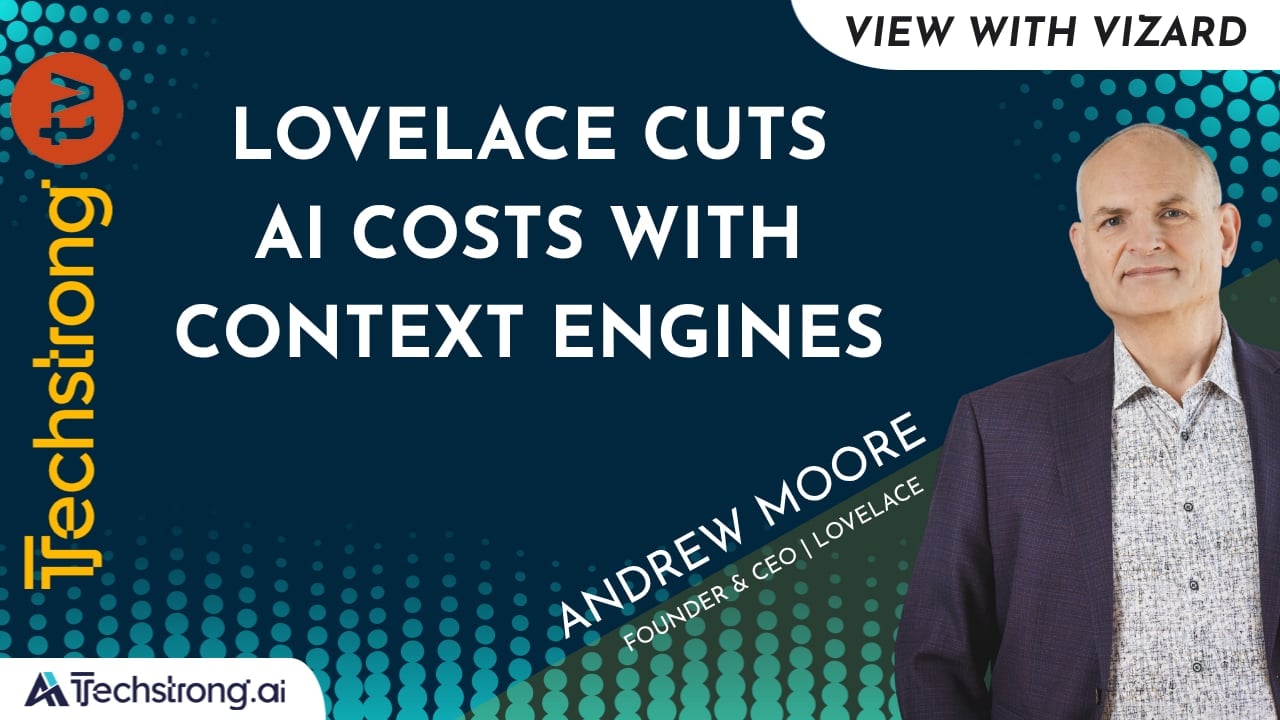
Synopsis: Enterprise AI keeps running into the same wall. The more data a model needs to reason over, the more context has to be crammed into the prompt, and the costs and error rates scale together in the wrong direction. Retrieval-augmented generation softened the problem but did not solve it — RAG pulls back relevant chunks, not structured understanding, and agents still end up making confident leaps across data they cannot actually see clearly. The next layer of value is shaping up to be how context itself is engineered.
Andrew Moore, founder and CEO of Lovelace, sat down with Mike Vizard to walk through why knowledge graphs and what his team calls context engines are emerging as the missing infrastructure under reliable agentic AI. Lovelace’s YottaGraph and Elemental platform are built to let agents reason across massive data sets without stuffing prompts full of expensive, brittle context. The shift Moore is describing is essentially a move from probabilistic guessing toward structured reasoning that an enterprise can actually audit.
Moore and Vizard work through what changes when entity resolution and graph-based context sit between models and data. Token economics get healthier because agents stop paying for redundant or irrelevant context on every call. Model independence becomes real — the structured layer outlives any particular foundation model, so swapping providers does not force a rewrite. Safety-critical use cases get a path forward because reasoning steps can be traced back to specific entities and relationships rather than disappearing into a black box.
The bigger argument is that probabilistic reasoning alone is not going to carry enterprise AI to the next stage. Without a durable layer of structured context — graphs, resolved entities, validated relationships — agentic workflows stay too expensive to scale and too opaque to defend. Context engines are starting to look like the piece that turns AI from an impressive demo into something finance, security and compliance will actually sign off on.