Non-deterministic agents break the rules traditional software security was built on
AI agent security has become the critical gating factor for enterprises that want autonomous software doing real work.
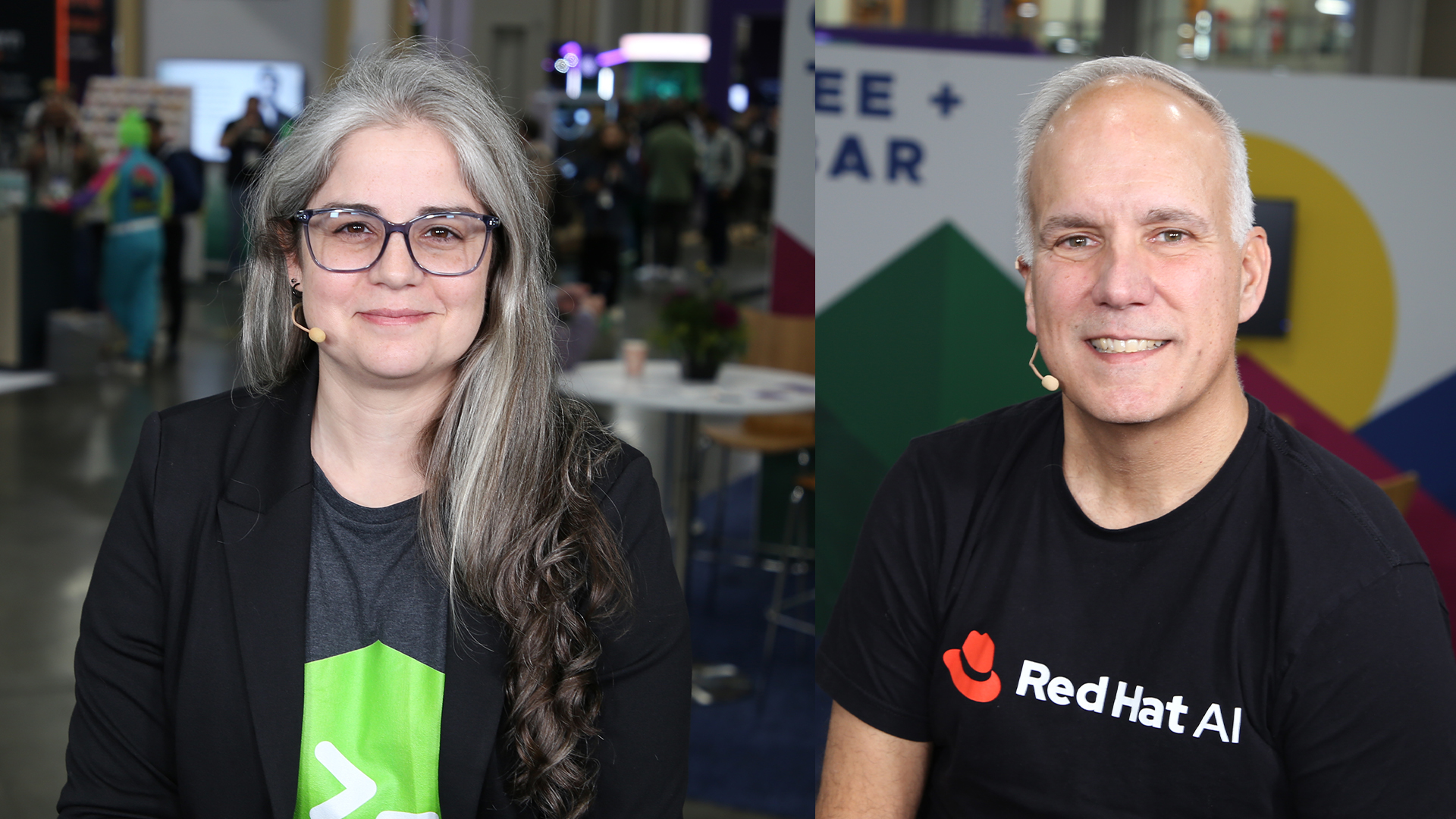
Unlike chatbots that answer questions, agents take actions, and every tool or credential they touch widens the potential damage. To that end, Red Hat Inc. has spent the past year building guardrails for that shift, including a sandbox for OpenClaw agents. The complexity lies in the fact that agents break the assumptions traditional software security was built on, according to Joe Fernandes (pictured, right), vice president and general manager of Red Hat AI at Red Hat.
“For forever, we’ve been building software, but that software is deterministic. It does what we program it to do,” Fernandes said. “Agents are different. They’re non-deterministic; you’re giving them a goal. You don’t know what actions they’re going to take to get to that goal.”
Fernandes and Jessica Forrester (left), senior distinguished engineer and chief architect of Red Hat AI at Red Hat, spoke with theCUBE’s John Furrier and Rebecca Knight at KubeCon + CloudNativeCon NA, during an exclusive broadcast on theCUBE, SiliconANGLE Media’s livestreaming studio. They discussed how Red Hat is building layered security for autonomous AI agents through sandboxing, identity management, access controls and enterprise-scale agent management. ( Disclosure below.)*
Building AI agent security in layers
Red Hat learned lessons through its own engineering teams. When it first built an agentic software development life cycle, it handed agents prefetched data and let them touch nothing else, Forrester explained. OpenShell, the open-source agent runtime Nvidia Corp. launched in March with Red Hat as a founding member, let the company loosen that grip safely. The two companies have since expanded their partnership around securing autonomous agents. One approach from Red Hat involves giving agents access to the tools they need while keeping sensitive credentials out of reach.
“With OpenShell, your agent doesn’t ever get any real keys to anything. It gets masked on the way in and then swapped on the way out,” Forrester said. “If something convinces it to give away its keys, it’s not actually giving any real keys away. That really helps you have a little bit more faith in what’s happening inside that agent box.”
OpenShell can also run agents in Kata Containers with their own kernels, inside full virtual machines on OpenShift Virtualization and behind network egress controls, Forrester noted. Red Hat has also detailed kernel-level agent isolation in its platform. Identity comes next, with every agent assigned its own identity and the narrowest set of permissions, Fernandes added.
“It’ll integrate with different identity systems to basically allow you to assign agent identity,” he said. “Then you can authorize what that agent can do — and more importantly, what it can’t.”
Red Hat is now looking beyond individual agents. It is working with OpenAI Group PBC on OpenClaw Enterprise, a project for managing thousands of personal agents at scale, while OpenShell is available in preview in Red Hat AI. For enterprises still weighing AI agent security, the project’s maturity is the moment to watch, Fernandes explained.
“We’re really now approaching that stable milestone,” Fernandes said. “That’s when we feel like, ‘Okay, we’re comfortable enough. We can actually rely on this for enterprise production.'”
Stay tuned for the complete video interview, part of SiliconANGLE’s and theCUBE’s coverage of KubeCon + CloudNativeCon NA.
( Disclosure: Red Hat sponsored this segment of theCUBE. Neither Red Hat nor other sponsors have editorial control over content on theCUBE or SiliconANGLE.)*
Photo: SiliconANGLE
Support our mission to keep content open and free by engaging with theCUBE community. Join theCUBE’s Alumni Trust Network, where technology leaders connect, share intelligence and create opportunities.
- 15M+ viewers of theCUBE videos , powering conversations across AI, cloud, cybersecurity and more
- 11.4k+ theCUBE alumni — Connect with more than 11,400 tech and business leaders shaping the future through a unique trusted-based network
Are you an AWS customer? Support SiliconANGLE financially by buying your AWS services from our Marketplace portal page and links: https://siliconangle.com/aws-marketplace/
About SiliconANGLE Media
theCUBE AIand theCUBE SuperStudios — with flagship locations in Silicon Valley and the New York Stock Exchange — SiliconANGLE Media operates at the intersection of media, technology and AI.
Founded by tech visionaries John Furrier and Dave Vellante, SiliconANGLE Media has built a dynamic ecosystem of industry-leading digital media brands that reach 15+ million elite tech professionals. Our new proprietary theCUBE AI Video Cloud is breaking ground in audience interaction, leveraging theCUBEai.com neural network to help technology companies make data-driven decisions and stay at the forefront of industry conversations.