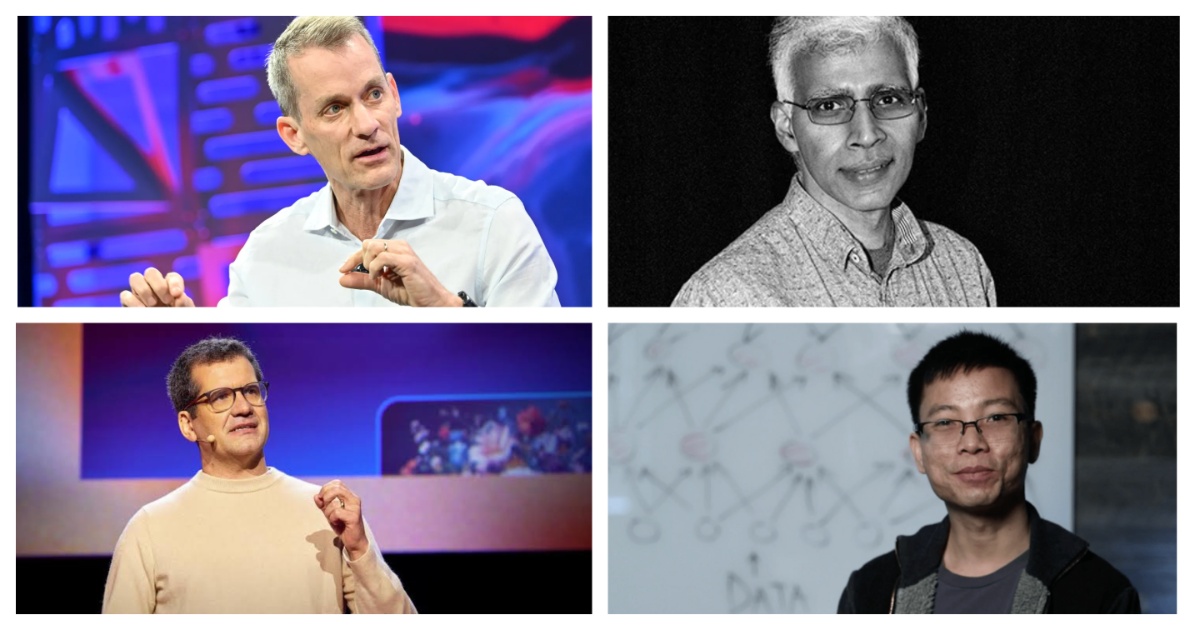
Google hasn’t only lost its most visible employee in Jeff Dean who’s left to start a new startup named Discovery Loop, but it’s lost 3 other luminaries as well.
Jeff Dean, Sanjay Ghemawat, Oriol Vinyals, and Quoc Le are walking out the door with him, and between the four of them, they carry roughly a century of combined Google tenure and a hand in nearly every major system the company has shipped since the early 2000s. Discovery Loop, the new venture, is a Public Benefit Corporation built around the idea of automating machine learning research and, eventually, science itself. Google is staying involved as a founding investor and Cloud partner, which tells you something about how this exit is being handled compared to a typical departure.
What makes this particular grouping notable is how long these four have actually worked together. Dean said in his announcement that the founding team has collaborated for anywhere between 14 and 30 years, depending on the pairing, which is a strange thing to say about a startup team but also happens to be true. Here’s a look at who each of them is and what they built during their time at Google.
Jeff Dean #
Jeff Dean joined Google in 1999, back when the company was still a search engine trying to figure out how to index the web without falling over. He holds a PhD in computer science from the University of Washington and spent time at Digital Equipment Corporation’s research lab before Google came calling. Over 27 years, he became arguably the most recognizable engineer in the company’s history, eventually rising to Chief Scientist for Google Research and Google DeepMind.
Dean’s fingerprints are on an enormous share of Google’s core infrastructure. Alongside Sanjay Ghemawat, he co-designed MapReduce, the programming model that let Google process massive datasets across thousands of machines, and Bigtable, the distributed storage system that underpins much of Google’s product stack. He also worked on Google’s original crawling, indexing, and ad-serving systems, meaning he had a hand in the plumbing behind both Search and AdSense in the company’s earliest years.
Later, Dean co-founded Google Brain and eventually became the public face of Google’s AI research, overseeing the merger of Brain and DeepMind and co-leading the Gemini project. He’s talked before about what keeps him at the work, describing engineering as fundamentally puzzle-solving done alongside people who keep teaching him things. He’s also been candid about the technical challenges of building tooling for AI agents that now move faster than the human-paced systems built to support them, and has spoken about the origins of Google’s TPUs, which trace back to a speech recognition feature that made engineers realize Google’s data centers would need custom chips to keep up.
Sanjay Ghemawat #
Sanjay Ghemawat is the quieter half of one of computing’s more famous partnerships. Born in West Lafayette, Indiana, he studied at Cornell before completing a PhD at MIT under Barbara Liskov, one of the field’s most decorated computer scientists. Before Google, he worked at DEC’s Systems Research Center, the same lab where he first crossed paths with Dean.
Ghemawat joined Google in late 1999 and has spent the years since as a Google Fellow in the Systems Infrastructure Group, working on the kind of systems most people never think about but rely on constantly. Alongside Dean, he co-designed the Google File System and MapReduce, then went on to build Bigtable and later Spanner, Google’s globally distributed database. Wired once called him one of the most important software engineers of the internet era, and the description holds up: modern cloud computing owes a lot of its shape to decisions Ghemawat made about how to store and move data at a scale nobody had attempted before.
He was elected to the National Academy of Engineering in 2009 and picked up the ACM-Infosys Foundation Award jointly with Dean in 2012. Unlike Dean, Ghemawat has kept a low public profile for someone whose code has touched nearly every Google product built in the last two decades, which makes his decision to leave alongside Dean feel less like a surprise and more like the continuation of a partnership that has simply outgrown its original company.
Oriol Vinyals #
Oriol Vinyals brings the deep learning and AI research side of the founding team. Born in Sabadell, Spain, he studied at the Universitat Politècnica de Catalunya before earning a PhD in EECS from UC Berkeley. He joined Google Brain and later moved to DeepMind, where he became VP of Research and technical co-lead on Gemini alongside Dean and Noam Shazeer.
Vinyals’ research record reads like a list of the field’s foundational moments. In 2014, working with Ilya Sutskever and Quoc Le, he co-authored the sequence-to-sequence (seq2seq) paper, which showed that neural networks could map input sequences directly to output sequences and became a direct ancestor of the transformer architecture used in nearly every large language model today. He also co-invented Pointer Networks and worked on knowledge distillation and early versions of TensorFlow.
Beyond language, Vinyals led AlphaStar, the DeepMind project that trained an agent to reach Grandmaster level in StarCraft II, a result significant enough to land on the cover of Nature in 2019. He also contributed to AlphaFold, DeepMind’s protein-folding system, and AlphaCode, before taking on the Gemini co-lead role that made him one of the most influential figures in Google’s current AI push. His research has been cited well over 100,000 times, and in 2016 MIT Technology Review named him one of its Innovators Under 35.
Quoc Le #
Quoc Le rounds out the group as the researcher most associated with automating the research process itself, fitting given Discovery Loop’s stated mission. Born in Vietnam’s Thừa Thiên Huế province, he studied at the Australian National University before completing a PhD at Stanford under Andrew Ng. In 2011, Le co-founded Google Brain alongside Ng, Dean, and Greg Corrado, and one of his early projects became something of a legend inside the company: training a neural network on 10 million YouTube thumbnails that taught itself to recognize cats, using 16,000 machines, a scale nobody had tried before at the time.
Le went on to co-develop word2vec and seq2seq, both of which became standard building blocks for modern natural language processing. In 2017, he started the AutoML project, using neural architecture search to let machine learning systems design other machine learning systems, an idea that eventually produced EfficientNet, a family of image recognition models. His 2022 paper on chain-of-thought prompting, which improved how large language models handle multi-step reasoning, has become one of the more heavily cited techniques behind today’s reasoning models. He also worked on Meena and LaMDA, and more recently on AlphaGeometry, a system capable of solving Olympiad-level geometry problems.
What This Means #
Google has already had a rough few months on the talent front. Transformer co-author Noam Shazeer’s earlier flirtation with leaving and the departures of Nobel laureate John Jumper and others to rivals like Anthropic both happened within weeks of each other back in June. But those were individual researchers moving to competing labs. This is different in kind: four of the people who built the infrastructure other researchers built on top of, leaving together to start something new, with Google itself writing a check to be part of it.
Discovery Loop’s pitch is that the scientific process, propose an experiment, run it, study the results, repeat, hasn’t fundamentally changed in decades and doesn’t scale well when done by hand. The plan is to start by pointing AI models at machine learning research itself before expanding into harder problems like medicine, clean water, and cybersecurity. It places the company in the same lane as other recent labs betting that AI can meaningfully speed up scientific discovery, a category that has already been pulling talent out of the big labs for a while now.
Sundar Pichai’s own tribute to Dean called it a privilege to have worked alongside him and Ghemawat, and confirmed Google’s continued involvement as an investor and cloud partner. Whether that arrangement ends up looking more like the OpenAI-Microsoft model or something closer to an acquisition-in-waiting is the kind of question that will take a while to answer. For now, Discovery Loop says it’s building a small, in-person team and is hiring.