*Editor's note: The "Short of War" Podcast discussing this article is AI-generated.*When U.S. and Israeli forces launched Operation Epic Fury on February 28, 2026, a parallel war began online. This battle is being fought not with bombs or drones, but with deepfakes and recycled reels. Dramatic footage shows explosions at U.S. military facilities, the sinking of the USS Abraham Lincoln, and fires in Tel Aviv. Yet none of it is real. Instead, online users are circulating deepfake images and viral social media videos to spread false information about the war. While falsehoods have long circulated in wartime, the combination of AI-assisted fabrication and online platform algorithms ensure the most provocative disinformation spreads faster than fact-checkers can follow.
These dynamics are not anomalies. In our recent research, we find that structural shifts in how information is produced and consumed are reshaping international politics in significant ways. “Information disorder”—a media environment with low barriers to content creation, rapid spread of false or misleading material, and algorithmic amplification of sensational and fragmented narratives—presents a fundamental challenge for scholars and practitioners alike. Here are three lessons that defense planners and security scholars need to know about this emerging environment.
Lesson 1: Information Disorder Gives Authoritarian States an Asymmetric Advantage over Democracies #
Irregular warfare has always been about asymmetry between actors in conflict. Information disorder shifts power toward authoritarian states, empowering regimes that are well-positioned to exploit this environment. Meanwhile, structural barriers disadvantage democratic states from using these same processes.
Democratic governance depends on citizens accessing and evaluating information in order to hold leaders accountable. This accountability mechanism underpins not only democratic politics but also many advantages that democratic states bring to foreign policy. International Relations (IR) scholars theorize that democracies are more credible when signaling during crises, more consistent in keeping international commitments, and more likely to show restraint when using force.
These mechanisms erode when citizens are bombarded with misinformation, confused by competing narratives, and sorted into algorithmic information bubbles. Many people today get news from social media, and social media algorithms privilege content that elicits anger and outrage, as these emotions drive engagement. As a result, false claims often spread farther and faster than verified reporting. In this environment, citizens confront selective and often competing information about the origins of a conflict, the success of a military operation, or the credibility of an ally. Without a shared understanding of basic facts, the political constraints that underpin democratic foreign policy begin to erode.
Authoritarian regimes face fewer equivalent constraints. Countries like Russia and China have long controlled their domestic information environments and are well-positioned to exploit this shift in warfare. As early as 2020, the State Department assessed that Russia views the information environment as a forum for “perpetual adversarial competition,” where it can disseminate disinformation and propaganda via diverse means, including government statements, state-funded media, proxy websites, bots, and false social media personas. In Africa alone, Russia has sponsored 80 disinformation campaigns targeting more than 20 countries.
China shares the view that information is a key strategic domain for warfare but has developed its own distinct approach. Rather than engage in overtly adversarial and disruptive campaigns, China focuses on long-term influence designed to bolster its international image and role in the world. Its state-controlled media is global in reach, disseminating messages via both social media and private Public Relations (PR) companies in ways that feel familiar to local audiences. Content focuses on key priorities like China’s reputation around human rights and the South China Sea, but also leverages ongoing international conflicts (e.g., Russia-Ukraine and Israel-Gaza) to project images of China’s positive global role.
Authoritarian disinformation campaigns have already paid dividends. In our book project, we show how Russia’s strategic messaging around the 2014 annexation of Crimea shielded it from significant political costs. When unmarked soldiers seized government buildings in Crimea, Russia denied that they were Russian troops, insisting instead that they were "local self-defense units." This denial bought critical time, and amid weeks of confusion and uncertainty, Russian forces were able to seize control of the Crimean parliament and hold a hotly disputed referendum leading to accession. Russia then shifted its rhetoric to claims of self-determination, forcing Western critics into protracted legal debates rather than unified condemnation. The result: a UN General Assembly resolution, designed to affirm Ukraine’s territorial integrity, had 58 abstentions, with China, India, Brazil, South Africa, and much of the Global South declining support. Russia's information strategy fragmented the global coalition that might have imposed more robust costs.
For defense planners, the lesson is clear. Information disorder is not just cheap talk or noise. It influences how publics and elites understand the nature of reality. And by shaping perceptions, it provides strategic actors with the tools to delay responses, fragment coalitions, and exploit the openness of democratic societies.
Lesson 2: Information Disorder Undermines Multilateralism and Collective Security #
Achieving political objectives often depends on cross-border cooperation, yet information disorder makes multilateral coordination significantly more challenging. When governments form alliances or join international organizations, they establish common understandings of problems, rules, and reputational consequences for violations. Our research identifies at least two pathways through which information disorder degrades these foundations.
First, information disorder fragments threat perception. When citizens and leaders in different countries inhabit different informational ecosystems, they lack a common understanding of shared threats. Climate change illustrates this clearly. Multilateral climate cooperation requires broad consensus about the nature and urgency of the threat, yet fossil fuel companies and opposed states have exploited the information environment to sow doubt, deepen polarization, and delay action. The IPCC's own 2022 assessment warns that rising misinformation is disrupting the transmission of climate science to the public, eroding support for curbing emissions.
Second, information disorder lowers the political costs of noncompliance. Concern about political and reputational backlash deters states from violating international commitments. But when leaders can fabricate pretexts for violations or provide compelling deepfakes to deny them outright, the factual baseline that enables international accountability erodes. In another recent paper, we show how foreign governments can use strategic messaging to significantly reduce the U.S. public’s willingness to punish other countries for violating international law. Information disorder makes this type of rhetorical manipulation easier, faster, and more convincing.
For practitioners who rely on multilateral ties to buttress U.S. security priorities, information resilience may be a precondition for operational effectiveness. Missions, coalitions, and partnerships will depend on the ability to arrive at a shared truth, which means officials must be prepared to monitor, detect, and counter narrative attacks from adversaries.
Lesson 3: Information Disorder Accelerates Conflict #
Information disorder has direct implications for violent conflict. Even prior to the AI era, active social media use was associated with an increased number and severity of civil conflicts, and exposure to hate speech online may increase motivation for hate crimes. Amid increased information disorder, conflict dynamics could escalate through several pathways.
Information disorder makes it easier for state and non-state actors to inflame social cleavages and destabilize ongoing conflicts. Governments or armed groups seeking to target a marginalized population can exploit social media to sow the seeds for violence or spread inflammatory content at scale. In Myanmar, for example, disinformation on Facebook played a significant role in violence against the Rohingya.
Amid an ongoing conflict, information warfare can also lead to calls for escalatory attacks and retaliation. During the 2025 conflict between India and Pakistan, misinformation and false claims of invasion bombarded social media, spreading so rapidly that government agencies began issuing fact checks on their official X accounts. Indian TV channels echoed false online claims and began reporting that Indian forces had entered Pakistan. News consumers fact-checked claims with AI models that often hallucinated events. Such dynamics could easily lead citizens to demand retaliation for attacks that never occurred or protest the government’s war strategy based on false information.
A Pragmatic Response to Information Disorder #
Information disorder is a structural feature of the modern operating environment and policymakers must prepare for it like any other challenge.
First, practitioners should invest in information resilience as a core military and intelligence capability. The U.S. government can start by reversing recent cuts to the units within the Departments of State and Homeland Security that counter disinformation. It should also expand CYBERCOM and SOCOM's information operations missions and work to attract top talent to this effort. The speed at which AI is changing information demands capabilities that match the pace of the threat.
Second, policymakers should protect the legitimacy and viability of multilateral commitments and organizations. Our research shows that international organizations are effective at countering foreign government denials, and case studies in our book project suggest multilateral organizations have unique comparative advantages in strategic messaging. Collective security organizations like the North Atlantic Treaty Organization and multilateral forums like the United Nations are often better positioned than states to counter disinformation. The U.S. should invest in these organizations’ capacity to provide information that supports liberal democratic norms.
Finally, government officials need to recognize that shoring up democratic information ecosystems isn’t just a matter for civil society; it is essential for U.S. national security. The asymmetric vulnerability of democracies is a strategic problem that demands a comprehensive response. As AI models evolve and create new opportunities for our adversaries, now is the time for government action to set guardrails and protect American democracy.
Information has always been a currency of power in international politics. But what has changed in the modern environment is the radical ease with which that currency can be counterfeited. For irregular warfare practitioners, information disorder is not a looming threat for future discussions. It is a problem right now, and we must respond accordingly.
The three dynamics we have described—authoritarian advantage, the erosion of multilateral cooperation, and conflict escalation—are not independent problems. They are mutually reinforcing features of a transformed information environment. Democracies built their postwar dominance in part on the credibility of their institutions and the openness of their information flows. These same features are now sources of vulnerability. Meeting this challenge requires democracies to treat the integrity of their information environment as a strategic interest on par with military readiness.
Julia* C. Morse is an associate professor of political science at the University of California, Santa Barbara, and the author of The Bankers' Blacklist (Cornell University Press, 2022). Her research examines international organizations, compliance, and the politics of information, including how states contest accusations that they have violated international law. A former FBI intelligence analyst, she is co-authoring a book with Tyler Pratt, Damage Control: Lies, Evasions, and the Cost of Breaking International Law. She is a 2025-2026 Public Voices Fellow.*
Tyler* Pratt is an assistant professor of political science at the University of North Carolina at Chapel Hill, where his research examines how states cooperate, compete, and justify their behavior within international institutions. A former foreign affairs officer at the U.S. Department of State, he is co-authoring a book with Julia Morse, Damage Control: Lies, Evasions, and the Cost of Breaking International Law, on how governments use strategic messaging to manage the fallout from international law violations, including acts of military aggression.*
The views expressed are those of the author and do not reflect the official position of the Irregular Warfare Initiative, Princeton University’s Empirical Studies of Conflict Project, the Modern War Institute at West Point, Department of the Army, Department of War, or the United States Government.
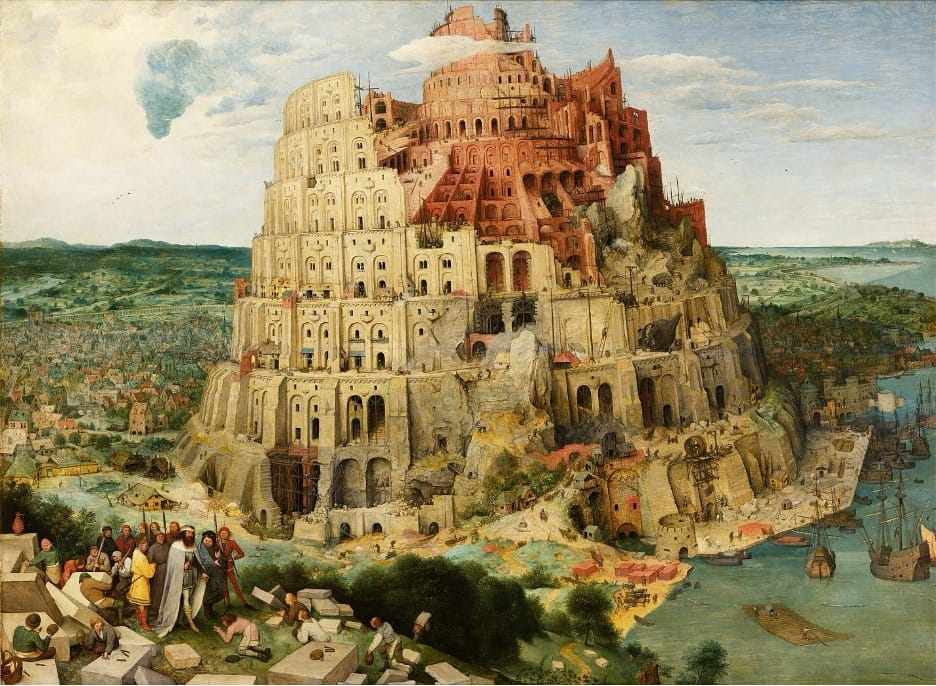
Main image is a painting of the Tower of Babel by Pieter Bruegel taken from Wikimedia Commons.
_-_Google_Art_Project_-_edited.jpg?ref=irregularwarfare.org)
If you value reading the Irregular Warfare Initiative, please consider supporting our work. And for the best gear, check out the IWI store for mugs, coasters, apparel, and other items.