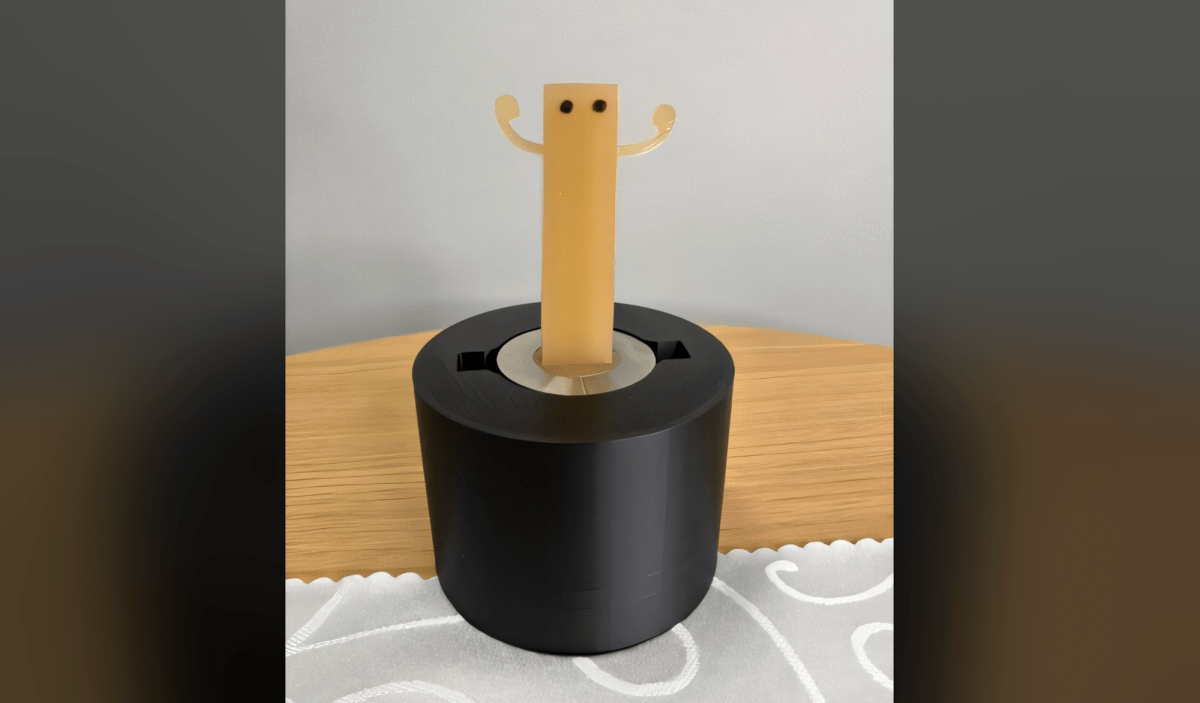
Everyone has preferences when it comes to their food, but what happens when your next meal talks back?
That uncomfortable question is at the core of a new study conducted by a team of researchers at Japan’s University of Electro-Communications. To answer it, they created one of the world’s only known edible robots, something they more clinically refer to as an edible agent (not to be confused with an Edible Arrangement, the popular fruit basket). In the experiment, the team wanted to see whether they could shape how viewers perceived the robot by altering the way it behaved, and then see whether that perception made people more reluctant to eat the little guy. The findings were recently published in the journal PLOS One.
The consumable part of the robot is made of a gummy candy-like material sweetened with sugar and apple juice. It’s connected to a pneumatic system that pumps air through internal chambers to make the robot move. The resulting pulses and thrusts look similar to a mini version of the inflatable air puppets with long, wavy warms you see outside used car dealerships. A hidden speaker lets the robot vocalize, in this case speaking Japanese in one scenario and crying like a cranky baby in another. Tiny arms and black dot eyes were added to up the weird factor.
A talking ‘god’ robot and a crying baby #
Around 1,000 participants watched two videos showing a researcher interacting with the robot. The first video was designed to cast the robot in a “god or strict mentor” role. A researcher just off-screen consults the robot about their personal problems. With the camera focused on its beady eyes, the robot responds in a deep, emotionally flat Japanese voice generated using speech synthesis software. As it speaks, the robot sways back and forth.
The second video was more unsettling. The robot no longer speaks in an adult voice, but instead sounds like a helpless baby. When a researcher waved their hand, the robot responded with a playful chuckle. When they approached it with an inflatable toy, it emitted a frightened sound. When approached repeatedly, the robot grew angry. The gooey robot finally let out a sad hum as the researcher waved goodbye.
After watching the clips, the presumably bewildered study participants were asked to answer a series of psychological survey questions designed to measure how much agency or experience they attributed to the robot in each video. In psychology, agency corresponds to perceived control and decision-making ability. Experience reflects whether something seems capable of feeling emotions like pain or joy. Unsurprisingly, participants rated the Japanese-speaking robot higher in agency and the crying baby higher in experience.
But then something counterintuitive happened. Having established that participants perceived the robot as having some kind of mind, the researchers asked whether they would hesitate or feel guilty about eating it. By and large, they didn’t seem to care. Participants were slightly more reluctant to eat the talking robot, but not by much. Guilt was a non-issue either way.
So, are humans ambivalent cannibals? #
Before you lose complete faith in humanity, a few major caveats are in order. While the researchers asked participants how they would feel about eating the seemingly alive robot, no one actually had to do it. Consuming it was all still theoretical. The sight and sounds of a gummy robot crying out in agony as it’s being scarfed down for lunch likely would elicit some sort of reaction.
Maybe more importantly, none of the participants were physically in the room with the robot. The researchers note that conducting the experiment entirely online was a practical decision made to secure a large enough sample size. While understandable, it is a limitation to a study whose central question involves something as inherently physical and visceral as eating. A far more illuminating experiment would be asking participants to observe the robot in person, take a bite out of it, and then give their post-mortem.
Interestingly, something along those lines has already been done with this same robot. A separate 2024 paper introduced the edible robot and used it to explore the psychology of eating things that are still moving. The practice is common enough in Japan to have its own word: odorigui or “dance-eating.” In that experiment, 16 Osaka University students were asked to pop the edible robot in their mouth while it was still moving and let it dance around for 10 seconds before chomping down. When asked how they felt afterward, participants tended to feel more guilty about eating it the more the robot moved.
The key difference between the robot in that study and the more recent one is the introduction of vocalization and the addition of arms and eyes to make it seem more lifelike. But those additions only go so far when they are muted by the detached sterility of a computer screen.
Still, the researchers are optimistic they are onto something with the very unique little robot. Future versions could potentially be expanded to represent a broader range of animals, possibly opening the door to exploring the psychology and ethics of why some people and cultures refuse to eat creatures that others find perfectly acceptable. It could also be used to examine human attitudes toward novel foods like lab-grown meat and gene-edited fungi, which are being pitched as possible solutions to food shortages as global populations and appetites grow.