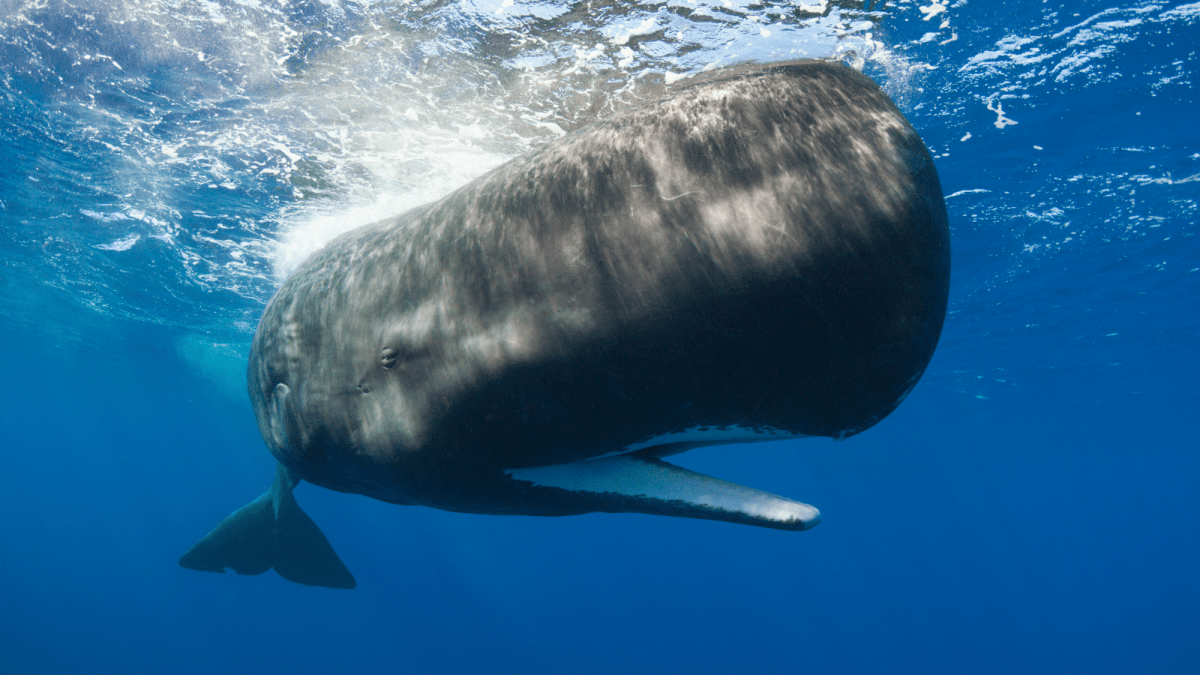
Like a group of scheming teens shifting their conversation when a teacher walks by, sperm whales (Physeter macrocephalus) change the way they communicate when ships are near. The time between their clicks becomes shorter, and they even change how they use certain vowel sounds. The findings add another piece to the puzzle of translating the language of sperm whales, and are published today in the journal Ecological Informatics.
Speaking whale #
For the past six years, Project CETI (Cetacean Translation Initiative) has been listening in on the chatter of sperm whales in the Eastern Caribbean off the coast of the island of Dominica. They’ve used various robotics and machine learning methods to study and attempt to translate what the whales are saying. “We’re beginning with an unknown communication system that is almost like an alien,” David Gruber, Project CETI founder and CEO and National Geographic Explorer, tells Popular Science. “And in the first few years, it was about understanding the fundamental units of what sperm whales are using to communicate. Now, we’re beginning to make language models that are able to predict dive behavior by their voices, as we understand more about their alphabet.”
Codas, vowels, and ships #
For this new study, the team used acoustic recordings of sperm whales near Dominica. They looked at vocalizations called codas, or the structured click sequences that the whales use to communicate. Sperm whales also use sounds that resemble vowels called an A-vowel and an I-vowel. In total, they analyzed over 1,000 codas collected from acoustic tags attached to 15 individual whales over four years. When vessels are present, the whale’s codas change. The codas are shorter, and they will increase certain vowels, particularly A-vowels
“One key thing is they’re [the codas] going to be really close together. We call it the interclick interval. So the spacing between each click becomes really compressed,” says Gruber. “And then they will increase their use of a certain vowel. So they’ll be using more of the encoded vowels. They [the vowels] become harder for us to distinguish, and they kind of look like spaghetti.”
According to Gruber, this is similar to humans talking in a crowded and noisy nightclub or bar. The conversation likely won’t be a whispered, ann in-depth analysis of a favorite author’s work, or explaining a complicated recipe. Instead, the noise may make it so that you have to ask the same question three times and the conversation may be more focused on getting another drink, hitting the dance floor, or leaving.
They team also found that the presence of ships in the area can also be predicted by the changes in sperm whale’s codas, and that the codas themselves can indicate that a vessel is present nearby.
“We recently uncovered vowels in sperm whale vocalizations. This study is the first to show that whales shift how they use these vowels in response to their environment when shipping noise is present,” Project CETI’s Linguistics Lead Gašper Beguš from the University of California, Berkeley added in a statement. “This may be a glimpse that the complex features of sperm whale codas potentially convey information about what’s happening in the world around them.”
A team of ‘baby whales’ #
The results also show that certain coda features, particularly the ones that are related to rhythm and click timing, are the strongest way to predict that a vessel is present. Human-made noise is intersecting with and influencing whale communication in other parts of the world, and may reflect stress-related behavior.
Long-finned pilot whales (Globicephala melas) in the busy Strait of Gibraltar have to reach the upper limits of their vocal range, and are essentially shouting at each other over shipping traffic. Boat noise is also forcing humpback whale (Megaptera novaeangliae) mothers and their calves to dive to deeper, more dangerous water. While Dominica is not currently on a major shipping route, global shipping in general has increased 300 percent in only 30 years.
With more scientific eavesdropping on sperm whales, the team at Project CETI hopes to translate whale language to the best of our ability and use how humans impact it to help inform conservation policies. Learning a new language is also pretty fun.
“We see ourselves more as baby whales. We now have an understanding of the fundamentals of the alphabet and the vowels,” says Gruber. “So in one sense, we’re imagining that we are two-year-old whales now, and as we go further in the project, we’ll be a three year old, and a four-year-old, as we continue to get a more complex understanding of their language.”
It’s an understanding that may help save one of the planet’s biggest animals.