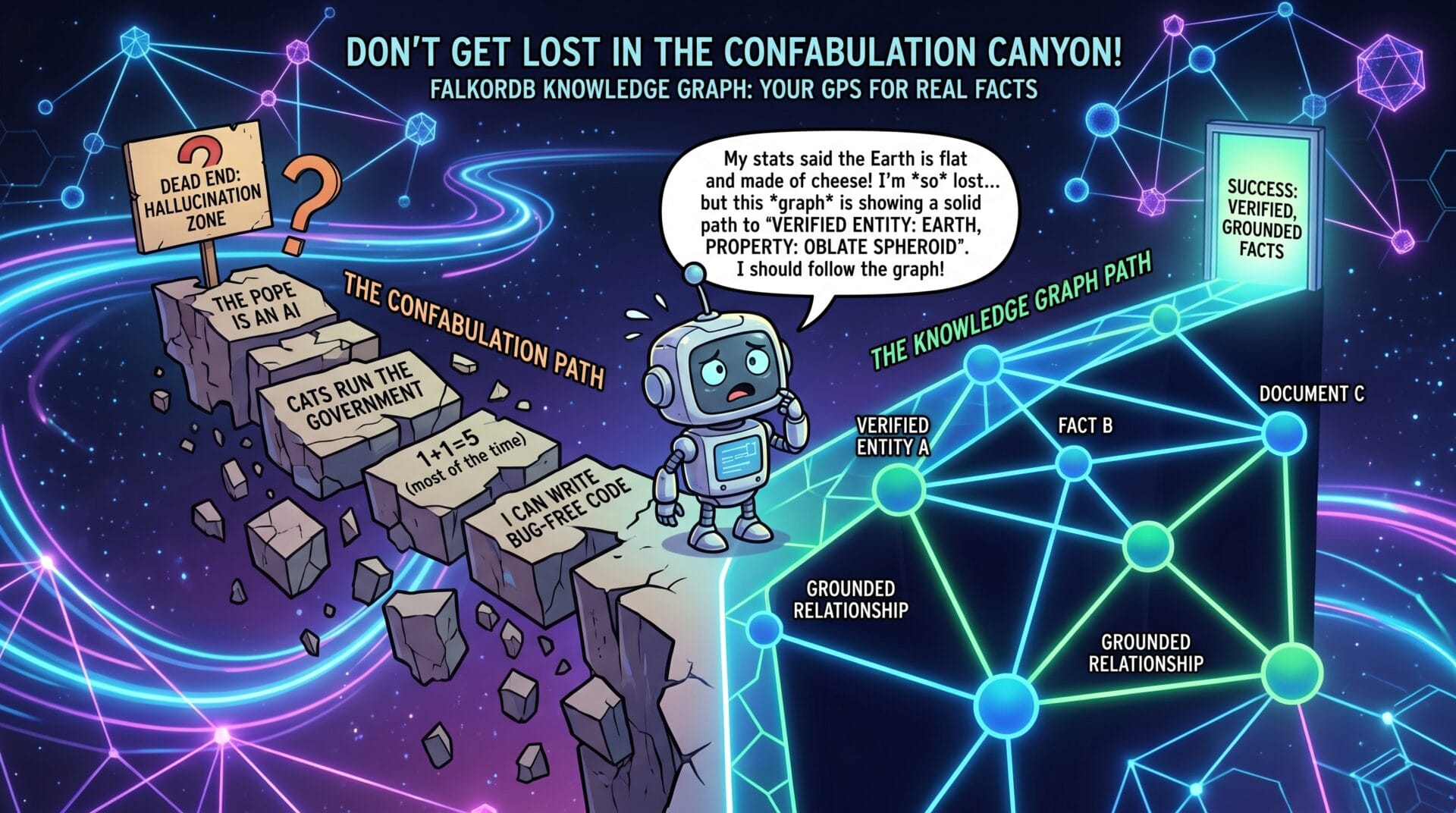
Preventing LLM hallucinations in a RAG system is usually treated as a model problem. It is not. An LLM that hallucinates isn’t broken. It’s doing exactly what it was designed to do: generate the most statistically plausible continuation of a prompt, whether or not that continuation is factually grounded. The problem is the retrieval layer that feeds it.
Standard Retrieval-Augmented Generation (RAG) addresses this by pulling context from an external store before generation. But “pulling context” is not the same as “enforcing context.” Vector similarity search finds chunks that are semantically close to a query. It does not verify whether those chunks are logically connected, whether the relationships between them are valid, or whether the entities they reference actually exist in your data. The model receives a bag of plausible-sounding fragments and does what it always does: it generates.
The result is a subtler, more dangerous class of hallucination. The model isn’t fabricating from nothing. It’s confabulating from loosely related context. The answer sounds grounded because it references real documents. But the relationships between the facts, the causal chains, and the entity-level accuracy are still invented.
FalkorDB’s graph architecture attacks this at the structural level. By representing knowledge as an explicit graph of nodes and typed edges, and by retrieving through deterministic traversal rather than probabilistic similarity, it narrows what the LLM can be handed in the first place.
This article covers why vector-only retrieval fails at grounding, what graph-based retrieval does differently, what schema enforcement does and does not guarantee, and how FalkorDB implements this in production RAG systems.
Key takeaways #
- Vector search returns chunks that are similarto a query. Graph traversal returns subgraphs that areconnectedto it through explicitly modeled relationships. - The cost of a hallucinated relationship is higher than the cost of a hallucinated fact, because relationships propagate errors across entire reasoning chains.
- A schema constrains what retrieval can return. It does not verify that the underlying facts are true, which moves error correction to ingestion time where it is auditable.
- Hybrid retrieval only helps if the merge is deliberate. Naively concatenating vector chunks and graph context measurably dilutes precision.
- Graph-enforced retrieval earns its cost in domains with a definable schema and real downstream consequences: clinical, legal, financial, and agentic systems.
Why Vector RAG Fails at Grounding #
Vector search is a proximity engine. It converts your query into an embedding, finds the nearest stored embeddings, and returns the chunks that live closest in semantic space. For many tasks, this works well. For grounding an LLM’s factual claims, it has a fundamental limitation: proximity is not the same as relevance, and relevance is not the same as correctness.
Three failure modes of vector-only retrieval
Context fragmentation. Vector RAG chunks documents into fixed-size segments, typically 100 to 500 tokens, before embedding them. This slices through entity relationships, causal chains, and logical dependencies. The chunk that explains what a policy says may score high on similarity. The chunk that explains when it applies, and to whom, may score much lower, or not appear at all. The LLM receives an incomplete picture and fills in the gaps.
Relationship blindness. Embeddings capture semantic similarity between passages of text. They do not capture the structure of the domain. Whether Drug A interacts with Drug B, whether Contract X supersedes Contract Y, whether Employee Z reports to Division W: none of these are recoverable from vector proximity alone. The model must infer them from co-occurrence patterns in the retrieved text, which is exactly the kind of reasoning that produces confident-sounding errors.
Entity conflation. Two entities with similar names or descriptions will produce similar embeddings. A query about “Apple’s Q3 revenue” may surface chunks about Apple Inc., Apple Records, and a commodity analysis that mentions apples. Without typed entities, there is no mechanism to enforce which one is relevant.
Benchmark note:A[2025 benchmark study on ORAN specifications]compared Vector RAG, GraphRAG, and Hybrid GraphRAG. Averaged across all question difficulties, graph pipelines scored higher on faithfulness (0.59 versus 0.55) and factual correctness (0.50 for GraphRAG and 0.58 for Hybrid GraphRAG, versus 0.48). All three performed comparably on easy questions at roughly 0.77 faithfulness. The separation appeared on medium and hard questions, which is precisely where hallucination risk is highest.
That same study contains a warning worth taking seriously. Its Hybrid GraphRAG configuration scored worst on context relevance, because it concatenated vector results and graph results into one prompt and the extra verbosity diluted precision. Combining the two retrieval modes is not automatically better. How the merge is performed determines whether hybrid retrieval helps or hurts, which is an architectural question rather than a choice of retrieval mode.
Independent work points the same direction on error profile rather than raw score. Research presented at the VLDB 2026 Agent+Graph Workshop evaluated complex multi-hop, multi-entity questions and found that a zero-shot LLM with no retrieval hallucinated on roughly 59% of them. Adding graph tools alongside vector search more than doubled the precision and recall of factual correctness against a vector-only baseline, and produced the highest fine-grained truthfulness score of the three configurations tested, at a modest increase in token usage. (The work was funded by Neo4j, and its knowledge graph was a lightweight document structure rather than a domain ontology, so read it as evidence for structure-aware retrieval generally.)
What changes is not that every metric improves. What changes is where the errors go.
How Graph Architecture Enforces Grounding #
A Knowledge Graph is not a document store with a different shape. It is a formal model of a domain: entities represented as nodes, relationships represented as typed and directed edges, and properties attached to both. The critical difference for RAG grounding is that the structure of the graph is itself a constraint on what retrieval can return.
When retrieval traverses a graph rather than scanning an embedding space, it doesn’t return chunks that are “similar to” the query. It returns subgraphs that are connected to the query entities through explicitly modeled relationships. The LLM doesn’t have to infer whether two facts are related. The graph either contains that edge or it doesn’t.
What deterministic traversal looks like
Consider a query: “Which medications prescribed to patients with diabetes are contraindicated with metformin?”
Vector RAG embeds the query, finds semantically similar chunks, and returns passages about metformin, diabetes medications, and drug interactions in general. The model synthesizes an answer from these fragments, potentially conflating different patient populations or outdated interaction data.
GraphRAG traverses the Knowledge Graph: starting from the Medication
node for metformin, following CONTRAINDICATED_WITH
edges to other medications, then intersecting those with medications actually prescribed to patients who carry a Type 2 Diabetes diagnosis. The result is a precise subgraph of entities and relationships that exist in the data.
The second approach doesn’t just retrieve more relevant context. It retrieves traceable context, where every fact in the prompt has an explicit path back to the query entity and that path can be shown to an auditor.
The ontology as a constraint on retrieval
The graph schema, or ontology, defines which node types exist, which relationship types are valid between them, and which properties each can carry. That schema constrains the retrieval layer.
Without a schema, an extraction pipeline can invent not just facts but relationship types, recording that Entity A CAUSES
Entity B when the evidence only supports CORRELATES_WITH
. With a schema-enforced graph, retrieval can only surface relationship types that were explicitly modeled. The context the LLM receives is bounded by what the graph contains.
What schema enforcement does not guarantee
This distinction matters, and glossing over it is how GraphRAG gets oversold.
A schema guarantees structural validity. It does not guarantee truth. An LLM-based extraction step will happily produce (Metformin)-[:CONTRAINDICATED_WITH]->(Aspirin)
from a misread sentence. That triple is fully schema-valid, and it will be retrieved deterministically, forever, by every query that touches it.
So graph architecture does not eliminate hallucination. It relocates it, from generation time to ingestion time. That relocation is the actual win, and it is a substantial one. A generation-time error is stochastic, invisible, and unrepeatable, so you cannot review it. An ingestion-time error is a specific row in a specific graph. It can be queried, diffed against a source document, flagged by a validation rule, corrected once, and corrected for every downstream query at the same time.
The practical implication: graph structure reduces hallucinations not by making the LLM smarter, but by making both the retrieval layer less ambiguous and the remaining errors reviewable.
How FalkorDB Implements Strict Context Retrieval #
Several FalkorDB design decisions bear directly on grounding.
Multi-hop traversal with openCypher
FalkorDB uses the openCypher query language with FalkorDB extensions, enabling multi-hop traversals that follow relationship chains across arbitrary depth. Its query engine is written in Rust over a sparse-matrix representation of the graph, which is what makes deep traversals cheap enough to put on a request path.
A single Cypher query can traverse from a query entity through multiple relationship types, collecting only the subgraph portions that satisfy explicit path constraints. The LLM receives a structured, bounded context window: not a ranked list of semantically similar chunks, but a connected subgraph where every included fact has a relationship path back to the query entity.
MATCH (drug:Medication {name: 'Metformin'})
      -[:CONTRAINDICATED_WITH]-(other:Medication)
MATCH (patient:Patient)-[rx:PRESCRIBED]->(other)
MATCH (patient)-[dx:HAS_CONDITION]->(:Condition {name: 'Type 2 Diabetes'})
RETURN DISTINCT patient.id, other.name, rx.dosage, dx.severity
Three modeling details are worth noting, because they are the difference between a query that grounds an answer and one that quietly returns a partial result:
CONTRAINDICATED_WITH
is matchedundirected. Contraindication is a symmetric relationship, and matching only one direction silently drops every pair that happens to be stored the other way.- Dosage lives on the
PRESCRIBED
relationship and severity onHAS_CONDITION
, not on theMedication
andCondition
nodes. Those nodes are shared across the whole patient population, so a property stored there would be the same value for everyone. DISTINCT
and a patient identifier are both required, or the result set collapses into ambiguous duplicate rows.
The query cannot return a medication that isn’t explicitly connected to both the contraindication and the patient condition. The constraint is structural, not probabilistic.
Hybrid vector and graph retrieval in one query
FalkorDB combines graph traversal with native vector similarity search inside a single query, which is what allows the merge to be deliberate rather than a concatenation of two prompt blocks.
| Retrieval task | Best served by | FalkorDB mechanism |
|---|---|---|
| Semantic similarity (“find concepts related to X”) | Vector search | Native vector indexing with cosine and Euclidean similarity |
| Relationship traversal (“find entities connected to X via Y”) | Graph traversal | openCypher multi-hop queries |
| Entity disambiguation | Schema enforcement | Typed node labels and relationship constraints |
| Multi-step reasoning | Graph path finding | Cypher MATCH with chained relationship patterns |
The practical effect: an agent can issue one query that finds candidate entities by vector similarity, then traverses their relationships and returns only the paths that satisfy the query’s constraints. The vector layer answers “what is relevant.” The graph layer answers “how are these things actually related,” and, just as importantly, discards the semantically-close-but-unconnected candidates before they ever reach the prompt.
Schema-enforced ontology via the GraphRAG SDK
FalkorDB’s GraphRAG SDK provides a pipeline for extracting entities and relationships from unstructured documents and them into a typed Knowledge Graph. The SDK takes an explicit ontology definition before ingestion, specifying node types, relationship types, and their valid combinations.
This is the grounding mechanism that operates before retrieval begins. Extraction output that does not conform to the declared ontology is rejected rather than written, so the graph accumulates only relationship types someone deliberately modeled. Retrieval then operates under a closed-world policy: if a relationship isn’t in the graph, it is not surfaced.
The SDK ranked first on GraphRAG-Bench, a standardized benchmark for production GraphRAG pipelines.
Multi-graph isolation for multi-tenant deployments
Grounding has a tenancy dimension that rarely gets discussed. If a RAG system serves multiple customers from one shared index, a retrieval leak is a hallucination with a compliance incident attached: the model states something true about the wrong tenant.
FalkorDB runs many isolated graphs in a single instance rather than partitioning one large graph by property filters. Each tenant gets its own graph, so cross-tenant retrieval is not a query you have to remember to write correctly. It is a boundary the engine enforces.
Latency low enough to keep graph traversal on the request path
A common objection to graph-based retrieval is latency, since traversing relationships is heavier than a nearest-neighbor lookup. FalkorDB’s in-memory architecture, built on a sparse matrix representation and served as a Redis module, is designed around this constraint: published benchmarks show p99 response times under 140ms for complex graph queries.
This matters for hallucination prevention because latency pressure is one of the main reasons teams default to simpler vector pipelines. When graph traversal is fast enough to sit inside a live request, the grounding tradeoffs of vector-only retrieval stop being a necessary compromise.
Where Graph-Enforced Retrieval Matters Most #
Graph-enforced grounding is useful in any RAG system. It becomes non-negotiable where hallucinated relationships carry real consequences.
Healthcare and life sciences
Multi-hop reasoning over medical entities, including drug-drug interactions, patient condition histories, and clinical trial eligibility criteria, requires traversing explicit relationship chains rather than retrieving semantically similar text. A passage that discusses metformin and a passage that discusses a contraindicated drug can both score high on similarity without the interaction between them being stated anywhere in the retrieved text.
FalkorDB customer AdaptX uses graph-based retrieval for medical data analysis, where the cost of a hallucinated clinical relationship is not a UX problem. It is a patient safety risk. It is also a domain where the auditability point becomes concrete: a clinician can be shown the exact path that produced an answer, and a wrong edge can be corrected at the source.
Financial services and regulatory compliance
Regulatory texts reference each other through supersession and exception relationships. A regulation that applies in one jurisdiction may be superseded by a later rule, which itself carries exceptions. Vector similarity cannot model this. A graph in which Regulation A
has an explicit SUPERSEDED_BY
edge to Regulation B
, which carries a HAS_EXCEPTION
edge to Clause C
, can.
Research published at the GenAIK 2025 workshop applied graph-based retrieval to financial and regulatory documents. On FinanceBench the gains were real but modest: a 6% reduction in hallucinations alongside an 80% drop in token usage. The striking result came from a harder task, comparing the EU’s Digital Operational Resilience Act against US FFIEC guidelines to detect contradictions. There, structured retrieval cut the complexity of contradiction detection from O(n²) to O(k·n) in the number of chunks, and reduced token consumption by a factor of 734.
That contrast is instructive. Graph retrieval delivers marginal gains on straightforward lookup and order-of-magnitude gains when the answer depends on precise supersession and exception logic. The paper’s own conclusion is appropriately hedged: results depend on the dataset, the graph design, and the retrieval task.
Agentic AI systems
Agents that take actions such as booking, purchasing, or modifying records face a specific failure mode: acting on relationships that don’t exist. An agent that concludes Product A is in stock because a vector search returned semantically similar inventory records, rather than reading the IN_STOCK
property of that specific Product
node, will confidently execute a transaction against phantom inventory.
XR.Voyage uses FalkorDB to manage LangChain agents, keeping agent memory and knowledge retrieval tied to the actual state of the graph rather than statistical proximity to that state.
The common thread across these domains: the cost of a hallucinated relationship exceeds the cost of a hallucinated fact. A wrong fact is wrong in isolation. A wrong relationship propagates across an entire reasoning chain.
When to Use Graph-Enforced Retrieval #
Graph-based retrieval is not a universal replacement for vector search. The right architecture depends on what your RAG system is being asked to do.
Vector-only retrieval is sufficient when:
- Queries are primarily semantic, in the shape of “find documents about topic X”
- Relationships between retrieved chunks don’t affect answer correctness
- The domain is genuinely unstructured and an ontology would be difficult to define
- Latency budgets are extremely tight and approximate answers are acceptable
Add graph-enforced retrieval when:
- Answers depend on multi-hop relationships between entities
- The domain has a definable schema, such as medical, legal, financial, or organizational data
- Hallucinated relationships carry meaningful downstream consequences
- You are building agents that act on retrieved information rather than summarize it
- You need auditability, meaning the ability to trace exactly which path produced a given answer
- You serve multiple tenants from one system and retrieval isolation is a compliance requirement
The hybrid model, using vector search for entity discovery and graph traversal for relationship verification, is what FalkorDB is built for. Running both in one engine avoids maintaining separate vector and graph stores, and it means the merge between them happens inside the query rather than by stacking two result sets into a prompt.
For teams evaluating this transition, the vector database vs. graph database comparison and the GraphRAG vs. Vector RAG analysis go deeper on specific use cases.
Grounding Is an Architecture Problem, Not a Prompt Problem #
The instinct when an LLM hallucinates is to improve the prompt. Add more context. Add a “do not make up facts” instruction. Add a self-verification step. These help at the margins, but they treat the symptom.
Hallucination in RAG systems is primarily a retrieval problem. If the context window contains ambiguous, fragmented, or relationally incomplete information, the model will fill the gaps. That is not a failure of instruction-following. It is the model doing exactly what it was trained to do with incomplete input.
FalkorDB addresses this at the source, by making retrieved context consist of explicitly modeled, path-verified subgraphs rather than probabilistically ranked text chunks. The LLM still generates, and it can still overreach on what it was given. But the context it works from is constrained to relationships that someone modeled and that the graph actually contains, and when one of those relationships turns out to be wrong, there is a specific edge to fix.
That is a different kind of reliability guarantee than a prompt instruction can offer. It is not a guarantee of truth. It is a guarantee that errors are structural, locatable, and correctable.
Frequently Asked Questions #
Does GraphRAG eliminate hallucinations? No. It constrains the context the model receives and makes the remaining errors auditable. A schema-valid but factually wrong edge in the graph will still be retrieved and still be believed. The difference is that this error lives in a specific place, can be found by querying for it, and gets fixed once for all downstream queries.
Do I need to replace my vector database to use GraphRAG? No. Most production systems need both retrieval modes. The question is whether you run them as two systems with a synchronization layer between them, or in one engine where the merge happens inside the query. FalkorDB supports native vector indexing alongside graph traversal in a single query.
What is the practical difference between GraphRAG and vector RAG? Vector RAG returns text chunks ranked by embedding similarity to the query. GraphRAG returns a subgraph of entities connected to the query through explicitly typed relationships. Vector search answers “what looks relevant.” Graph traversal answers “what is actually connected.”
How much latency does graph traversal add? Less than most teams assume. FalkorDB’s benchmarks show p99 under 140ms for complex multi-hop queries, which keeps traversal viable inside a live request rather than relegated to an offline pipeline.
Do I need to define an ontology before I start? For schema-enforced ingestion, yes, and this is a feature rather than overhead. Defining node types and valid relationship types forces the modeling decisions that would otherwise be made implicitly and inconsistently by an extraction model. The GraphRAG SDK takes the ontology definition up front and rejects extraction output that doesn’t conform to it.
To see how this works in a live environment, try FalkorDB free or explore the GraphRAG SDK documentation to start building schema-enforced Knowledge Graphs for your RAG pipeline.
Author #
Gal is a Software and AI Engineer, leading the development of GraphRAG-SDK, a specialized toolkit for building Graph Retrieval-Augmented Generation (GraphRAG) systems. It integrates knowledge graphs, ontology management, and state-of-the-art LLMs to deliver accurate, efficient, and customizable RAG workflows.