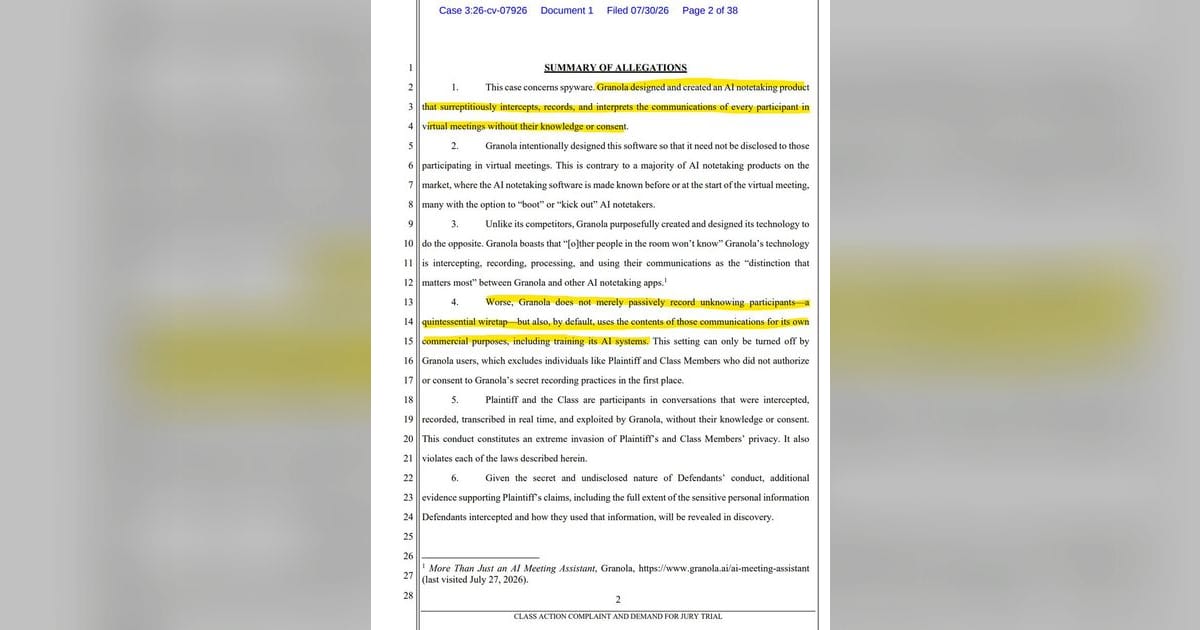
Granola faces a proposed class action alleging that its AI notetaker unlawfully captures meeting participants' conversations without their knowledge and may use their words to improve its models.
The complaint, filed July 30th in the U.S. District Court for the Northern District of California, strikes at a product decision founders Chris Pedregal (@cjpedregal) and Sam Stephenson (@samstphenson) made central to Granola: the software captures microphone and computer audio locally, without sending a visible bot into the meeting.
Florida resident Tarra Chamberlain alleges that Granola was used during at least one Zoom or Microsoft Teams meeting she attended, and that she received no notice that her speech was being captured, transcribed and processed. The complaint alleges, based on information and belief, that Granola also used the resulting content to train its AI systems.
The allegations have not been adjudicated. Technology lawyer Rob Freund (@RobertFreundLaw) surfaced the filing in a thread on X.
The product choice at the center of the case
Granola's privacy documentation says the application runs locally and captures audio directly from the user's microphone and system audio. Because no bot joins the meeting, other participants do not see an additional attendee.
Granola says users are responsible for obtaining consent before activating the software and strongly recommends telling participants that AI-enhanced notes are being taken. Granola also says audio is cached temporarily for transcription, deleted when transcription is complete and never retained as an audio recording. Notes and transcripts, however, are retained indefinitely unless a user or administrator sets another policy.
That division of responsibility drives the lawsuit. Chamberlain argues that placing the consent obligation on the Granola user leaves other participants with no practical way to know that Granola is running, refuse the transcription or control how the resulting data is handled.
The complaint repeatedly describes Granola's processing as interception and recording. Granola's documentation draws a narrower distinction: the audio passes through its transcription system in real time, while the audio file itself is deleted. The case will test whether that technical distinction changes the legal analysis under federal and California wiretapping and privacy statutes.
Granola's model-training settings create a second dispute. Its model training documentation says anonymized data from Free and Business accounts may be used by default to improve Granola's services. Account holders can opt out, while Enterprise customers are opted out by default and can enforce that setting across an organization. Granola says third-party model providers are contractually prohibited from training on customer data.
Chamberlain's argument focuses on the people who never opened a Granola account. They cannot change the setting because they are not Granola users, even though their speech may appear in a transcript controlled by someone who is.
Granola also acknowledges that it cannot guarantee anonymized data was not used before an account holder opted out. The complaint seeks to represent a nationwide class of people whose communications were recorded, intercepted or used by Granola, plus a California subclass.
The filing brings claims under the federal Electronic Communications Privacy Act, the California Invasion of Privacy Act and California's computer data and unfair competition laws, along with common-law privacy and unjust enrichment claims. Chamberlain is seeking class certification, an injunction, damages, restitution and disgorgement.
A $1.5 billion bet on conversation data
The lawsuit arrives four months after Granola raised a $125 million Series C at a $1.5 billion valuation. Index Ventures led the March 25th round, with participation from Kleiner Perkins and existing investors Lightspeed, Spark and NFDG. Including Granola's seed, Series A and Series B rounds, Granola has announced at least $192 million in funding.
Pedregal previously founded the AI homework app Socratic, which Google acquired in 2018. Stephenson came to Granola from product design and note-taking projects. They began assembling Granola's team in early 2023 and publicly released the application in May 2024.
Their pitch was built around making meeting capture feel less intrusive than the visible bots used by rival transcription products. Granola still describes the absence of a bot as part of a "privacy-first design." Yet invisibility also removes the most obvious signal that software is listening.
Granola has since expanded from personal notes into shared repositories, APIs and AI tools that search conversations across a business. Pedregal wrote in the Series C announcement that transcripts are Granola's richest source of organizational context. Granola says customers include Vanta, Gusto, Thumbtack, Asana, Cursor, Lovable, Decagon and Mistral AI.
That expansion raises the stakes of the complaint. A meeting transcript can move from one user's private notes into shared folders, enterprise search and automated workflows. Granola's consent controls must cover every person whose voice becomes part of that context, including people who never chose to use Granola themselves.