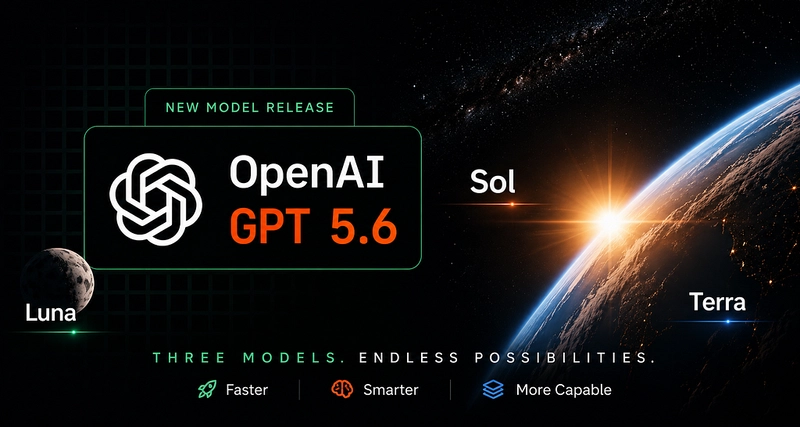
If you're building an AI workflow, picking the wrong tier now means either wasting money on overkill compute or hitting a reasoning ceiling that kills your app's reliability. Here is the breakdown of the lineup: GPT-5.6 Sol: The heavy hitter. This is designed for maximum intelligence and complex reasoning. If you're deploying autonomous LLM agents or doing high-end research, this is the one.
GPT-5.6 Terra: The middle ground. It balances strong capabilities with significantly lower latency. This is the sweet spot for most enterprise assistants and production-grade apps.
GPT-5.6 Luna: The speedster. Optimized for massive scale and minimal cost. Use this for simple classification, basic chat, or high-volume data processing.
The most interesting addition is the Pro variant available for each tier. These aren't just "better" models; they allocate more compute during the inference process to allow for deeper planning and better logical consistency. If Sol is the brain, Sol Pro is the brain with a few extra seconds to think before it speaks, which is critical for complex engineering tasks.
Practical Deployment Guide: Which one to use? #
Choosing the right model depends entirely on your specific use case. Since I've been testing these for different workflows, here is my take on the mapping:
Advanced Coding & Architecture: Go with
Sol Pro. The increased compute for planning prevents the "hallucination loops" often found in smaller models when dealing with large codebases.
Customer-Facing Copilots: Terra is usually enough. It's fast enough that users don't feel the lag, but smart enough to handle nuanced queries.
High-Volume Automation: Luna is the only logical choice here to keep your API costs from spiraling while maintaining acceptable quality for routine tasks.
For those implementing this via API, the modularity means you can actually route requests dynamically. You can use Luna to classify a user's intent and then "escalate" the prompt to Sol if the reasoning requirement is too high. This is a huge win for optimizing the cost-to-performance ratio in a real-world AI agent setup.

[Next Fixing my messy terminal workflow w →](https://promptcube3.com/en/posts/1150/)