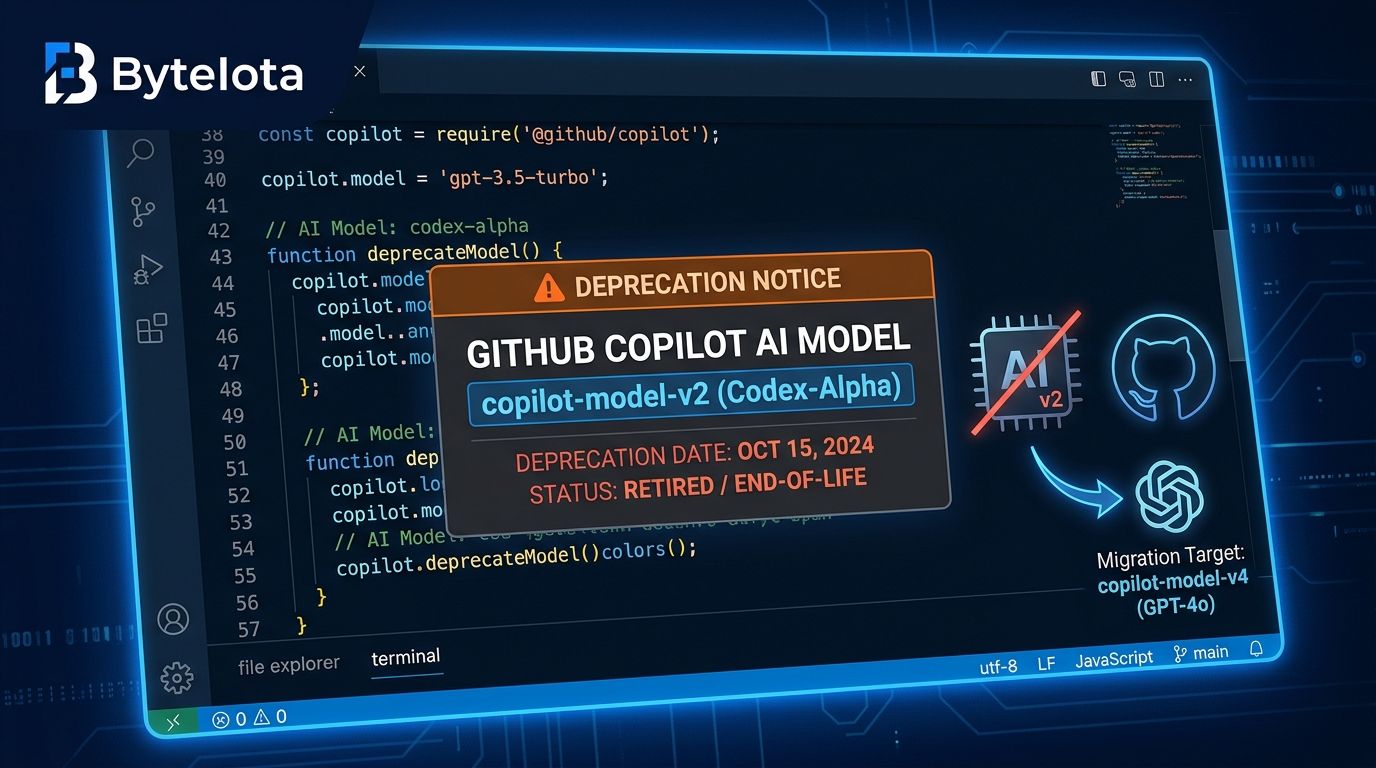
GitHub Copilot killed six AI models today — September 1, 2026 — and if you hardcoded any of their identifiers in a GitHub Action, Copilot Extension, or internal tool, those integrations are already failing. Claude Opus 4.5, Claude Opus 4.6, Claude Sonnet 4.5, Claude Sonnet 4.6, Gemini 3.1 Pro, and Raptor mini are gone. MAI-Code-1-Flash follows on September 10. Here is what you need to check right now.
The Full Retirement List #
GitHub has been signaling this since July 31, but the deprecations are live as of today. Here is the complete picture:
| Deprecated Model | Replacement | Model ID |
|---|---|---|
| Claude Opus 4.5 / 4.6 | Claude Opus 5 | claude-opus-5 |
| Claude Sonnet 4.5 / 4.6 | Claude Sonnet 5 | claude-sonnet-5 |
| Gemini 3.1 Pro | Gemini 3.6 Flash | — |
| Raptor mini | MAI-Code-1.1-Flash | — |
| MAI-Code-1-Flash | MAI-Code-1.1-Flash | — |
One exception: Claude Sonnet 4.6 remains available to individual GitHub Copilot subscribers on annual plans. Everyone else loses it today. MAI-Code-1-Flash exits on September 10 — get ahead of it.
What Actually Breaks #
The retirement covers every Copilot surface: the IDE extension, Copilot.com, and — critically — any Copilot Extension or workflow that calls the API with an explicit model parameter. If your code says model: claude-sonnet-4-6
anywhere, it will either throw an error or fail silently. The silent failure mode is the nasty one: your workflow keeps running, you see no obvious error, and your AI capability is just gone.
Real-world impact is already showing up. GitHub community threads titled “Claude Sonnet 4.6 Suddenly Disappeared” and “The requested model is not supported” errors in open-source projects confirm that many developers were not prepared for today.
Three Steps to Fix It Now #
Run this audit immediately:
Step 1 — Search your repositories for deprecated model identifiers:
git grep -rn "claude-sonnet-4-6|claude-opus-4-6|claude-opus-4-5|claude-sonnet-4-5|gemini-3.1-pro|raptor-mini|mai-code-1-flash"
Step 2 — Update all matches to supported replacement model IDs. Sonnet 4.5 and 4.6 become claude-sonnet-5
. Opus 4.5 and 4.6 become claude-opus-5
. Check GitHub’s Copilot documentation for the current Gemini and MAI-Code identifiers.
Step 3 — Test your integrations before the end of the day. Run your CI suite, exercise any Copilot Extensions, confirm agent workflows execute as expected. Do not assume a clean search result means nothing is broken — some integrations inherit model selection dynamically.
Enterprise Admins: Your Model Policy Just Changed #
There is a second change that arrived quietly. GitHub’s global model policy reached general availability on August 26 with a reversed default: unconfigured generally available models are now automatically enabled for Copilot Business and Enterprise users. Previously, admins had to explicitly opt in. Now they have to opt out.
If your organization has governance requirements around which AI models developers can access, check your Copilot admin settings today. The rollout was incremental through September 1, which means your organization may have already crossed the threshold. Open-weight models and models requiring data retention remain disabled by default.
The Credit Hit Landing Simultaneously #
September 1 is not just a model retirement day. GitHub ended its promotional credit period at the same time. Copilot Business seats drop from 3,000 to 1,900 included credits per month — a 37 percent cut. Enterprise seats fall from 7,000 to 3,900 — down 44 percent. Seat prices are unchanged.
Copilot Studio harness agents also begin consuming credits today after a grace period. Standard and Copilot Chat harness agents are not affected. If you have custom harness agents running in Copilot Studio, expect your credit usage to increase starting now.
MAI-Code-1-Flash: The Next Deadline #
September 10 is nine days away. If you use MAI-Code-1-Flash in any integration, add it to your audit today and update to MAI-Code-1.1-Flash before the next wave hits. Getting caught twice is avoidable.