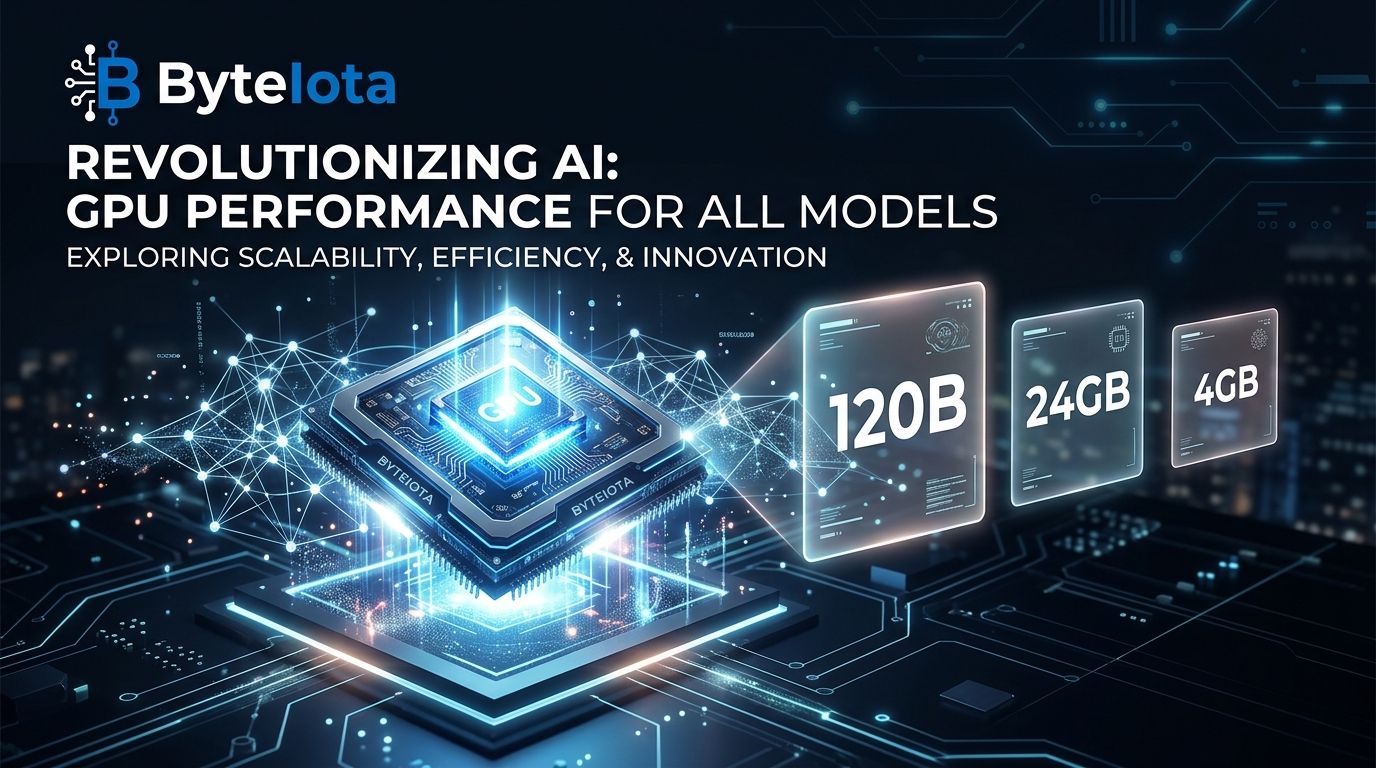
NVIDIA released three open Nemotron 3.5 models on October 15. Two are live now. The third — a 4GB edge model called Bolt E4B — arrives October 23. If you have been waiting for a local AI agent that fits in the same VRAM budget as a game, that is your date.
Three Models, Three Use Cases #
The Nemotron 3.5 lineup covers data center to desktop edge:
- Nemotron 3.5 Super VL (120B / 12B active) — Server and enterprise agents. Hybrid Mamba-Transformer mixture-of-experts architecture, 1M token context, accepts text, images, video, audio, and documents in a single pass. Available now on Hugging Face and NVIDIA Build.
- Nemotron 3.5 Bolt 74B-A9B (24GB) — Workstation and laptop. Compressed to 24GB, runs on RTX Spark, DGX Spark, A100, and H100. GGUF and BF16 weights are already on Hugging Face. Available now.
- Nemotron 3.5 Bolt E4B (4GB) — Edge. GeForce RTX, NVIDIA Jetson, DGX Spark. Built for voice assistants, interactive characters, and embedded agents with multi-turn tool use. Ships October 23.
The 4GB framing is what makes this launch interesting. NVIDIA is targeting physical AI on Jetson — the kind of always-on agent that runs alongside a robotics stack — alongside consumer GPU deployments. The comparison class for E4B is Phi-4 Mini and Gemma 3 4B. It is not a frontier model; expect tradeoffs in reasoning depth. But multi-turn tool use at 4GB is genuinely new territory.
Running Bolt 74B Right Now #
The 74B Bolt is available today and works with the usual local inference stack. The simplest paths:
brew install llama.cpp
llama serve -hf unsloth/NVIDIA-Nemotron-3.5-Bolt-74B-A9B-GGUF:IQ2_XXS

ollama pull nvidia/nemotron-3.5-bolt-74b
ollama run nvidia/nemotron-3.5-bolt-74b
vLLM works on Ampere, Hopper, and Blackwell. LM Studio and Unsloth both have support. The Unsloth GGUF quantization reports 84 tok/s on RTX Spark hardware — fast enough to serve as an interactive agent backend.
What Super VL Is Actually Built For #
Super VL’s post-training story is where NVIDIA went beyond base capabilities. The model was fine-tuned on specialized enterprise tasks using GRPO reinforcement learning via NeMo RL, and NVIDIA reports 9–44% improvement over Claude Opus 5 and GPT-6.1 Sol on five domain benchmarks: document intelligence, security resilience, financial receipt extraction, scientific experimentation, and medical insurance claims.
The practical capabilities: tool calling with auto, required, or named function selection; structured JSON output via schema; and a reasoning mode. Atlassian, CrowdStrike, Perplexity, Salesforce, and Synopsys are named early integration partners. NVIDIA’s developer blog has a full walkthrough of multimodal agentic use cases, including document extraction with schema-constrained JSON output.
Read the License Before You Ship #
The marketing says “open” and the training infrastructure — NeMo RL and NeMo Gym — is Apache 2.0. The model weights are not. Both Super VL and Bolt are released under the OpenMDW License Agreement v1.1. Check whether your use case — commercial deployment, fine-tuning, redistribution — is covered before it becomes a conversation with your legal team after launch. The license is on Hugging Face alongside the Bolt 74B weights. Training recipes and usage cookbooks are in the NVIDIA-NeMo/Nemotron GitHub repository.
Mark October 23 #
Super VL is the model enterprises will evaluate. Bolt 74B is the model developers will run locally this week. Bolt E4B is the model to watch — it is the first serious attempt at a fully agentic model in a 4GB footprint, and the Jetson target signals NVIDIA’s intent to own the physical AI edge stack from model to hardware. A week from now you will be able to test that claim on any modern GeForce GPU. Details are in VentureBeat’s benchmark breakdown and on the official NVIDIA Nemotron 3.5 blog post.