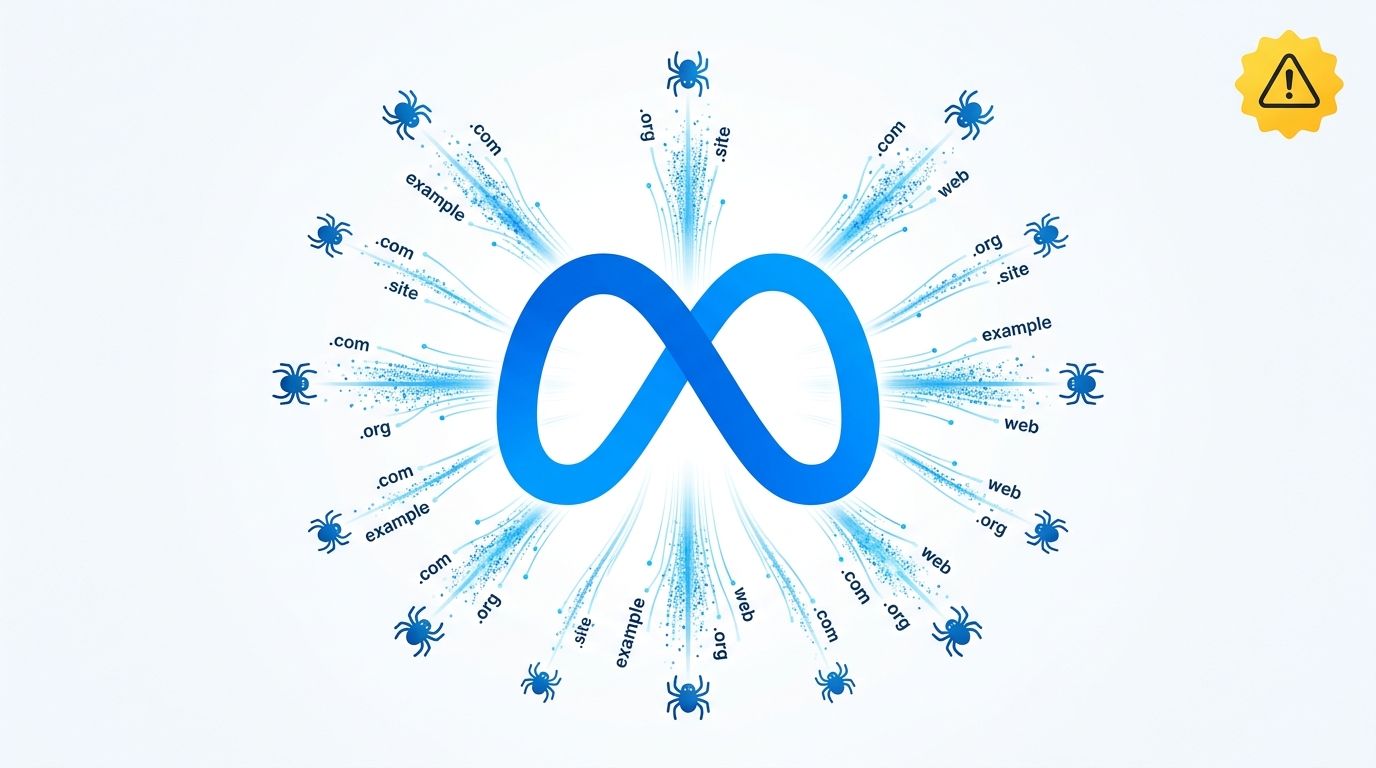
Meta updated its commercial terms today, and if your company maintains a Facebook, Instagram, or WhatsApp business account, you have until October 30 to decide whether to consent — because doing nothing counts as consent. The updated terms authorize Meta to use automated bots and web scrapers to crawl any website “associated with” a business account, and to use whatever it collects to train its AI products, including Llama. There is no opt-out. Two weeks is what you have.
What Meta’s October 30 Terms Actually Authorize #
The specific language matters here. Meta’s updated Commercial Terms state that business account holders authorize Meta to “use automated software (such as web scrapers, bots, spiders, crawlers, and user agents) and to create test credentials to access, index, cache, analyze, collect, retrieve, and crawl domains, web pages, and URLs associated with your products or services.” The scraping is not a one-time event — Meta is also authorized to “periodically retrieve updates” from those URLs.
The “test credentials” clause is particularly troubling. It means Meta can create fake user accounts on your site to access content behind registration walls — your developer documentation, your gated tutorials, your paid tiers. According to Nieman Lab’s investigation, attorney Matt Topic of Loevy & Loevy put it plainly: “This is a remarkable provision to bury in terms of service, given that this would give Meta access to material that would likely cost many millions of dollars in a licensing market.” The collected content feeds into “AI at Meta” — explicitly listed as a covered product — which means your website content could end up in Llama’s training data.
Related: Meta Muse Spark Open: 816B Agent Model, One License Gotcha
There Is No Opt-Out #
Meta did not build an opt-out mechanism into these terms. The company’s position is simple: if you keep using Meta’s business products after October 30, you’ve accepted the updated terms. The only escape is to “stop all access or use of our Products for business or commercial purposes” before the deadline. For most companies, that means deleting Facebook Pages, stopping Meta ads, and pulling out of Instagram business accounts — an unrealistic ask for any organization that depends on social distribution or advertising revenue.
Stephen Beale, founder of The Steampunk Explorer, told TechRound he is seriously weighing whether to shut down his Meta accounts despite relying on Facebook for audience reach. That calculation — real audience loss versus surrendering your content as AI training data — is now every business’s problem. The developer community’s reaction, per Daily.dev, is broadly cynical: most suspect Meta was already scraping this content, and the updated terms are legal cover for activity already happening.
What robots.txt Can and Cannot Do Against Meta Scrapers #
Meta operates two distinct crawlers, and the difference matters for anyone considering technical mitigation. Meta-ExternalAgent handles foundation model training and indexing, and it respects robots.txt. According to a detailed developer analysis on Dev.to, you can block it with the following configuration:
User-agent: meta-externalagent
Disallow: /
However, Meta-ExternalFetcher — the bot that runs whenever someone shares one of your links on Facebook — does not respect robots.txt. Blocking ExternalFetcher also breaks link previews for everyone sharing your content on Meta’s platforms. Meta deliberately made the scrapers share infrastructure with legitimate preview functionality, meaning blocking the training crawler costs you something real. Your robots.txt entry blocks the training crawler. It does nothing about the fetcher that fires on every user-initiated link share.
There is a second trap: if your site hosts licensed images, syndicated articles, or any third-party content you do not own, you cannot legally grant Meta rights to scrape it. The new terms do not protect you from that exposure. Identify what is on your public pages before October 30.
What Developers Should Do Before October 30 #
You have 14 days. These steps, in order of importance:
- Add
User-agent: meta-externalagent / Disallow: /to your robots.txt to block the training crawler. Accept that ExternalFetcher still runs on link shares. - Audit your public pages for third-party content you do not own — licensed photos, syndicated text, embedded material. These create IP exposure the terms do not cover.
- Document which domains are linked to your Meta business accounts before the deadline, so you have a clear record of what consent covers.
- Use server authentication for genuinely sensitive content. robots.txt alone is insufficient for private material.
- If you have substantial original content at risk, consult a media IP attorney before October 30.
Meta’s statement that the updated terms “consolidate language previously spread across its terms” and represent “no new practical capability” deserves skepticism. If nothing changed practically, updating the terms was unnecessary. The new language grants explicit AI training rights that Meta did not have in writing before — or at least could not clearly claim. Whether courts enforce clickwrap consent for rights this broad remains unsettled. Treating them as enforceable is the safer assumption until a court says otherwise.
Key Takeaways #
- Meta’s updated commercial terms, effective October 30, authorize scraping of websites linked to any business account for AI training with no opt-out available.
- The “test credentials” clause means Meta can bypass registration walls — gated content, developer docs, and paid tiers are all in scope.
- robots.txt blocks Meta-ExternalAgent (training crawler) but not Meta-ExternalFetcher, which fires on link shares and ignores robots.txt by design.
- The only true opt-out is abandoning Meta’s business products before October 30 — for most companies, that is not realistic.
- Audit your site for third-party content before the deadline; you cannot legally grant Meta rights to content you do not own.