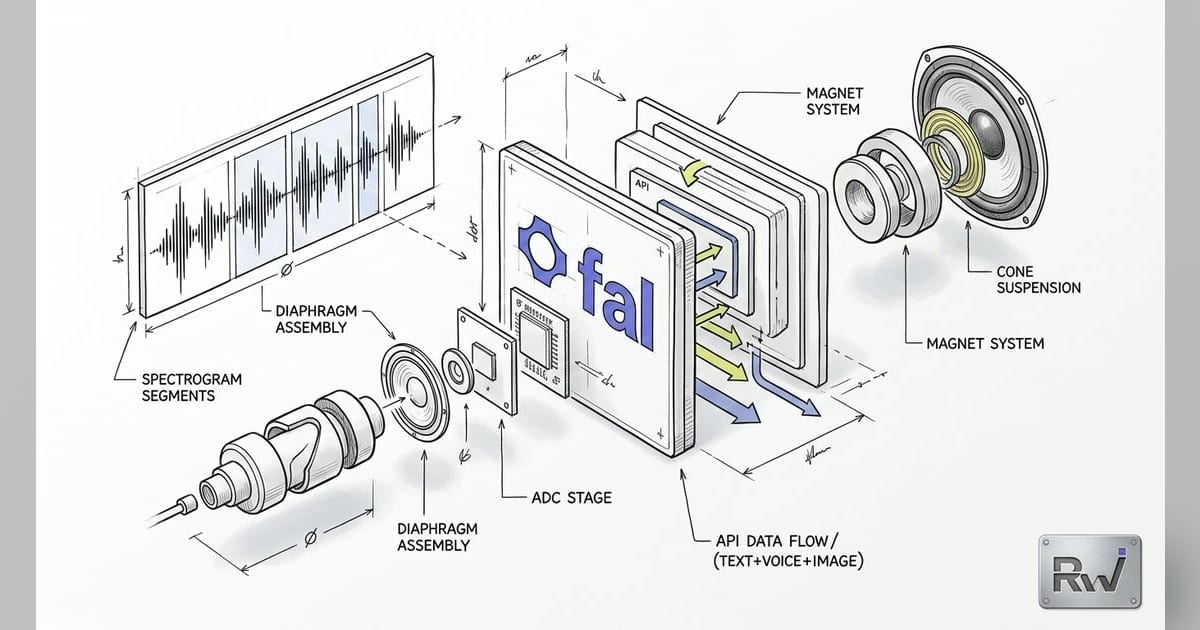
Burkay Gur and Gorkem Yurtseven's Fal has made ByteDance's Seed Audio 1.0 available through its hosted model gallery and API, putting a new multimodal sound model inside the same developer platform Fal has used to aggregate image, video, audio, 3D, and code generation models.
Fal's thread on X framed the listing as a step toward richer creative pipelines, where voice, music, sound effects, and multi-speaker scenes are no longer stitched together across separate tools. The more precise version is visible on Fal's model page: Seed Audio 1.0 is listed as bytedance/seed-audio-1.0
, marked for inference, commercial use, and partner access, and described as a ByteDance audio model that can generate natural-sounding audio from text, reference audio, or an image.
Fal Seed Audio 1.0 thread on X The launch is not a funding story and not a new Fal model. It is Fal doing what Fal was built to do: turn model distribution into infrastructure. The San Francisco company, founded in 2021 by Gur and Yurtseven after infrastructure work at Coinbase and Amazon, has spent the last two years positioning itself as the routing layer for generative media models that developers want before enterprises are ready to negotiate separate vendor relationships, capacity commitments, and integration work for each one.
That is why the Seed Audio endpoint matters beyond one more model card. ByteDance and Volcano Engine released Doubao-Seed-Audio 1.0 in China this week, with Sina's June 24 coverage describing a model that can generate an audio work end to end from text or reference audio, including character dialogue, emotional tone, background music, ambience, and effects. Fal's own page uses narrower language, and that distinction matters: Fal verifies that the hosted endpoint accepts text, reference audio, or image input; broader claims about complete cinematic scenes come from Chinese launch coverage and ByteDance's ecosystem positioning.
What developers actually get
The Fal API docs expose Seed Audio 1.0 through the company's standard JavaScript client, queue API, webhooks, and file handling flow. The required field is a prompt. Optional inputs include a preset voice, up to three reference audio URLs, and one image URL, though the docs say image input cannot be combined with audio references.
The supported output formats are WAV, MP3, PCM, and OGG Opus, with sample rates from 8 kHz to 48 kHz. Fal's visible playground example uses the prompt, "Generate a short suspense radio drama in a late-night convenience store, in English," and returns a 65-second MP3 at a 24 kHz sample rate. The model page lists the price at $0.075 per minute.
That pricing is the commercial wrapper around the technical shift. Audio generation has historically split into categories: text-to-speech, voice cloning, music generation, dubbing, sound effects, and post-production mixing. Seed Audio is being positioned against that fragmentation. If a developer can ask for a late-night convenience store radio drama and get dialogue plus sonic setting in one pass, the product surface changes from a voice API to something closer to scene generation.
The open question is provenance. Fal's model page does not disclose what data ByteDance used to train Seed Audio 1.0. It also does not name the ByteDance researchers or product leads behind the model. For buyers, especially entertainment, gaming, education, and advertising teams, those omissions are not academic. Audio models touch likeness, voice identity, music rights, and source-material risk. Fal marks the endpoint for commercial use, but the model card does not answer the full copyright and consent question.
Fal's founder bet is aggregation, not model ownership
Fal was founded before the current generative media stack had settled into familiar lanes. Its about page says Gur and Yurtseven started the company in 2021 after seeing AI infrastructure problems during their tenures at Coinbase and Amazon. The company says it first focused on fast inference for models such as SDXL and Whisper before expanding into a broader developer platform for generative media.
That background explains why Fal keeps shipping model access rather than trying to become a single-model lab. The company's homepage says it offers more than 1,000 production-ready image, video, audio, and 3D models, serverless GPUs, dedicated compute, and a model gallery for developers. Fal also says it is trusted by more than 1.5 million developers and can scale to more than 100 million daily inference calls with 99.99% uptime. Those are company-supplied numbers, but they are consistent with Fal's broader pitch: the scarce resource is not only GPU access, but the production path from model release to working application.
Fal has funded that strategy aggressively. In February 2025, the company said it raised a $49 million Series B from Notable Capital and Andreessen Horowitz, with Bessemer Venture Partners, Kindred Ventures, and First Round participating, bringing total funding to $72 million at the time. In December 2025, Fal said it raised a $140 million Series D with Sequoia, Kleiner Perkins, and NVIDIA joining the investor group. TechCrunch reported that the Series D valued Fal at $4.5 billion.
The company's May 2026 AWS partnership post made the enterprise logic explicit. Fal said more than 2.5 million developers were building on its platform and named Amazon MGM Studios, Canva, and Adobe as production customers. In the same post, Yurtseven, identified by Fal as CTO and co-founder, said generative media inference has unusual demands because of model variety, parallelism, and latency.
Seed Audio fits that thesis cleanly. The model itself belongs to ByteDance. The distribution problem belongs to Fal. Every time a frontier media model appears first inside a regional cloud product, research lab, or consumer-facing app, developers need a path to put it into production without rebuilding their stack. Fal is betting that path becomes a durable business.
Audio is catching up to image and video
The first wave of generative media infrastructure was dominated by images, then video. Audio is now moving into the same pattern: a few model labs compete on output quality, while developers look for stable APIs, pricing, file handling, safety controls, and predictable capacity.
Fal's Seed Audio listing lands in that market at a useful moment. ElevenLabs has expanded beyond voice into agents, dubbing, and music. Suno and Udio pushed prompt-to-song generation into mainstream creator workflows. Stability AI has promoted audio models with an emphasis on licensing. ByteDance is coming from a different position: it already operates major consumer creation surfaces, a cloud platform in Volcano Engine, and the Seed family of generative models.
For Fal, the competitive line is not only against Replicate, Baseten, Modal, RunPod, Together AI, Fireworks AI, DeepInfra, and the hyperscaler AI platforms. It is against time. Developers move quickly when a new model looks useful, but production teams slow down when they have to evaluate commercial terms, output controls, latency, storage, and integration work. Fal's job is to collapse that delay. The company is also building workflow surfaces around the raw endpoints. Fal Assets is live as a signed-in library for saving, organizing, searching, and reusing generations across Fal. That matters for audio because the generated file is rarely the end of the work. A brand, game studio, education app, podcast tool, or video editor needs asset management, references, variants, and repeatable generation history.
The Seed Audio endpoint is still a model listing, not a full audio workstation. But it shows where Fal is aiming. Gur and Yurtseven are not asking developers to bet on one model winning every modality. They are asking them to bet that generative media will remain fragmented at the model layer and consolidated at the infrastructure layer. Seed Audio gives Fal one more argument that the consolidation point can be its API.