Alibaba's Qwen team released Qwen-MM-Plugins, an open-source toolkit that adds image, video, document and 3D processing to existing AI-agent harnesses rather than asking developers to move their work into a new Qwen interface.
Qwen / Alibaba on X Qwen introduced the project in an August 9 post on X, six days after the repository's August 3 "init for release" commit. No individual project leader is identified in the available announcement or repository materials.
Alibaba has not identified an individual project leader for this release.
Qwen-MM-Plugins extends Alibaba's developer tooling into the agent integration layer. Its documented targets include Claude Code, Codex, Qoder, OpenClaw, Qwen Code and Gemini CLI, with manual setup available for opencode, pi and QwenPaw. The release places Qwen-built capabilities inside agent environments maintained by other model vendors.
A toolkit above the model layer
Qwen-MM-Plugins divides each capability into a skill, which tells an agent what it can do, and an optional Model Context Protocol server that provides the underlying tools. This follows the packaging model used by systems such as Claude Code, where a plugin can bundle skills and MCP servers alongside other components.
The core Qwen package reads images, videos, documents and 3D models. It also lists OCR, visual grounding, segmentation, speech recognition, visual chat and web search. Separate modules provide long-video memory, media generation and editing, Blender control, FreeCAD workflows and the production of Chinese educational videos from math or science problems.
The 3D modules show how far the toolkit reaches beyond chat and code. The Blender capability provides tools for modeling, materials, lighting and rendering. The FreeCAD module supports parametric modeling, property changes, STEP and STL import or export, and finite-element analysis.
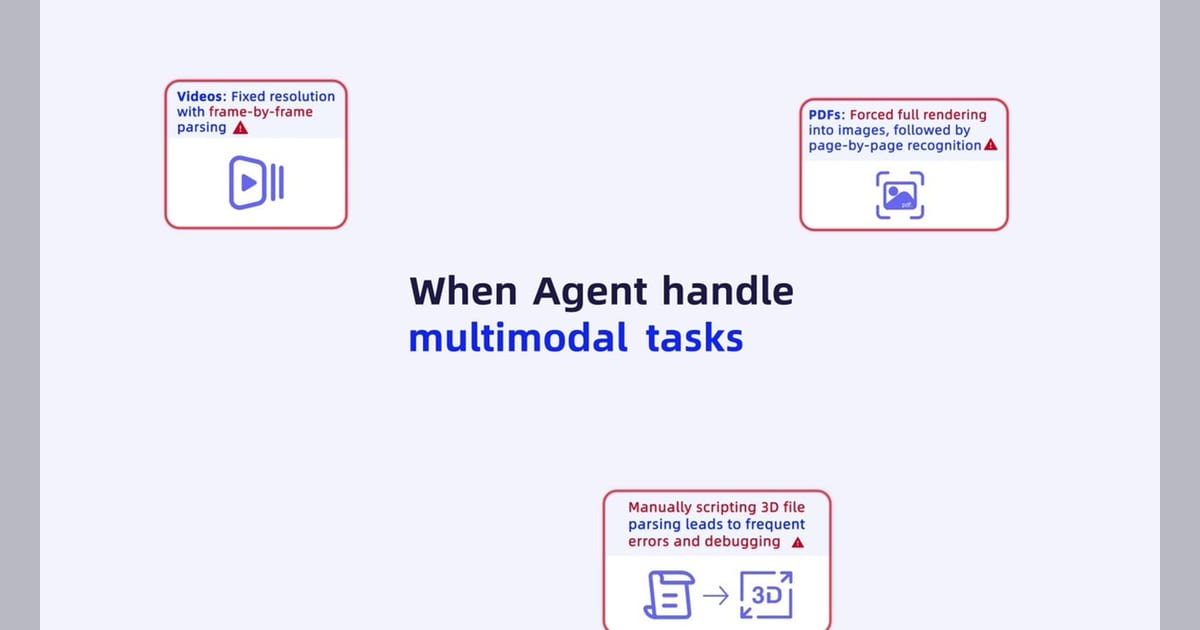
Qwen's announcement framed the toolkit as an answer to brittle media workflows. Its promotional material pointed to fixed-resolution, frame-by-frame video parsing, PDFs rendered and recognized page by page, and error-prone scripts for processing 3D files. Those are descriptions of the workflow problems Qwen says the project addresses, not independent performance findings.
Open source, with service dependencies
Alibaba released the code under the Apache 2.0 license. The Blender and FreeCAD components include separately attributed MIT-licensed code.
The toolkit can read images, video and documents without an API key, according to its installation documentation. Several higher-level functions remain tied to external services. Vision chat, OCR, grounding, transcription, generation and the construction of long-video memory require an Alibaba DashScope API key. Web and image search use Serper, while segmentation can require a separately configured server.
Developers also need local system packages for some workflows. Video and audio functions depend on ffmpeg. Document visualization may call LibreOffice, while other paths can use Blender, LaTeX or Chromium. Windows support currently runs through WSL2; Qwen's documentation says native Windows has not been validated.
Those boundaries matter when evaluating the project's portability. The Apache license makes the orchestration code easy to inspect and modify, while a meaningful share of the advanced workflow still passes through Alibaba or third-party infrastructure. Teams evaluating the package will need to account for API costs, data handling and the operational work required to maintain the desktop and command-line dependencies.
Alibaba is distributing capabilities through rival harnesses
Qwen-MM-Plugins arrives as media-model providers are moving closer to agent runtimes. Runway, for example, offers an MCP connector that lets agents generate visual assets without leaving tools such as Claude, ChatGPT or Cursor. Qwen's repository covers a wider set of perception and action categories, spanning OCR, video memory, media editing, 3D modeling and CAD. The projects have not been independently compared on reliability or output quality.
Alibaba's design gives developers a common capability package across several agent environments. A developer using Claude Code can install Qwen-MM-Plugins through that harness's marketplace mechanism. A Codex user can add the same repository through Codex's plugin commands. Gemini CLI users can register the skills and MCP services while continuing to use Google's model endpoint. Qwen gains a place in each workflow even when Qwen Code is not the primary interface.
The release connects Alibaba's model work to a practical developer surface. Model benchmarks can win initial attention, while plugins determine whether a model becomes useful inside daily work. Supporting rival harnesses lets the Qwen team distribute its capabilities even when another vendor provides the agent interface.