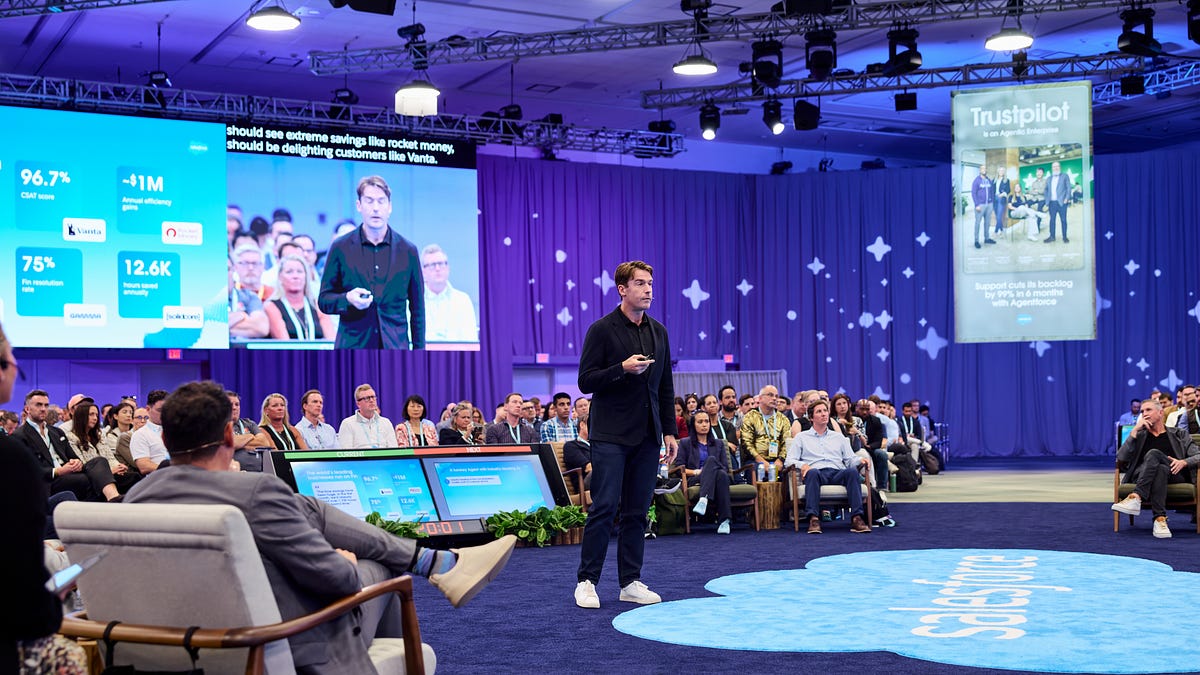
Just days after Salesforce completed the acquisition of his startup, Fin, for $3.6 billion last month, co-founder Des Traynor found himself thrown into the fire, delivering a keynote at Salesforce’s carnival for customer-facing software tools, Dreamforce.
When I catch up with Traynor last week over a video interview, the Irish entrepreneur says new boss Marc Benioff has not demanded that Traynor and co-founder Eoghan McCabe unveil a cutesy animal mascot to represent the brand alongside the rest of Salesforce’s product suite.
“I don’t know, that will be difficult,” he says, questioning whether Fin lends itself to a furry creature. (A free tip for Benioff: the answer’s probably a dolphin, friendlier than a shark.)
Of course, we’re not connecting for a goofy marketing consult, but to talk about Fin’s new product releases announced today – the last big ones, most likely, to have been built and mostly shipped before the company joined the Salesforce menagerie.
Fin is announcing the release of its newest AI agent today, Fin 4, as well as an updated underlying model, Apex 2.0.
The updated agent operates more proactively across a wider range of customer use cases, Traynor says, moving Fin past shorter-term support functions and deeper into ongoing customer success. The updated agent can seek out a human response when necessary (‘human in the loop’), without handing over the entire conversational flow to become that person’s responsibility.
“We want Fin to handle literally everything that it can, without damaging the customer experience,” Traynor says.
Why pay attention? First, Fin isn’t small: the company claims more than 30,000 customers, who use it to handle about two million customer queries every week. Of those customers, about 12,000 use its AI agent, including Anthropic, Clay, DoorDash, and Synthesia; Anthropic alone resolves more than half a million conversations monthly using Fin, the company says, with most of those conversations handled entirely by AI, not requiring its support team.
Then there’s how Fin’s product direction fits into a wider trend of agentic tools moving to be more proactive and cross-functional. We wrote last month about how Sierra, another customer service-focused agentic company valued at nearly $16 billion, has given more rein to its agent-builder tool, Ghostwriter, to help its customers in uses increasingly tied to growth and sales.
Fin’s moving in that direction, too, with Fin 4 helping more in what is considered “customer success” – longer-term relationships with customers that improve retention and upselling opportunities, versus simply triaging problems – and tying in more closely with sales.
The company’s bet: customers will increasingly use one, or just a couple, of more powerful agents to handle cross-functional tasks, instead of replacing current human job functions on a one to one basis.
“It would be sad if we end up reinventing the world with a dozen different, disparate tools,” Traynor says.
Such a vision means businesses will likely need to employ fewer individual customer support people, Traynor concedes — but he argues there will still be a need for humans in the loop.
More on how Fin, formerly known as Intercom, is thinking about this future – and life under the Salesforce banner – below.
We’re excited for Season 3 of The Upstarts Podcast to debut tomorrow, October 8! We have a killer lineup of startup guests, telling unfiltered founder stories and sharing real company-building lessons.
Our first guest is reportedly fielding investment offers at a valuation north of $20 billion for his startup looking to bring back the woolly mammoth and the dodo. Check out the trailer below, and be sure to subscribe on YouTube, Apple or Spotify to catch our next episodes as they drop.
Fin’s view
Fin essentially offers two types of agents to customers: an Operator agent that increasingly pilots its customer relationships, flagging potential pain points or opportunities; and its support agent that actually manages most of its conversations with end users.
The higher-level agent isn’t quite self-optimizing to the point that it can simply manage itself, Traynor says, but that’s the direction these tools are going. The goal is for Fin to learn and then course-correct around bigger-picture strategy, flagging things like when a customer might be getting more likely to churn, or when humans on the team are wasting time conducting actions that it could automate on their behalf.
“Software used to be pointy-clicky task, and workflow, based,” says Traynor. “The conversations we see people having with Operators are not that, they’re high-level.”
That means, inevitably, companies will employ fewer lower-level human customer support managers to do “heavy lifting” that isn’t differentiated, Traynor says. Among businesses, “that’s not controversial,” he argues.
Still, Traynor says humans won’t be fully cut out. Some situations may require sensitivity or extra care to maintain a customer relationship; others will require a human’s judgment call to resolve competing priorities or directives.
Fin’s founders are very much in the camp that businesses and their customers are still acclimating to a reality where talking to an agent that solves your problem faster is preferable to talking to a human who can’t be as helpful, or as fast.
When it comes to improving internal systems, meanwhile, Traynor anticipates a world where users express a general intent, business outcome, or problem, and tools like Operator can problem-solve and test their way to the best automated process to achieve them.
Not doing so, he argues, will eventually look like “very much a SaaS era thing.”
Ohana life
Fin’s future as part of the Salesforce family, meanwhile, is still being sorted out. Traynor says his team hasn’t yet had higher-level product strategy sessions with the wider organization; the team behind its new model, Apex 2.0, hasn’t met with the Salesforce AI research teams, either.
“We’re still working through this right now,” Traynor says.
The first priority for Fin, according to its co-founder, will be to figure out how to integrate and sell Fin across the wider Salesforce customer base. “How do we make it work as easily and as deeply-integrated as possible? That will be the first chunk of work,” he adds.
Eventually, he, McCabe and Benioff and co. will need to have a “mind meld” on their vision for customer-facing AI agents moving forward.
What Traynor wants to see in the world: one super agent that handles all of your customer-facing tasks.
“You teach that one agent everything about your business, give your strategies, and it handles sales, marketing, support, e-commerce, renewals, whatever the hell it is your business does,” he says.
But whether that agent is Fin’s, or Fin helps power a Megazord customer agent under the Salesforce banner, will likely be out of his control. My guess would be on the latter: that Fin helps power a new, grander-sounding Salesforce customer experience agent. Benioff can announce that one at the next Dreamforce.