Recently, our team at Fixstars had the opportunity to attend the Embedded Vision Summit, where industry leaders gathered to discuss the latest breakthroughs in computer vision and edge AI. Among the many fascinating sessions, one presentation truly stood out: “ Industrial Vision Meets Physical AI: From Automated Vision to Human-Centric Agentic Systems,” delivered by Dr. Mahbubul Alam, Chief Research Scientist at Hitachi America Ltd.
The session provided a deep dive into the limitations of traditional automated visual inspection and painted a compelling picture of how “Agentic AI” is set to revolutionize manufacturing and industrial maintenance. Here are my key takeaways from the session, along with some thoughts on what this means for software optimization at the edge.
The Limits of Classical Visual Inspection
Traditionally, automated visual inspection has relied on fixed, generic pipelines. You train a model on a dataset, deploy it, and hope it catches defects. However, Dr. Alam highlighted three fundamental gaps that deployment in real industrial environments often reveals:
No Memory: Systems treat every inspection independently, unable to track how a specific defect evolves over time (e.g., month over month).No Uncertainty Reasoning: Systems are forced to make binary “pass/fail” decisions without confidence quantification, leading to high false positives.Fragility to Physical Changes: Real-world assets change. Viewpoints shift, lighting varies drastically, and dirt can mask defects. Traditional models degrade rapidly under these conditions.
Enter “Human-Centric Agentic Physical AI”
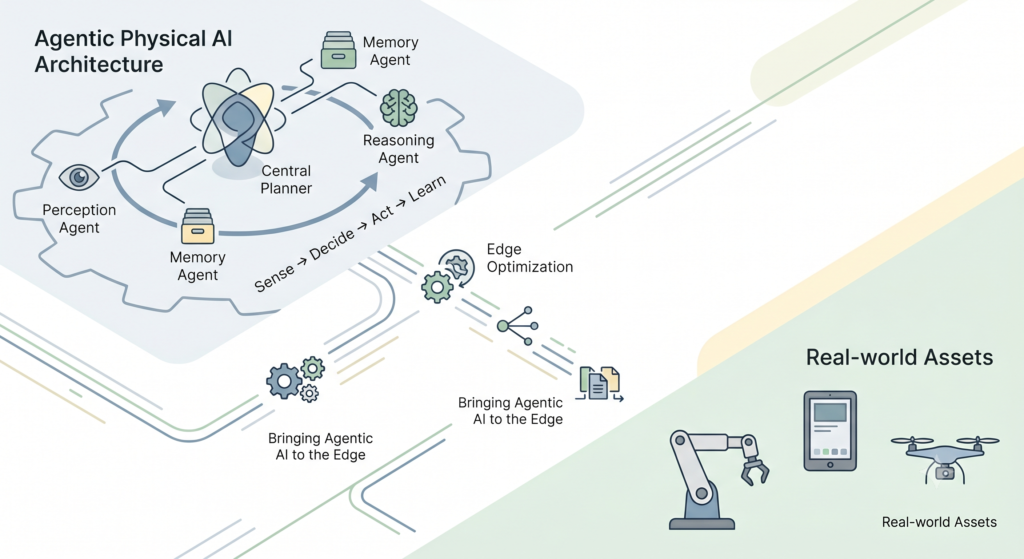
To solve these challenges, Hitachi proposed a paradigm shift toward Agentic Physical AI. Instead of a single static model, the architecture utilizes a “Central Planner” orchestrating specialized agents: a Perception Agent, a Memory Agent, and a Reasoning Agent.
This creates a closed-loop system: Sense → Decide → Act → Learn
In a fascinating case study on welding defect inspection—a notoriously difficult task due to limited training data and high variability in materials—they demonstrated how using “Deep Co-training” (combining Semi-Supervised Learning and Unsupervised Domain Adaptation) alongside this agentic workflow drastically reduced false alarms while keeping human operators in the loop for uncertain cases.
The Fixstars Perspective: Bringing Agentic AI to the Edge
Listening to Dr. Alam’s presentation, I was deeply impressed by the conceptual leap from basic vision models to intelligent, reasoning agents. However, my mind immediately jumped to the critical hurdle of deployment and performance.
Running a planner-driven architecture with multiple continuous agents (Perception, Memory, Reasoning) simultaneously requires massive computational resources. When this needs to happen not in a cloud server, but on a factory floor, inside a handheld device, or on an autonomous drone (as Hitachi’s future direction suggests), the computing environment becomes severely constrained by power, thermal, and latency limits.
This is exactly where the industry needs to bridge the gap between advanced AI concepts and bare-metal execution. To make Agentic Physical AI practical at the edge, heavy software optimization is mandatory.
At Fixstars, this is our core domain. We specialize in software acceleration and multi-core processor optimization across CPUs, GPUs, and FPGAs. To deploy multi-agent systems without latency bottlenecks, it is essential to optimize the memory hierarchy, accelerate neural network inferences, and tailor the software perfectly to the specific edge hardware. Advanced architectures like the ones presented by Hitachi will only reach their full potential in industrial settings when backed by uncompromising software performance.
Learn more about our optimization services at Fixstars.
Conclusion
Industrial AI is moving from simple perception to complex reasoning. The shift toward Human-Centric Agentic Systems is highly promising for improving safety, reliability, and cost in industrial inspection.
As AI models grow more complex and “agentic,” Fixstars is excited to continue partnering with innovators to accelerate these technologies, ensuring they run lightning-fast and efficiently on any edge device.