Enterprise storage becomes AI memory as privately run models close in on the frontier
As open-weight models close in on the performance of proprietary frontier systems, enterprises are gaining a credible way to run generative AI on hardware they own. That shift puts the data already sitting in corporate storage at the center of the private AI conversation.
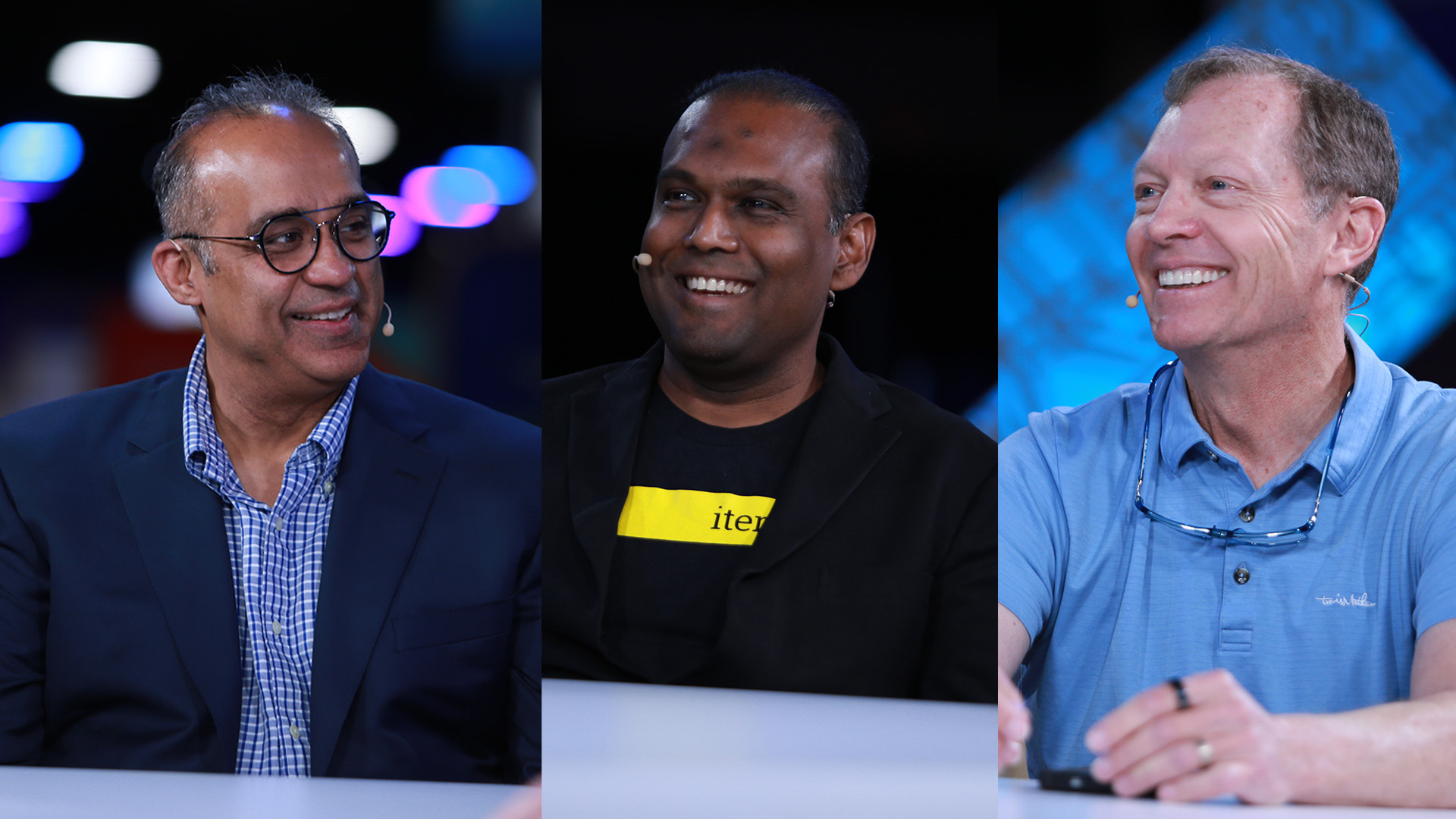
Many organizations are now moving AI out of pilot projects and into production built on intelligent data infrastructure. The past two years went largely into getting sprawling data estates ready for AI, which is why productivity gains are now landing across industries, according to Ashish Dhawan (pictured, left), senior vice president, general manager and chief revenue officer of the Cloud Business Unit at NetApp Inc.
“There’s been more maturity about the usage of models in private AI. You find that whether it’s closed models or open-weight models, they’re getting close to the frontier,” Dhawan said. “That’s where our AIPod Mini with Iterate can really work well.”
Dhawan, Brian Sathianathan (center), co-founder and chief technology officer of Iterate Studio Inc., doing business as Iterate.ai, and Jon Nordmark (right), co-founder and chief executive officer of Iterate.ai, spoke with theCUBE’s Christophe Bertrand at NetApp INSIGHT, during an exclusive interview on theCUBE, SiliconANGLE Media’s livestreaming studio. They discussed how the companies’ partnership packages private AI for enterprises and where agentic AI is producing measurable results. ( Disclosure below.)*
Open-weight models move private AI closer to enterprise data
The partnership centers on the AIPod Mini, a turnkey appliance that pairs NetApp infrastructure with Iterate.ai’s Generate platform. The goal is to keep the model, the hardware and the data under the customer’s control rather than sending information to a third-party service, according to Sathianathan.
“AIPod Mini has attached connections to the NetApp storage, and it talks to NetApp using the ONTAP protocol that’s time-tested,” Sathianathan said. “Then on top of it, on top of the AIPod Mini, we are running our Generate software. That software has an LLM embedded in it, so you can run all your AI queries locally and fully privately within your four walls.”
Out of the box, the system ships with more than 200 agent templates, more than 200 skills and access to more than 800 tools, according to Nordmark. In one insurance deployment, accident-report analysis that would normally take an analyst about eight hours was finished in eight minutes. Iterate.ai frames its approach as outcome-based AI, judged on business results rather than technical specifications.
“What we mean by that is it’s got to produce the proper KPIs and business outcomes,” Nordmark said. “Now, the technical things are kind of table stakes, but everything else is what really matters to the enterprise.”
Healthcare offers a sharper example. Hospitals typically collect 80% to 85% of what they bill insurers, and Iterate.ai’s forensic revenue cycle agent identified $17.4 million in denied claims for a hospital with $150 million in annual billing, according to Sathianathan. The workflow chains three agents that read payer contracts, examine incoming denials and draft resubmissions, Nordmark added. As agents take on that kind of back-end work, control over what they can access becomes critical.
“If these autonomous agents are beginning to run, what it also means is you want to have governance,” Sathianathan said. “You want to have permission. That’s where the NetApp platform is really powerful.”
NetApp also used the event to launch Novus, a storage architecture engineered for zettabyte-scale capacity in AI factories. For the partners, the larger point is that capable open-weight models only pay off when they can reach the institutional knowledge held in enterprise storage.
“Memory plus context equals knowledge. We talk a lot about that. Memory is what makes AI work,” Nordmark said. “So much of a company’s memory is in storage today, and that’s what NetApp’s here to unleash.”
Here’s the complete video interview, part of SiliconANGLE’s and theCUBE’s coverage of NetApp INSIGHT:
( Disclosure: TheCUBE is a paid media partner for the NetApp INSIGHT 2026 event. Neither NetApp Inc., the sponsor of theCUBE’s event coverage, nor other sponsors have editorial control over content on theCUBE or SiliconANGLE.)*
Photo: SiliconANGLE
Support our mission to keep content open and free by engaging with theCUBE community. Join theCUBE’s Alumni Trust Network, where technology leaders connect, share intelligence and create opportunities.
- 15M+ viewers of theCUBE videos , powering conversations across AI, cloud, cybersecurity and more
- 11.4k+ theCUBE alumni — Connect with more than 11,400 tech and business leaders shaping the future through a unique trusted-based network
Are you an AWS customer? Support SiliconANGLE financially by buying your AWS services from our Marketplace portal page and links: https://siliconangle.com/aws-marketplace/
About SiliconANGLE Media
theCUBE AIand theCUBE SuperStudios — with flagship locations in Silicon Valley and the New York Stock Exchange — SiliconANGLE Media operates at the intersection of media, technology and AI.
Founded by tech visionaries John Furrier and Dave Vellante, SiliconANGLE Media has built a dynamic ecosystem of industry-leading digital media brands that reach 15+ million elite tech professionals. Our new proprietary theCUBE AI Video Cloud is breaking ground in audience interaction, leveraging theCUBEai.com neural network to help technology companies make data-driven decisions and stay at the forefront of industry conversations.