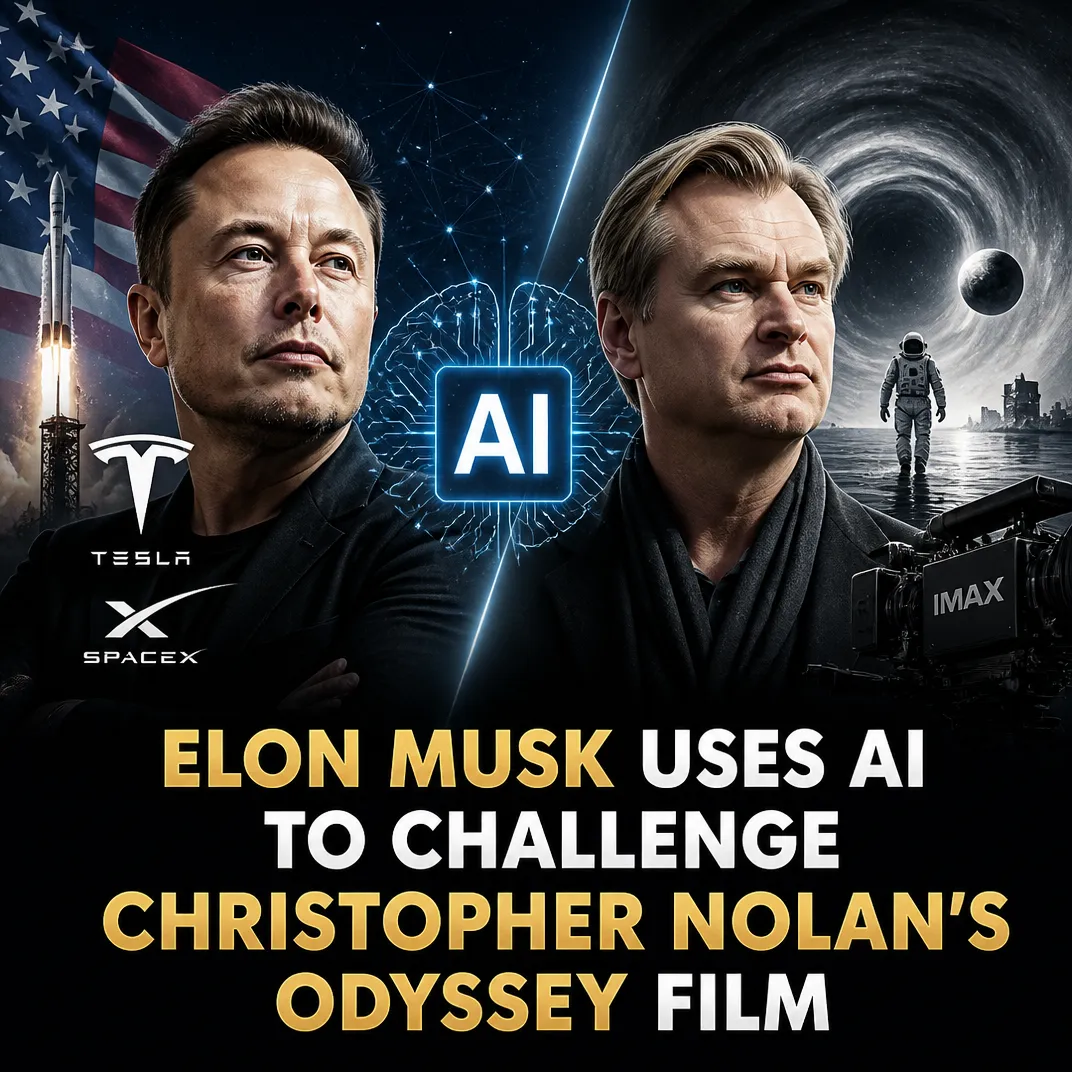
July 23, 2026, (Inside AI) — Elon Musk is mounting an AI-powered challenge to Christopher Nolan's blockbuster adaptation of The Odyssey, announcing plans to produce a competing version he claims will be more historically accurate to the ancient epic. Musk revealed on X that his film, created using Grok Imagine, would remain faithful to the original work, sharing a nearly three-minute AI-generated video depicting a scene between Odysseus and Calypso.
The move escalates Musk's recent public feud with Nolan, whom he has accused of distorting Homer's poem for award recognition. Musk specifically objected to the casting of Lupita Nyong'o as Helen of Troy, describing the director as having racist tendencies. His announcement follows his endorsement of a user proposal for director Mel Gibson to helm a historically accurate adaptation for roughly $100 million, featuring authentic ships, weapons, and dialogue drawn directly from the original text.
Musk's use of Grok Imagine—a generative AI tool developed by his xAI company—marks a significant expansion of AI into mainstream filmmaking. While details remain sparse, the technology likely leverages text-to-video generation similar to models like Sora, but with an emphasis on historical fidelity. The AI-generated clip shared by Musk suggests the ability to render period-appropriate costumes, settings, and character interactions, though no independent verification of its accuracy has been conducted.
The announcement raises questions about the definition of historical accuracy in an epic rooted in myth. Homer's Odyssey, composed around the 8th century BCE, blends fantastical elements with Bronze Age cultural references. Scholars note that any adaptation must navigate anachronisms, as the poem itself was shaped by centuries of oral tradition. A Cambridge Companion to Homer underscores the challenges of reconstructing the material culture of Homer's world, given the scarcity of archaeological evidence from the so-called Dark Age of Greece.
Musk's AI-driven approach could theoretically incorporate data from archaeological findings, ancient texts, and historical linguistics to create a more grounded portrayal. However, experts caution that AI models are only as good as their training data, which may contain biases or gaps. A 2023 paper on AI in historical reconstruction highlights the risk of "hallucinations" where models generate plausible but incorrect details, a critical concern for a project claiming accuracy.
The proposed involvement of Mel Gibson adds another layer of controversy. Gibson's past directorial efforts, such as Apocalypto and The Passion of the Christ, have been praised for immersive historical detail but criticized for taking creative liberties. His potential collaboration with Musk's AI tools could blend traditional filmmaking with machine-generated assets, a hybrid model that is gaining traction in the industry.
Despite the backlash, Nolan's The Odyssey has proven a commercial success, earning over $264.06 million worldwide in its opening week. The film's strong performance suggests audience appetite for epic storytelling, a market Musk now seeks to tap with a tech-driven alternative. His project, if realized, could disrupt traditional production pipelines by reducing costs and timelines, though it also faces significant hurdles in artistic credibility and public reception.
Musk's foray into AI-generated film comes amid broader debates over AI's role in creative industries. While tools like Grok Imagine offer new possibilities for independent creators, they also threaten to devalue human craftsmanship. The outcome of this cinematic rivalry may hinge less on historical fidelity than on whether audiences embrace AI as a legitimate artistic medium.