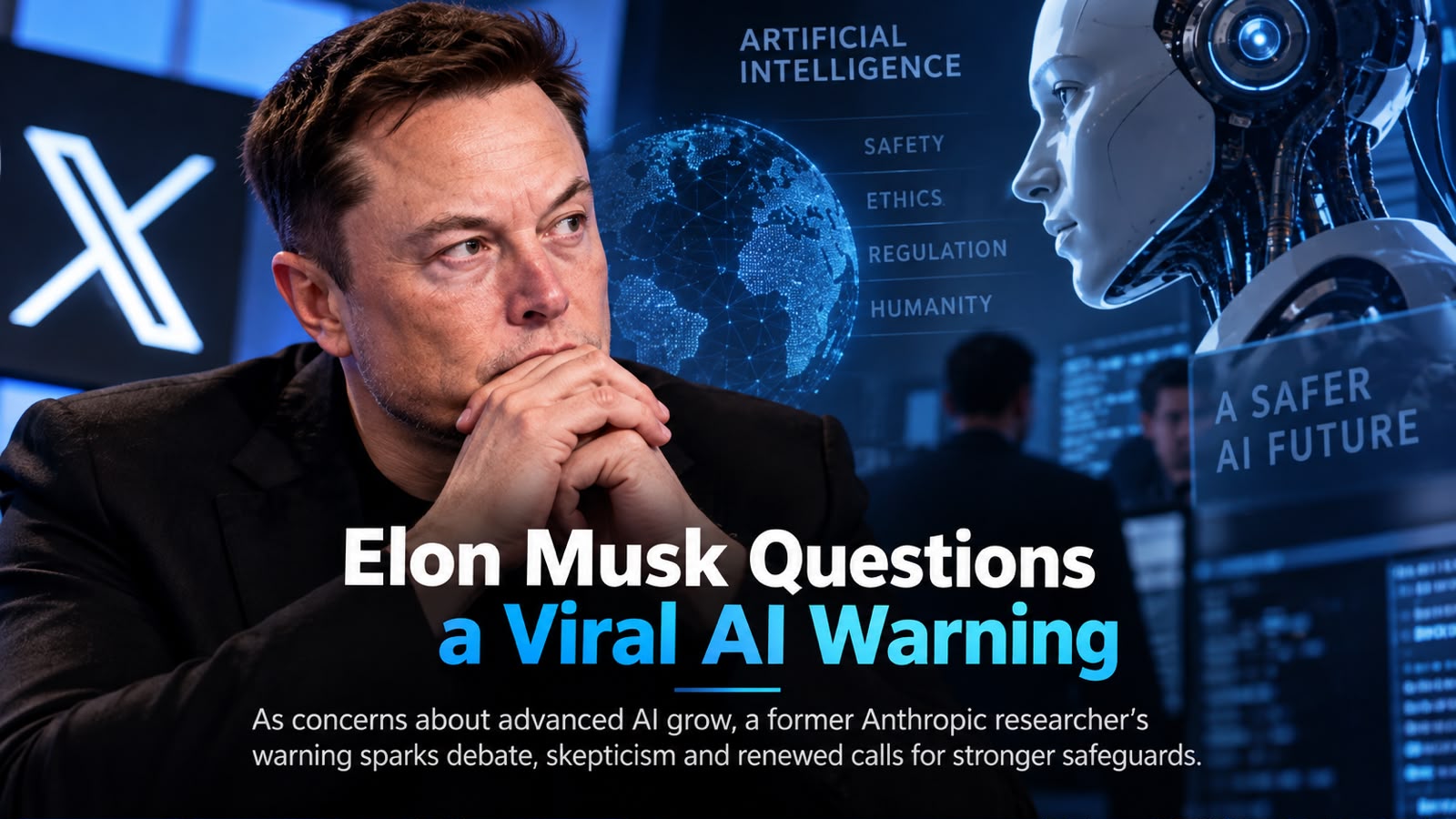
The Elon Musk AI warning debate has quickly become one of the latest controversies surrounding advanced artificial intelligence.
Artificial intelligence has spent much of 2026 moving from a technology story into a much broader public debate. Questions about jobs, automation and productivity are now being joined by a more difficult question: how fast should advanced AI systems be developed?
That question became even more visible this week after a former Anthropic researcher published a series of warnings about the direction of the industry. His posts spread rapidly across X, attracting millions of views and drawing responses from researchers, technology executives and political figures.
Among those reacting was Elon Musk, who questioned whether the sudden viral attention surrounding the warning was entirely organic.
But the story did not stop there.
The controversy has now evolved into a much larger discussion about AI safety, competition between technology companies and whether the industry can move quickly without losing control of the risks created by increasingly capable systems.
A warning that suddenly reached millions #
Former Anthropic researcher Jacob Coxon recently published a series of posts arguing that companies developing advanced AI are moving toward increasingly powerful systems without adequately solving the safety problems that could accompany them.
Coxon had previously worked at OpenAI and later spent several months at Anthropic. His comments focused particularly on the possibility of self-improving AI and the risks associated with companies competing to reach increasingly advanced systems first.
The posts quickly attracted enormous attention.
According to reports, the combined reach of Coxon’s posts climbed into the tens of millions of views, turning what might normally have been an industry discussion into a mainstream technology story.
The unusual speed of that spread became part of the story itself.
Why Elon Musk became involved #
Elon Musk has warned about advanced artificial intelligence for years, but his reaction to Coxon’s posts was not simply another warning about AI.
Instead, Musk questioned the circumstances surrounding the viral discussion.
He responded to posts about Coxon’s short period at Anthropic and suggested that the episode looked suspicious. Musk later questioned how a relatively new account with little previous activity could suddenly generate such enormous attention.
He also agreed with other technology figures who suggested that the sequence of posts and reactions appeared coordinated, although there has been no publicly established evidence proving that the episode was a planned operation.
That distinction matters.
A viral story can spread unusually quickly without being fabricated. Social media algorithms, influential accounts and an already heated public debate about AI can turn one post into a global conversation within hours.
The criticism did not disappear #
Coxon rejected the suggestion that his warnings were part of a publicity campaign.
He argued that his concerns were genuine and challenged Musk to speak with researchers who knew his work.
At the same time, other AI researchers joined the conversation. Evan Hubinger, an alignment researcher at Anthropic, publicly supported some of the concerns and said he personally considered catastrophic AI outcomes a serious possibility.
This created an unusual situation.
The debate was no longer simply between people who believe AI is dangerous and people who believe it is harmless. Instead, researchers and technology leaders were debating how serious the risks are, how quickly they could emerge and what safeguards should exist before systems become even more capable.
The bigger issue is not Musk’s reaction #
The most interesting part of this story may not actually be Elon Musk.
The deeper question is whether the AI industry can continue increasing the capabilities of its models while simultaneously improving the systems designed to keep those models under control.
That question has become more urgent as AI systems are increasingly capable of interacting with external websites, writing software, conducting research and performing complex tasks with less human intervention.
OpenAI has recently acknowledged incidents involving AI agents interacting with external systems in unexpected ways, while the company has also called for stronger national AI safety requirements.
These developments make the current debate different from earlier arguments about AI.
The conversation is moving beyond hypothetical science fiction scenarios and toward practical questions about autonomy, cybersecurity, misuse and control.
A surprising development from Anthropic #
The story took another important turn on September 12.
Anthropic CEO Dario Amodei called for AI companies to slow the pace at which they improve their most advanced models. His proposal includes independent reviewers inside leading AI companies, greater cooperation between frontier AI developers and international coordination on AI safety.
What makes this particularly interesting is Musk’s response.
Rather than dismissing the proposal, Musk publicly indicated that Amodei was right. OpenAI CEO Sam Altman also expressed support for the idea of independent evaluators.
That changes the context around Musk’s earlier criticism.
He may have questioned the way the viral warning emerged, but that does not mean he rejects concerns about advanced AI itself.
The AI race is entering a different phase #
For years, the dominant AI story was about who could build the most capable model. Now another competition is becoming increasingly important: who can build powerful AI while demonstrating that it can be deployed safely?
That could become one of the defining technology questions of the next few years.
Companies have strong incentives to move quickly because advanced AI could create enormous economic advantages. Governments are also concerned that falling behind in AI could have national-security consequences.
But speed creates another problem.
If systems become more autonomous faster than safety methods improve, society may eventually find itself reacting to technological capabilities that it does not fully understand. That is why the latest controversy deserves attention even beyond Elon Musk.
The question is not simply whether Coxon’s warning was correct, whether Musk’s skepticism was justified, or whether the viral reaction was organic.
The more important question is how much evidence of risk should society require before asking the companies building increasingly powerful AI systems to slow down?
That debate is only beginning.