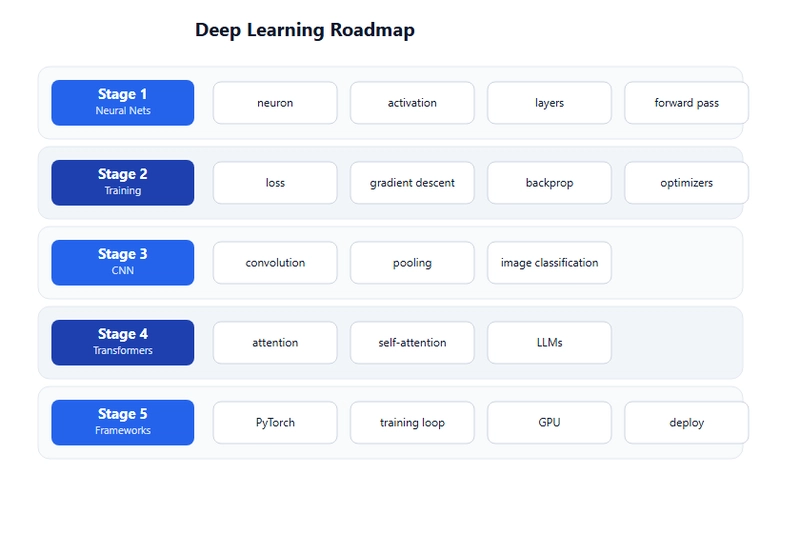
The Core Architecture #
A neuron is essentially a weighted sum followed by a non-linear activation. Without that activation function, your entire deep network would just be one giant linear regression, regardless of how many layers you stack.
The math is straightforward: y = activation(w1*x1 + w2*x2 + ... + b)
.
The weights (w
) and bias (b
) are the actual "knowledge" the model acquires. For the activation, ReLU is the industry standard for hidden layers because it's computationally cheap and avoids the vanishing gradient problem, while Softmax is the go-to for multi-class probability outputs.
In PyTorch, this is implemented as a sequence of linear transformations:
import torch.nn as nn
model = nn.Sequential(
nn.Linear(784, 128), # input (28x28 pixels) -> 128 neurons
nn.ReLU(), # activation
nn.Linear(128, 64), # 128 -> 64
nn.ReLU(),
nn.Linear(64, 10), # 64 -> 10 classes
)
The Training Workflow #
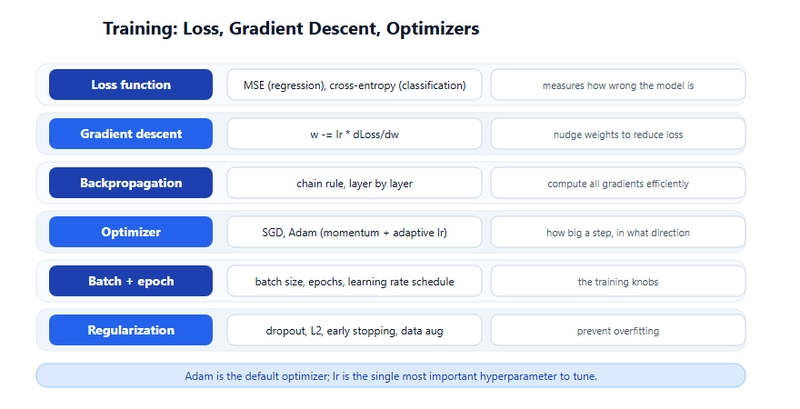
Training is just a repetitive cycle of guessing and correcting. This AI workflow consists of four critical steps per batch:
-
Forward Pass: The model makes a prediction.
-
Loss Calculation: A loss function (like CrossEntropyLoss) measures the distance between the prediction and the ground truth.
-
Backpropagation: The system calculates the gradient of the loss relative to every weight in the network.
-
Optimization: An optimizer (usually Adam or SGD) updates the weights to minimize that loss.
Here is a practical tutorial snippet for a basic training loop:
import torch
import torch.nn as nn
import torch.optim as optim

model = nn.Sequential(nn.Linear(784, 128), nn.ReLU(), nn.Linear(128, 10))
loss_fn = nn.CrossEntropyLoss()
optimizer = optim.Adam(model.parameters(), lr=1e-3)

for epoch in range(10):
 for X_batch, y_batch in data:
     pred = model(X_batch)
     loss = loss_fn(pred, y_batch)
     loss.backward()
     optimizer.step()
     optimizer.zero_grad()
For anyone moving into production, focusing on the optimizer's learning rate is usually where the most significant performance gains are found. If your loss is oscillating or exploding, the learning rate is almost always the culprit.
Next Orate: On-device TTS for Mac →