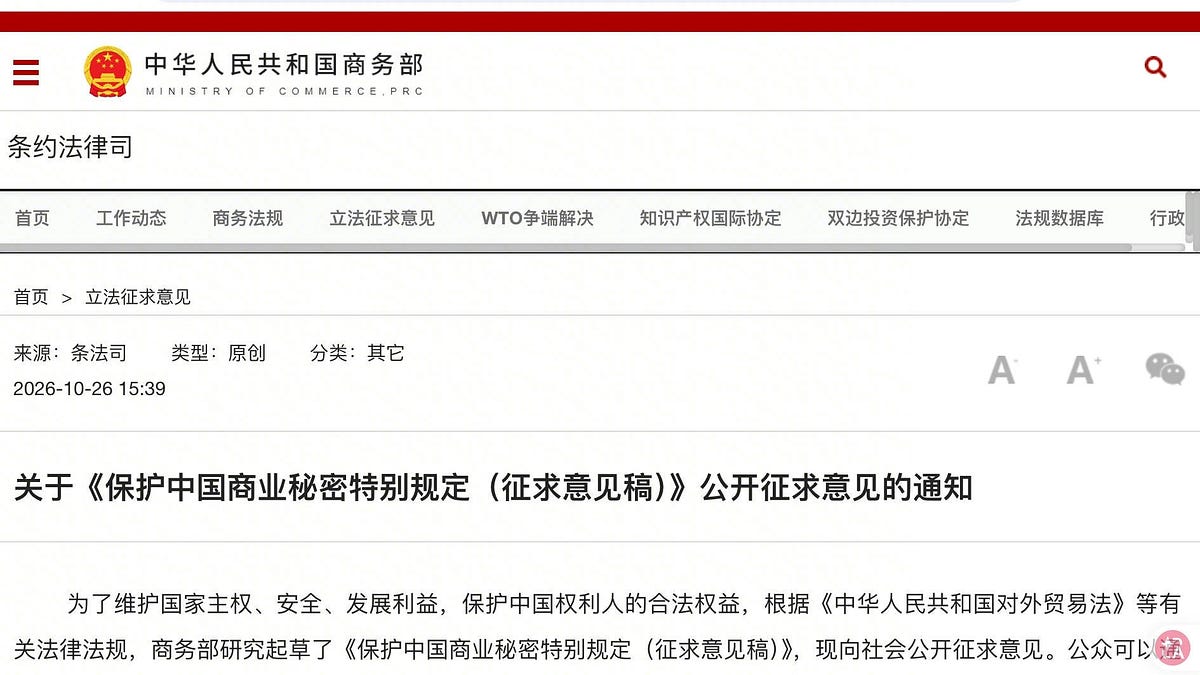
On October 26, China’s MOFCOM released the draft Special Provisions on the Protection of Chinese Trade Secrets for public consultation. The document is just ten articles long, but it addresses a very practical and increasingly urgent question: What should China do when a foreign company, organization, or individual infringes Chinese trade secrets in ways that harm, or pose a real threat to, China’s sovereignty, security, or development interests?
You can find a full English translation of the draft rules in this excellent piece by Inside China.
Trade secrets are a legal concept, but the basic idea is quite simple. They are commercially valuable pieces of information that a company keeps confidential and takes steps to protect. For an AI company, that could mean its core algorithms or model training techniques. For a battery manufacturer, it might be production processes and technical parameters developed over many years. Customer lists, business data, and other commercially sensitive information can also qualify.
In the past, when these trade secrets were stolen or used without permission by foreign companies, Chinese businesses generally had to rely on litigation and other legal remedies to protect their rights. In 2025, Beijing-based semiconductor equipment manufacturer E-Town Semiconductor Technology (屹唐股份) filed a lawsuit against US semiconductor equipment giant Applied Materials in the Beijing Intellectual Property Court, alleging that the US company had improperly obtained core trade secrets relating to plasma sources and wafer surface treatment technologies by recruiting former employees of its US subsidiary. Another case involved Beijing-based server manufacturer Xinyun Dongfang (新云东方), which lost a lawsuit against IBM in a US court in 2021. But cross-border trade secret disputes have a very practical problem: once technology has been taken overseas, it can be copied and put to use very quickly. Even if the original owner eventually wins a lawsuit, that does not necessarily mean it can get the technology back, or prevent the other party from continuing to use it.
This is the problem the new draft, prepared and released by MOFCOM’s Department of Treaty and Law, is trying to address. It would add a new set of government-level tools to China’s existing legal framework for protecting trade secrets.
The proposed rules are not intended to cover every trade secret dispute involving a foreign company. Under Article 2, two conditions must be met: first, a foreign company, organization, or individual must have engaged in conduct that infringes Chinese trade secrets; second, that conduct must have harmed China’s sovereignty, security, or development interests, or posed a real threat to those interests.
The words “real threat” are particularly interesting. My reading is that if a risk is sufficiently concrete and imminent, the Chinese government may not necessarily have to wait until the damage has fully materialized before taking action.
So what could China actually do?
The measures proposed by MOFCOM are quite substantial. China could restrict a foreign company’s trade in goods, technologies, and services with China, prohibit exports of certain items to that company, restrict its new investments in China, or impose restrictions on the entry, employment, and residence of individuals involved. Fines could also be imposed in accordance with the law.
Taken together, these measures could effectively shut a foreign company or individual out of significant parts of the Chinese market.
In my view, the proposal is essentially designed to change the cost-benefit calculation for foreign companies. In the past, a company might have calculated that obtaining valuable technology from a Chinese competitor was worth the risk, even if it eventually faced a lawsuit and had to pay damages. But if the consequences could also include losing access to the Chinese market and disrupting its entire business operations in China, that would be a very different calculation.
Consider, for example, the recent Meta–Manus transaction. The transaction was ultimately rolled back, and the equity ownership was restored. But what about the technology, knowledge, and experience that may have been transferred during the process? Could all of that really be returned in its original form? I doubt it is quite so simple. Regulatory intervention may be able to reverse an overseas acquisition that risks transferring commercially sensitive Chinese technology, but reversing the transaction does not necessarily reverse the spread of knowledge that may already have occurred.
Under the proposed special provisions, if a foreign acquirer were found to have infringed Chinese trade secrets during such a transaction, and the conduct met the national-interest threshold, the consequences might extend beyond the party transferring the technology. The foreign acquirer itself could potentially face Chinese trade and investment restrictions. In other words, a foreign buyer might have to ask itself a difficult question: Is this acquisition really worth pursuing if it could mean being shut out of the Chinese market altogether?
As for the procedure, MOFCOM could initiate an investigation on its own, while companies and individuals could also report suspected violations. Foreign companies under investigation would have the opportunity to present their arguments and defend themselves, but they would also be expected to cooperate and provide relevant information. If they refused to cooperate, MOFCOM could make a decision based on the facts and evidence already available.
Importantly, the proposed system is not simply about punishment. A foreign company that stops the infringement, eliminates the relevant risks, or compensates for the damage could apply to have the restrictions adjusted or removed. Chinese companies that genuinely need to continue doing business with a restricted foreign entity could also apply for special exemptions.
There are, however, several questions that will need to be clarified before the rules can work effectively. For example, how serious must a risk be to constitute a real threat to China’s development interests? How exactly should “Chinese trade secrets” be defined? What happens when the trade secrets belong to an overseas subsidiary of a Chinese company? How would fines be calculated, and how would these procedures interact with existing investigations and legal remedies? Perhaps most importantly, where should regulators draw the line between legitimate technology licensing, employee mobility, commercial due diligence, and actual trade secret infringement? The clearer these boundaries are, the easier it will be for companies to structure legitimate international cooperation.
There is another question I find particularly interesting: What kind of situations are these rules really intended to address?
I can see two broad scenarios. The first is relatively familiar: a foreign company or organization steals trade secrets from a Chinese company operating inside China. The second is more complicated. A Chinese company expands overseas, invests in a foreign business, enters into a partnership, or becomes the target of an acquisition. During that process, it faces pressure from foreign organizations to disclose technology, data, or commercially sensitive information.
Based on the wording of the draft, both scenarios could potentially fall within its scope. But looking at recent policy developments, I personally think the second scenario may become increasingly important. Chinese companies are now conducting research, investing, and operating around the world. Their core technologies are no longer necessarily concentrated inside China. Valuable technical knowledge may be distributed across overseas subsidiaries, research centers, and commercial partners. At the same time, some foreign governments have openly argued that Chinese companies should do more than simply build factories and create jobs locally. They also want those companies to share technology with local industries.
And the new proposal does not appear in a legal vacuum. Article 40 of China’s revised Foreign Trade Law, which took effect in March this year, already provides a basis for trade restrictions against foreign individuals and organizations in circumstances involving harm to China’s sovereignty, security, or development interests. The revised Anti-Unfair Competition Law, adopted in 2025, also provides for action against unfair competition conducted overseas when it disrupts competition within China or harms the interests of domestic businesses or consumers. So China already has legal grounds for responding to certain forms of misconduct originating outside its borders. What the proposed special provisions would do is make the response more specific: in qualifying trade secret cases, China could use trade and economic regulatory measures, not just traditional civil litigation, to protect its interests.
The timing is also worth noting. On October 19, the United States imposed sanctions under the Protecting American Intellectual Property Act against five Chinese companies, including MiraclePlus and its affiliated entities, as well as Shanghai Zhisu, over alleged trade secret theft. The measures included property-blocking restrictions. On October 20, MOFCOM publicly criticized what it described as the US misuse of sanctions on the grounds of trade secret theft and said China would take necessary measures in response as appropriate. I would not necessarily draw a direct causal connection between those US sanctions and the release of China’s draft rules. But the two developments illustrate a broader trend: both China and the United States are increasingly strengthening the protection of their own trade secrets and the technological advantages built upon them, against the backdrop of intense geopolitical and technological competition.
The proposed trade secret rules also remind me of another important development in China’s regulation of overseas investment.
In July this year, China’s new State Council Regulations on Overseas Investment came into force. Article 13 makes clear that companies cannot circumvent technology export restrictions by transferring prohibited technologies through activities such as sending technical personnel overseas, providing cross-border technical guidance, or conducting training. Restricted technologies cannot be transferred without the necessary authorization. Article 14 further requires companies whose overseas investments involve technology exports to comply separately with the relevant technology export rules. But what happens after the technology has already gone overseas? Article 15 addresses this issue by requiring security reviews, where applicable, for transfers or disposals of overseas investments and related assets or interests that affect or may affect national security.
On October 22, the National Development and Reform Commission (NDRC) released its revised Measures for the Administration of Overseas Investment, which will take effect on December 1. These measures provide more detailed implementation rules for the State Council regulations. One provision is particularly relevant to trade secret protection. Under Article 53, if a foreign party demands access to technology or data, or requires the transfer or disposal of assets or interests during the life of an overseas investment, and those demands threaten or harm China’s national interests or national security, the Chinese investor must immediately submit a report on the major adverse circumstances.
This addresses a very specific problem. A Chinese company operating overseas may face pressure to “hand over the technology,” “provide the data,” or “sell the assets.” The NDRC explicitly acknowledged this concern in its official explanation, noting that a small number of countries had demanded technology, data, or the disposal of equity and assets from Chinese companies in ways that harmed Chinese interests. The revised rules are intended to strengthen reporting and protection mechanisms in such situations.
This is where the proposed trade secret provisions could become particularly relevant. The overseas investment rules would help bring potential risks to the attention of Chinese regulators. If the conduct of a foreign party also constituted trade secret infringement and met the national-interest threshold under the proposed special provisions, the latter could provide an additional enforcement option once formally adopted. The two systems would have different legal requirements, but they could potentially complement each other.
There is another recent development worth mentioning. China’s securities regulator has also stepped up its scrutiny of technology export compliance in overseas listings. In its filing reviews, the China Securities Regulatory Commission asked 28 companies seeking overseas listings whether they had complied with China’s technology export restrictions and dual-use export controls. More than half of these companies were in the semiconductor sector or related supply chains.
Taken together, these developments point to a broader shift in China’s approach to technology protection. The government is increasingly concerned not only with how technology leaves China, but also who controls it after it goes overseas, and what happens if foreign parties obtain it improperly. The technology export control system, overseas investment rules, and proposed trade secret protection measures each have their own scope and legal thresholds. But all three address different aspects of the same challenge: protecting technology-related rights and interests as Chinese companies expand internationally.
I think these policy changes reflect two things: the increasingly complicated geopolitical environment China faces, and a historic change in China’s technological capabilities and position in global competition.
There is a fascinating story in Reform and Opening Up Brings a Rainbow (《改革开放腾彩虹》), a book by Wu Zukai, a member of the Chinese Academy of Engineering. In 1977, China was preparing to import color picture tube manufacturing technology from Japan to build what would later become the Rainbow Group in Xianyang, Shaanxi Province. At the time, China had already developed the ability to produce experimental color picture tubes, but there was a persistent problem: the brightness of domestically produced phosphor materials was consistently inferior to that of Japanese products, and Chinese engineers simply could not figure out why.
When Wu traveled to Japan for a technical visit, he brought three small bottles containing Chinese raw material samples, hoping his Japanese counterparts could help analyze them. Before leaving, someone warned him that taking those samples overseas might amount to leaking state secrets. He could even be accused of colluding with foreigners. But Wu went ahead anyway. The Japanese testing eventually helped identify the problem with the Chinese materials. After returning home, Wu worked with domestic manufacturers to improve their production processes. By 1981, China was able to mass-produce qualified phosphor materials domestically. That single improvement reportedly saved China around $2.5 million in foreign exchange every year.
I find this story revealing. Even in the early years of reform and opening up, Chinese authorities were concerned about the leakage of domestic technology and commercial secrets. But the country’s broader industrial challenge was very different from today’s. China was still technologically behind the world’s leading industrial economies. For many Chinese manufacturers, the biggest problem was not that foreign companies might learn too much about Chinese technology. It was that Chinese companies had too little access to advanced foreign technology, manufacturing processes, equipment, and management expertise. Sometimes they did not even know why their products were inferior to foreign alternatives. So the central policy priority was to open channels for technology exchange. China needed to import equipment, purchase technology, establish joint manufacturing arrangements, and send engineers overseas to learn. The goal was to build domestic industrial capabilities as quickly as possible.
That approach was also reflected in China’s technology trade legislation. On the day before China formally joined the World Trade Organization, the State Council issued a new set of Regulations on the Administration of Technology Import and Export, which came into force on January 1, 2002. They established an important principle: the free import and export of technology was the general rule, while prohibitions and restrictions were the exceptions. The regulations explicitly recognized that technical know-how held by companies, including unpatented manufacturing processes and production expertise, could be treated as commercial assets and transferred or licensed overseas. As long as the technology was not on a prohibited or restricted export list, companies could generally decide for themselves whether to sell it, whom to sell it to, how much to charge, and how to protect it through confidentiality agreements. For ordinary technology exports, the government required contract registration, but the contract did not need prior government approval to become effective.
Today, the situation is very different. Over several decades, China has built substantial technological and industrial strengths in areas such as rare earths, solar photovoltaics, electric vehicle batteries, and artificial intelligence. In some of these industries, Chinese companies are now among the world’s leading players. They are also moving further up the value chain, from manufacturing and assembly into the technologies, processes, and specialized knowledge that underpin industrial competitiveness. Meanwhile, the United States and the European Union have become increasingly concerned about the erosion of their advanced manufacturing capabilities. Both are trying to attract industrial investment, rebuild supply chains, and bring strategic manufacturing activities back home. But advanced manufacturing is not just about factories. It is also about the technologies that make those factories competitive. And those technologies are often embedded in trade secrets: production methods, technical parameters, process engineering, software, algorithms, and the accumulated experience of engineers and researchers.
From China’s perspective, this raises a new strategic concern. How can China prevent the technological and industrial advantages it spent decades building from gradually being transferred overseas through foreign investment, technology licensing, cross-border acquisitions, and the movement of skilled personnel? And how can it prevent those advantages from being gradually absorbed by other countries, including geopolitical competitors, in ways that could ultimately weaken the foundations of China’s own advanced manufacturing industries? That is the broader context in which I would read the proposed Special Provisions on the Protection of Chinese Trade Secrets. For Chinese companies that have already expanded overseas, are currently doing so, or are planning international investments, the proposed rules are also a reminder to pay closer attention to protecting technology and trade secrets in their overseas operations and cross-border transactions.