IBM CEO Arvind Krishna made a pointed claim at the Q3 2026 earnings call on October 21: open-weight models now deliver 90% of frontier effectiveness at 10% of the cost, and he expects 75–90% of enterprise AI tokens to migrate on-premises. The statement landed on Hacker News within hours (105 points), sparked benchmark breakdowns by morning, and surfaced a pointed question — is he right, or is this IBM talking its own book ahead of Spyre accelerator card sales?
The Cost Check: Open-Weight Models Win Here #
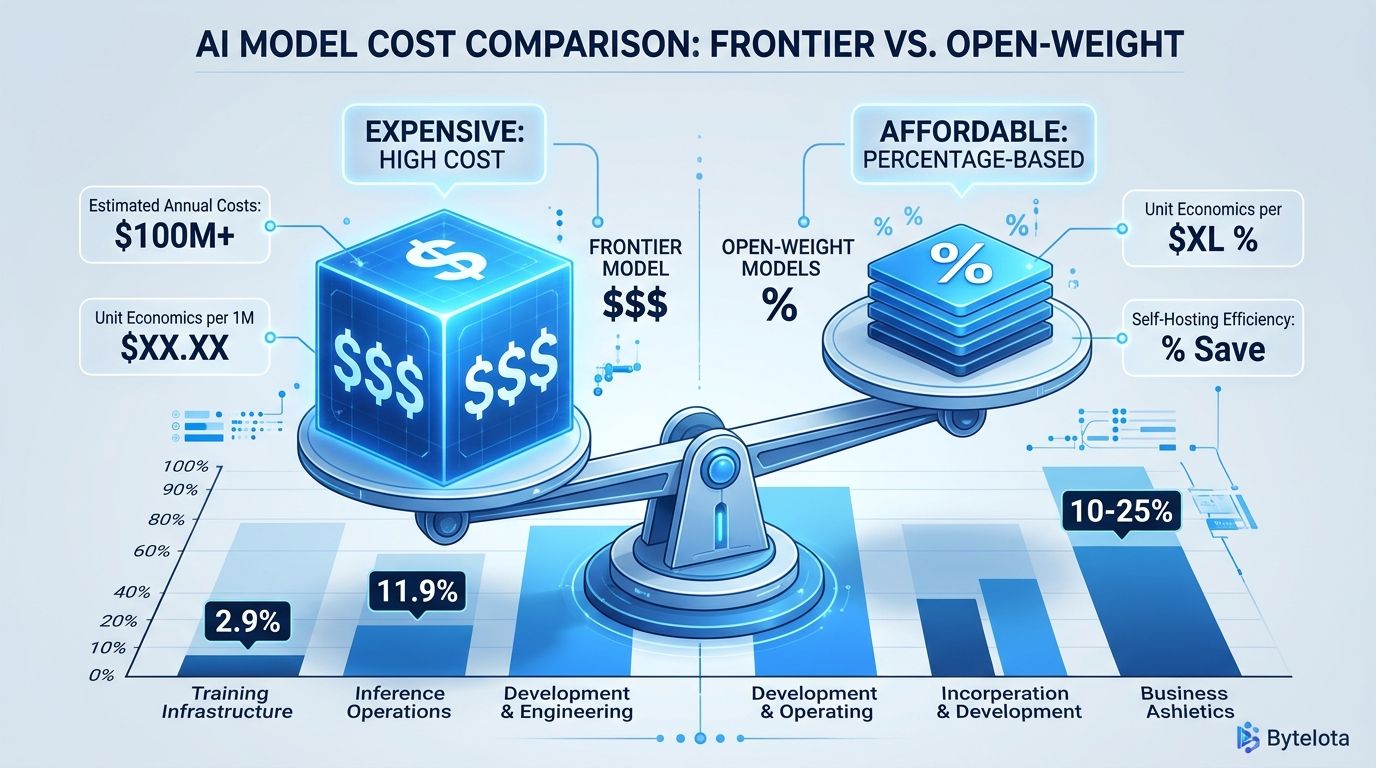
On pricing, Krishna is broadly accurate — and if anything, conservative. An independent benchmark on Dev.to compared nine models on a standardized 8,000-input, 500-output-token job at current list prices. DeepSeek V4.1-Flash comes in at 2.9% of Claude Opus 5’s cost. DeepSeek V4-Pro lands at 11.9%. IBM’s stated 10–25% range sits comfortably inside those real-world figures.
However, the cost advantage belongs to small models, not open-weight models specifically. Claude Haiku 5.5 and GPT-6 Luna — both closed and frontier-adjacent — are actually cheaper per token than many hosted open-weight equivalents. Consequently, the savings Krishna describes come from not running the largest model on every request, not from open-weight status as a principle. That distinction matters when you’re designing your routing strategy.
The Quality Check: The 90% Claim Has No Benchmark #
The 90% effectiveness claim has no publicly cited benchmark behind it. IBM never named the evaluation suite behind its 70/50/90 scale. In practice, on MMLU, the actual gap between top open-weight models and frontier today is roughly 3–6 percentage points. For most developers, that gap is meaningful only on specific hard tasks. On structured extraction, classification, summarization, and code generation within known codebases, the gap effectively disappears.
Nevertheless, Krishna isn’t wrong — he’s generalizing. “90% as good” holds for a wide class of enterprise tasks: routine email summarization, contract review, message classification. It does not hold for multi-step logical inference, complex code synthesis, or nuanced judgment under ambiguity. Those are exactly the workloads where frontier models continue to justify their price. In short, the 90% is accurate for the easy half of the work.
The Gotcha IBM Skips: Engineering Overhead #
Krishna acknowledged that the biggest obstacle to on-prem deployment isn’t hardware — it’s engineering talent. Kernel engineers, GPU clustering architects, and caching specialists remain scarce and expensive. Notably, he mentioned this only in passing. It deserves more weight.
Moreover, the economics of self-hosting require real scale. According to Vector Labs’ production analysis, a two-node H100 cluster runs $140,000–$245,000 annually. At moderate API usage (500M input / 100M output tokens per month), frontier APIs cost roughly $27,000 a year. Therefore, self-hosting only beats that threshold around 8–12 billion input tokens per month. Below that volume, you’re paying more, not less, once engineering hours factor in.
When Open-Weight Models Actually Win #
Meanwhile, Microsoft quietly validated the trend. Microsoft Decision-1 — the company’s new agent routing model — is built on Alibaba’s Qwen3.5-9B, not any OpenAI product. Even Microsoft chose an open-weight foundation for a production release. Additionally, open-weight models win on latency: local inference for Llama 3.3 70B hits 700+ tokens per second, while frontier APIs add 100–400ms of network round-trip regardless of model quality. For real-time agent workflows, that overhead compounds quickly.
Furthermore, the 72% figure buried in Krishna’s remarks may be the most interesting number: open-weight models already handle 72% of AI tokens market-wide. As ByteIota’s coverage of Kimi K3.1 Pro’s near-frontier performance shows, the gap is closing fast. Krishna isn’t predicting a revolution — he’s describing a transition already underway.
Three Questions to Decide for Your Stack #
Ultimately, whether IBM’s thesis applies to your team comes down to three practical questions:
- Volume: Do you exceed 8–12 billion input tokens per month? If not, frontier APIs likely win on total cost when engineering overhead is included.
- Task type: Is the work structured — extraction, classification, summarization, templated code? Open-weight models perform at parity. Is it open-ended reasoning or complex synthesis? Frontier still holds the edge.
- Data sovereignty: Do compliance requirements prevent sending data to third-party APIs? On-prem wins that argument regardless of cost.
The Verdict #
Krishna is largely right, but incomplete. The cost numbers check out. The 90% quality claim is directionally accurate for routine workloads — yet it is unsupported by any cited benchmark, and it quietly excludes the tasks where frontier models still justify their price. The engineering overhead is the clause he buries. IBM benefits from enterprises adopting on-prem AI — that’s what Spyre is for — but the underlying data doesn’t require IBM’s spin to hold up. The market was already moving this direction before he said it.
Don’t take IBM’s word for it. Run the math on your own token volume, identify your task types, and benchmark open-weight candidates against your actual workload. That’s the only 90% that matters.