Calling it the “intelligence foundation” of its platform, Casepoint today launched Casepoint IQ, a suite of tools within a single AI framework that spans the company’s products for e-discovery, legal holds, FOIA and investigations.
The company says that Casepoint IQ pulls together all of its AI capabilities – including new semi- and fully autonomous agents, its generative AI assistants, its pre-existing CaseAssist machine learning and predictive coding, and its Model Context Protocol (MCP) server – under one framework with a shared governance and audit layer.
Alongside the framework, the company is introducing its first two AI agents to customers, one for relevance determination and one for issue coding, with more to come as the product is further developed.
Casepoint IQ is live now in the platform and generally available to all customers. The two agents are currently in what Casepoint describes as an alpha release, in use by a handful of customers, with a beta version due out before the year ends.
An interesting aspect of today’s announcement is how the company is melding its new generative AI tools with the technology-assisted review (TAR) tools that have been part of the platform for at least a decade.
Rather than introduce Casepoint IQ as a separate product alongside those existing tools, the company is treating agentic AI, assistive AI and its older predictive coding as points on a single continuum, with the same permissions, logging and human-approval controls applied across the board.
And both the relevance-determination and issue-coding agents carry forward the sampling, precision-and-recall measurement and QA validation conventions that would be familiar to anyone who has previously used TAR for review.
“We’ve always believed intelligence should be built at the platform level, not confined to individual products,” said Vishal Rajpara, Casepoint’s founder and chief technology officer, in a statement. “Casepoint IQ offers the foundation where an innovation developed for one workflow can create value across the entire platform.”
From Agents to TAR
In a press briefing Monday, CEO Paul Colangelo described Casepoint IQ as a single framework that extends across four sets of capabilities:
IQ Agents. Colangelo described these agents as “purpose-built” to move legal, government and compliance work “from analysis to determination.” While the agents currently operate on a semi-autonomous level requiring human-in-the-loop oversight, the company plans to introduce additional levels that will allow the agents to operate with greater autonomy.
IQ Assist. This is Casepoint’s embedded gen AI. It is designed to help users find, understand and classify information through natural language search, summarization and workflow-specific assistance. During the media briefing, Chief Product Officer Pete Feinberg said there are now more than a dozen assistive AI tools across Casepoint’s e-discovery, FOIA, legal hold and file store applications.
CaseAssist. This is Casepoint’s machine learning and predictive coding technology, which Colangelo said has been in the platform for more than a decade. It prioritizes documents for relevance, helps identify potential privilege, and produces precision and recall reporting that Colangelo said helps teams validate results and support defensibility.
Casepoint MCP Server. Colangelo described this as a standardized connection that links approved external AI models and agents to the Casepoint platform, with authentication, permissions and audit logging applied to every transaction and no custom integration required.
Benefits for Practitioners
For practitioners, Casepoint says this new framework offers three practical benefits. First, it enables customers to add agentic capabilities within the platform they already use, without having to adopt separate tools, credentials or governance models. As new agents are developed, customers can add them to the same platform.
That platform is authorized under FedRAMP High and DOD Impact Level 5 and 6 standards. For customers, that means that adding new agentic workflows will not tigger a new vendor risk assessment, a separate security review, or new credentials to manage, Casepoint says.
Second, the company says that every AI-driven decision within the framework is permissions-aware, logged and traceable to the source, and that human-in-the-loop governance applies across the board, ensuring that every AI-driven decision is transparent and defensible.
In the briefing, Rajpara said that an agent “is never going to create the document, redact the document, produce a document to [the] other side,” and that human-led decision-making is built into the foundation.
Third, the company says organizations that prefer to use their own approved AI models or agents can connect them through the MCP server rather than being limited to the models Casepoint provides.
“Our customers have been clear: they want AI to take on more of the heavy-lifting work, but they still want visibility into, and control over how decisions are made, and have the final approvals,” Colangelo said in the release.
The First Two Agents
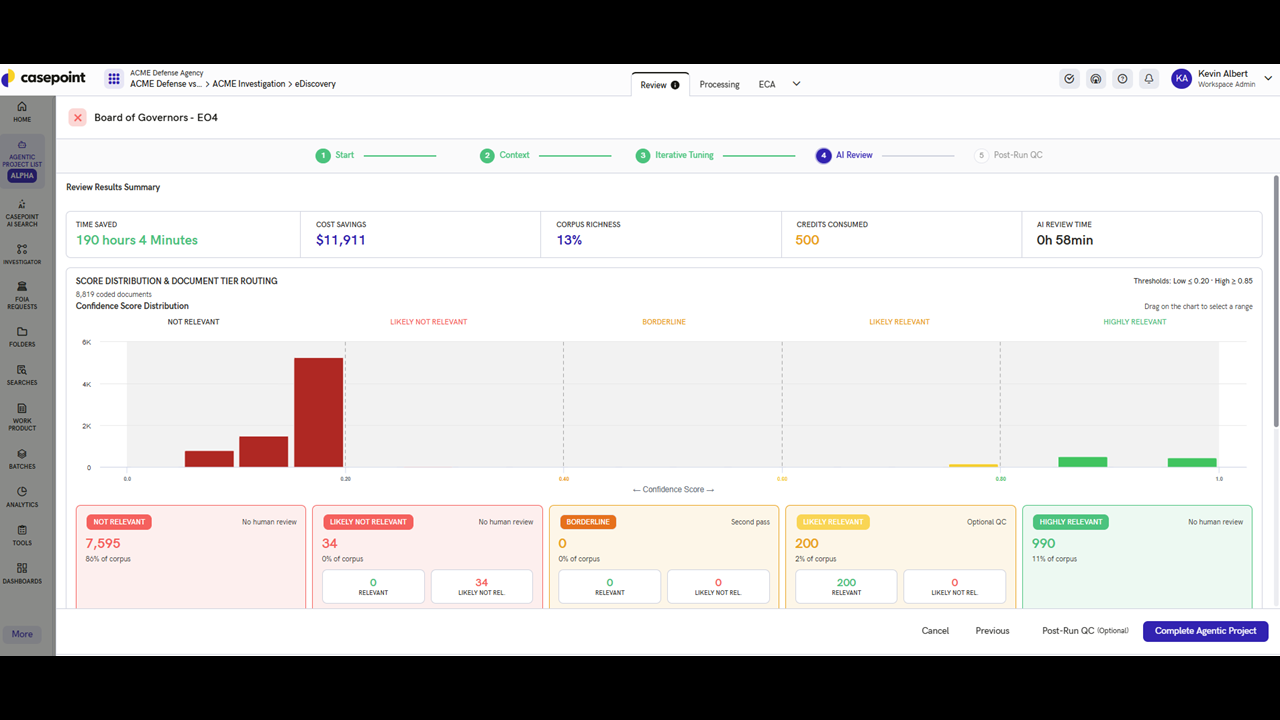
In the media briefing, Feinberg provided a demonstration of the relevance determination agent.
In the current alpha version, a user can run only a single agent per project. The beta version, coming later this year, will allow multiple agents to be chained into a workflow. An agentic workflow, for example, might proceed from relevance determination, then issue coding, then privilege review, then PII identification, and then redaction.
For the demo, Feinberg used a synthetic data set of roughly 10,000 documents that Casepoint built so it would have a gold standard to measure against, rather than relying on the Enron or Jeb Bush data sets that are often used for such purposes. Based on the demo, the agent runs through five stages:
- Setting the context. Rather than requiring users to write a prompt from scratch, the setup offers an “AI fast track” in which the user can load case documents. Feinberg added the complaint, the requests for production and a review protocol. Based on those documents, the system then extracted a case overview, key players, key terminology and a relevance definition, which the user can review and edit. Alternatively, a user can reuse the context from a prior project.
- Choosing an autonomy level. During setup, the user selects how much autonomy the agent will have. The alpha launches at what Casepoint calls level two, in which the LLM proposes what it will do and the user reviews and confirms before execution. As it develops additional agents, the company will set the permitted autonomy on an agent-by-agent basis.
- Iterative tuning. The agent selects a sample of 50 documents from the review set, predicts whether each is relevant, and writes a rationale for each prediction. A human then reviews each of the 50 documents. If the human’s decisions disagree with the AI’s, the system proposes refinements to the context based on the human’s feedback. Feinberg said the software enforces minimum quality thresholds of 90% recall and 80% precision. If the sample does not meet those thresholds, the user must adjust the context and run another 50-document sample.
- AI review. Once the thresholds are met, the agent reviews the full set. For the set of 10,000 documents used in the demo, Feinberg said it took about an hour, and a results screen reported time saved (190 hours, 4 minutes), estimated cost savings ($11,911, calculated at a review rate of 50 documents per hour and $50 per hour), corpus richness (13%) and AI review time (58 minutes). The agent assigns each document a predicted likelihood of relevance and routes documents into tiers for not relevant, likely not relevant, borderline, likely relevant and highly relevant. Feinberg said this scoring was intentionally carried over from TAR. “We’ve kind of blurred the lines, if you will, between our history with machine learning and TAR, where the world has gotten used to and comfortable with the idea of this kind of 0 to 1 score by document and these plotted histograms,” he said.
- Post-run QC. The final stage is a validation step in which the software draws a random sample and a human reviews each one against the agent’s decision. The system then calculates final recall, precision, elusion and F1 scores, with confidence intervals, that Feinberg said can be reported to opposing counsel or the court.
Pricing and Roadmap
During the briefing, a reporter asked Feinberg about a “credits consumed” figure on one of the demo screens. He said the agent currently displays raw token consumption and that the beta will convert tokens to credits.
Ultimately, Casepoint intends to offer unmetered use to its largest customers and, for smaller subscriptions, an allocated number of credits with metering and overage charges, “not terribly dissimilar” to what competitors are doing.
Asked whether Casepoint plans to add more agents or mainly to chain the existing two, Feinberg said “both.” He said that eight other agents are in active development, including agents to identify privileged material, find PII and redact documents, and that the company is “not done” developing assistive AI tools.
Rajpara told reporters to “assume that there is a farm of agents on the way.”
Casepoint said organizations can request a demonstration through its website, and that more information is available at casepoint.com/casepoint-iq.