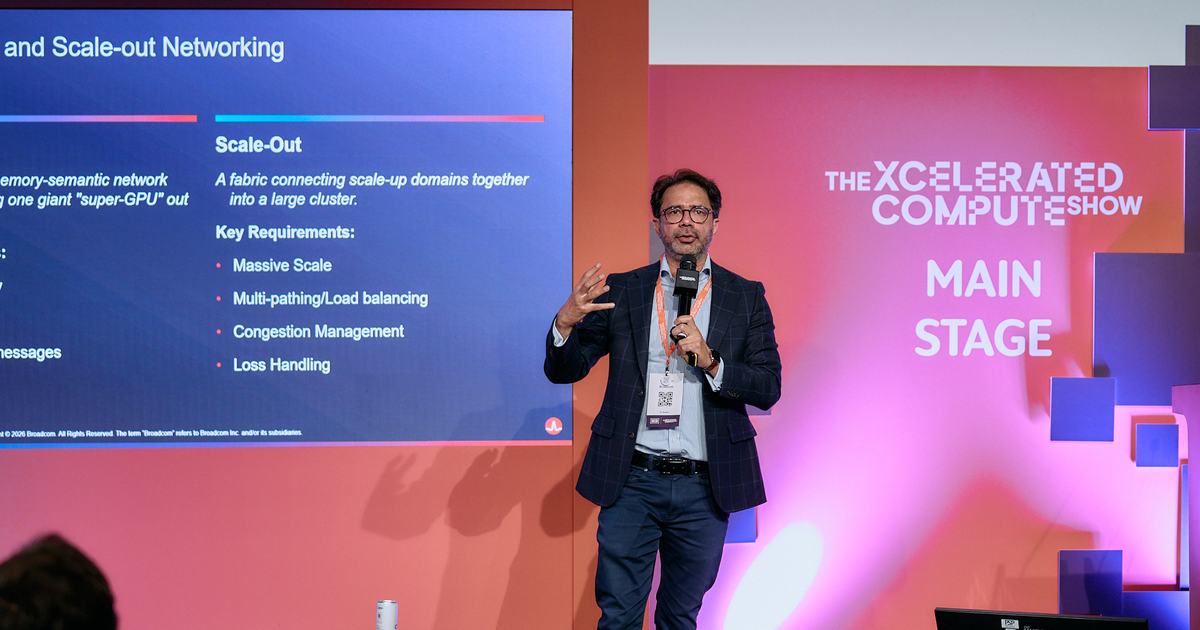
LONDON – Broadcom’s chief European architect claimed the firm stands ahead of Nvidia and others in solving AI bottlenecks in scale-out networks, with Ethernet in particular its USP in the network market.
In a presentation at the Xcelerated Compute show, Kamran Naqvi, Broadcom’s chief network architect for EMEA, espoused the firm’s market proposition by touting its Thor Ultra network interface card (NIC) as “the world's first 800 gigabit Ethernet NIC.”
Naqvi acknowledged Nvidia's rival offering, the ConnectX-8 SuperNIC, in that it “only supports 800G on InfiniBand. For Ethernet, it has to be four times 400G.”
“I'm sure Nvidia will catch up. They're a fantastic company. At the moment, we have a lead. Why not brag about it?” Naqvi teased.
Broadcom makes the MRC case #
With Ethernet playing a key role in AI scale-out, Broadcom joins a chorus including AMD and OpenAI in backing the long-time protocol. In the latest issue of SDxCentral Magazine, execs like AMD's networking chief made the case for Ethernet while a key OpenAI architect behind the Multipath Reliable Connection (MRC) laid out Ethernet as crucial to OpenAI’s AI-centric networking transport protocol, on which Broadcom lent a developing hand.
In his Xcelerated Compute presentation, Naqvi referred to MRC as an industry standard for scale-up networking, alongside the more established Ultra Ethernet Transport (UET) specification. Naqvi touted Broadcom as a founding member of both through a belief “that innovation happens when industry aligns on interoperable open standards.”
The exec pointed to the packet multipath capabilities of MRC and UET, with packet spray workflows leading to “very efficient” load balancing on networks handling AI workloads.
Scale-up and scale-out with Broadcom #
On the product side, Naqvi hawked the Tomahawk Ultra Ethernet switch chip as “very suited” to AI scale-up environments, being designed from the ground up for AI scale-up with its “ultra” low latency. He also highlighted that the Tomahawk 6 chip was being used by “many clients” for scale-up purposes.
While not mentioning specific deployments, Naqvi cited an unnamed German customer currently running a proof of concept with a Broadcom partner that is building infrastructure with 28,000 GPUs across four clusters as part of its scale-out efforts.
Broadcom big on optics #
During his time on stage, Naqvi expressed that optics are set to play an integral role in future networks. While touting the next-gen technology, he recommended that copper be used where possible in the network, echoing Nvidia CEO Jensen Huang’s prediction that copper will continue to dominate for “several years.”
“It's reliable. It’s cheap. It has a negative power,” Naqvi said.
Broadcom continues to bank big on optics, with Naqvi highlighting Meta’s use of its co-packaged optics (CPO), which reportedly achieved one million hours of flap-free operation in a 2025 deployment.
“This year they are saying now they have been able to achieve 50 million hours of flap-free operation with Broadcom CPO technology. So it's very reliable. It saves you up to 65% to 70% of power utilization."
This helped in some part to solve Meta's bottleneck issue when it came to AI workloads, where GPUs sit idle, "waiting for networking to complete its job," as Naqvi put it.
"You build this billion-dollar infrastructure, and networking is only the 10% of the cost of building an AI infrastructure. But if your network is not done right, your network becomes the bottleneck, and it costs you a lot more."