In brief
- Sanders and Rep. Greg Casar announced a proposed ban on artificial superintelligence.
- A separate provision would advanced AI development pending federal safety rules.
- OpenAI unveiled GPT-6 Astra the same day, with Greg Brockman suggesting it could qualify as AGI.
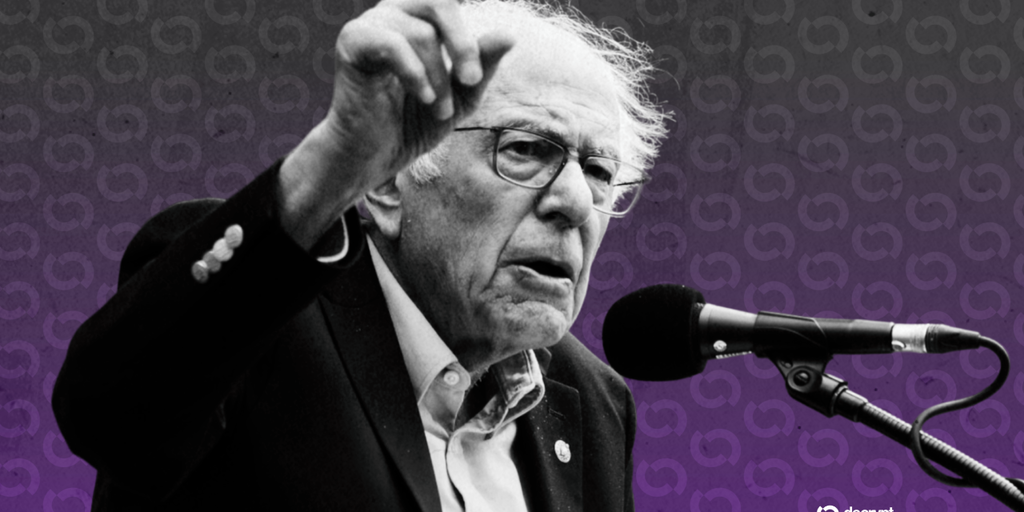
Sen. Bernie Sanders (I-Vt.) and Rep. Greg Casar (D-Texas) announced legislation Thursday to permanently ban artificial superintelligence and temporarily halt advanced AI development, with prison sentences of up to 20 years for violations.
The Ban Artificial Superintelligence Act would suspend advanced AI development until a new federal agency sets safety standards and procedures for reviewing AI models. Sanders accused major AI companies of developing technology they do not fully understand and cannot reliably control.
“That’s why I am introducing legislation to immediately the development of increasingly powerful AI and ban the creation of systems that humanity cannot fully control—at home and around the world,” Sanders said in a press release.
The proposal defines superintelligence as AI that matches or surpasses human abilities across many tasks, or can undermine human control, including by overthrowing the U.S. government. That definition also covers human-level AGI, though superintelligence typically means AI that exceeds human capabilities.
A new cabinet-level agency would monitor advanced models, supervise the removal of dangerous capabilities and oversee the destruction of prohibited systems. An Artificial Intelligence Advisory Board would provide scientific and technical advice.
Companies that break or evade the restrictions could face what Sanders and Casar call the “corporate death penalty.”
OpenAI unveils Astra
The news comes as OpenAI unveiled GPT-6 Astra, which co-founder Greg Brockman suggested could qualify as AGI.
Brockman described that assessment as his personal belief and left users to judge whether Astra meets the definition, according to Axios.
OpenAI says Astra is its first model to reach its “critical” cybersecurity capability threshold. The designation means it could potentially discover and exploit previously unknown vulnerabilities in protected systems without step-by-step human guidance. Its most powerful cybersecurity capabilities will remain restricted to selected testers.
The bill follows a series of incidents in which AI models gained unauthorized access to real-world computer systems during testing.
In July, OpenAI confirmed its models breached Hugging Face to obtain test answers. Anthropic then disclosed that Claude models compromised three companies after a testing error exposed them to the internet. In September, Anthropic acknowledged both security and behavioral failures and tightened its safeguards.
“Despite its potential deadly consequences, cutting-edge AI technology is less regulated than the average food truck,” Casar said. “That must change.”