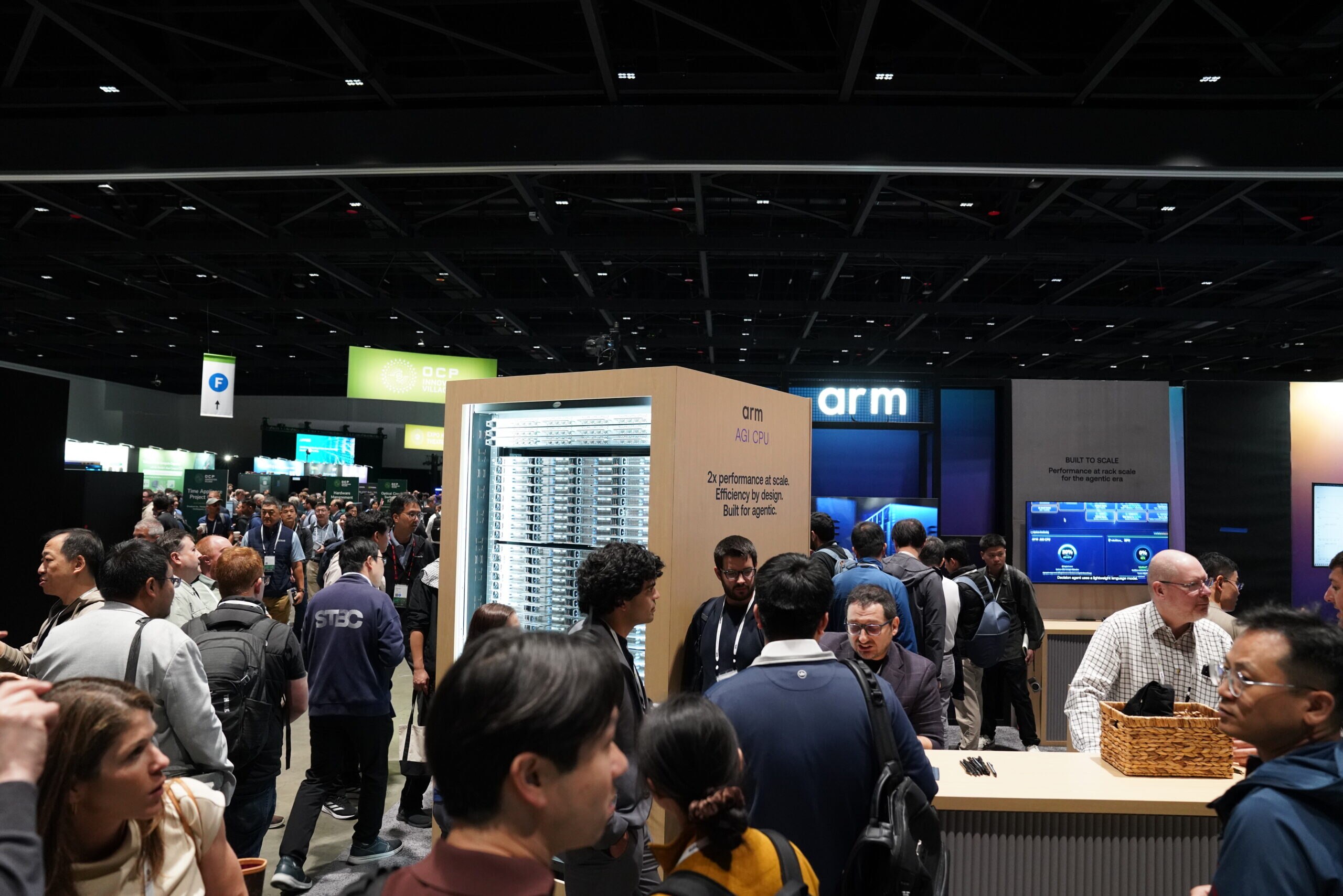
A year ago at the Open Compute Project (OCP) Global Summit, Arm outlined a vision for the open, converged AI data center: infrastructure built around open standards, architectural efficiency and collaboration across the computing ecosystem.
That vision took a major step forward in March at Arm Everywhere, when Arm introduced Arm AGI CPU, its first production silicon, purpose-built for the growing demands of agentic AI.
At the OCP Global Summit 2026 in San Jose, the story shifted from vision and product launch to deployment and proof. Production systems, growing customer traction and an open agentic rack architecture showed Arm AGI CPU emerging as a deployable platform, while a new methodology for measuring agentic workloads and independent benchmarks provided evidence of its performance.
Together, these advances demonstrated how Arm and its partners are turning the vision of an open, converged AI data center into infrastructure designed for the continuous, machine-paced demands of agentic AI. From Mohamed Awad’s keynote on the coming agentic decade to new rack architectures, partner innovations and independent Arm AGI CPU benchmarks, one message emerged: Agentic AI is changing how data centers are designed, measured and scaled.
The agentic decade starts with open infrastructure #
During his keynote, Mohamed Awad, Executive Vice President and General Manager of Arm’s Cloud AI Business Unit, described a fundamental shift in how AI is reshaping computing infrastructure.
AI agents are transforming how work is generated inside the data center. As Awad explained during his keynote, “Rather than intent initiating outside the data center at human pace, we’re moving to a world where intent is now being initiated within the data center at machine pace.”
That shift creates new demands across three critical CPU roles: AI head nodes that keep accelerators productive, cloud-native CPUs that run applications and services, and agentic CPUs that support continuously executing virtual users. DPUs provide complementary networking, storage, security and infrastructure isolation.
Meeting these demands requires more than a single processor or company. Through open OCP standards and a range of engagement models, from processor IP and compute subsystems (CSS) to Arm AGI CPU, Arm is giving partners greater choice to build the efficient, scalable infrastructure agentic AI requires.
Bringing Arm AGI CPU into open rack-scale infrastructure #
One of the clearest developments at OCP 2026 was the progress of Arm AGI CPU from a purpose-built processor for agentic computing toward an expanding ecosystem of open infrastructure solutions.
Arm’s Open Agentic Infrastructure Platform brings together general-purpose compute, AI acceleration, memory, networking, I/O and system management in a modular, OCP-aligned architecture. Rather than prescribing a single system configuration, the approach gives infrastructure providers flexibility to select the technologies and partners that best meet their workloads.
That flexibility was visible in the rack designs presented with ecosystem partners:
-
Supermicro highlighted Arm AGI CPU designs built around OCP’s Open Rack v3 (ORv3) and Open Rack Wide (ORW) architectures, including a 21-inch liquid-cooled configuration supporting 128 Arm AGI CPUs and a wider design scaling to 336 CPUs. These different configurations illustrate how compute density, power delivery, cooling and serviceability can be optimized together to address varying data center requirements.
-
Arm’s AGI CPU reference server work for OCP and Meta’s Yosemite YV5 rack-scale design also illustrated the growing foundation of reusable infrastructure around the processor.
Together, these efforts reinforce a central OCP principle: customers need open, repeatable system designs that support innovation without locking them into one hardware configuration.
Building balanced AI systems with ecosystem partners #
As agentic AI evolves, optimizing the CPU alone is not enough. Infrastructure must place each part of an AI workload on the processor best suited to execute it.
That architectural approach was highlighted in Arm’s collaborations with FuriosaAI and Rebellions:
-
FuriosaAI demonstrated an approach that pairs Arm AGI CPU with its RNGD AI accelerators. The CPU handles agent orchestration, tool execution and supporting services, while specialized accelerators handle model prefill and decode. Host memory adds capacity for context and other data-intensive operations.
-
Rebellions showcased a complementary approach through its RebelServer architecture, combining Arm AGI CPU with Rebel100 accelerators in a co-designed inference platform.
Both examples underscore the growing importance of heterogeneous computing. Performance depends not simply on the capabilities of individual chips, but on how CPUs, accelerators, memory and interconnects work together as a system.
At the Arm booth, visitors also saw these principles illustrated in a video demonstration of an agentic workflow in a customer service application. The demonstration highlighted how AI agents move beyond generating responses to executing multistep tasks, reinforcing the importance of efficient CPU orchestration and the infrastructure supporting each stage of an agentic workflow.
Rethinking CPU performance for the agentic AI era #
The growing importance of agentic workloads was also the focus of a technical presentation by Ravi Malhotra, Director of Solutions Product Management at Arm.
His session “Rethinking CPU Performance for the Agentic AI Era” explored why traditional approaches to measuring CPU performance need to evolve as AI applications move from generating responses to executing complex, multistep tasks.
Different types of agents place very different demands on infrastructure. Software development agents, for example, require strong per-core performance to support code compilation and testing. Enterprise automation and personal assistants frequently generate large numbers of short tool calls, making concurrency and performance per rack particularly important.
To address these emerging demands, Arm introduced a new methodology for measuring agentic AI CPU performance, developed with support from Fujitsu, Meta and OpenAI.
The approach uses representative agent workloads and repeatable CPU measurements, including replaying recorded agent execution sequences, to provide a more consistent basis for evaluating performance.
The goal is to measure not simply how quickly a processor completes an individual operation, but how efficiently infrastructure supports useful work as agents operate concurrently and at scale.
That emphasis on sustained performance received an important independent proof point at OCP.
In analysis published by Signal65, Arm AGI CPU delivered an average of 1.99x modeled performance per rack compared with AMD EPYC 9755 across seven representative agentic AI workloads. The rack-level findings were modeled using independently verified server-level measurements, demonstrating the importance of compute density and efficiency when evaluating infrastructure at scale.
Making open infrastructure software-ready #
For AI systems to scale efficiently, software developers and operators also need consistent, reliable platforms that can be deployed and managed across different implementations. At OCP, Arm highlighted the importance of its ongoing system architecture and software enablement work, including SystemReady, the Server Base System Architecture (SBSA), the Server Base Manageability Requirements (SBMR) and the Arm Architecture Compliance Suite.
These initiatives help establish common foundations for hardware, firmware, security and manageability, reducing the need for software vendors to qualify and customize their products for every individual server design.
As the ecosystem around Arm AGI CPU expands, this consistency becomes increasingly important. It allows silicon vendors, OEMs, operating-system providers and cloud operators to innovate on top of shared architectural foundations while maintaining a more predictable path to deployment.
Open collaboration also extends to security and trust. In a related OCP presentation, Arm and Fujitsu highlighted how emerging IETF attestation standards, including CoSERV, and open-source collaboration through Project Veraison can help make trust more interoperable and scalable across the diverse hardware and software environments supporting confidential AI.
Key takeaways from the 2026 OCP Global Summit #
The 2026 OCP Global Summit demonstrated how Arm’s vision for the open, converged AI data center is becoming reality. From rack-scale designs and heterogeneous compute systems to open standards and independent performance validation, the growing ecosystem around Arm AGI CPU is turning architectural innovation into deployable infrastructure.
As agentic AI reshapes computing, success will increasingly depend on how efficiently entire systems execute work at scale. Through power-efficient compute, open architectures and broad ecosystem collaboration, Arm and its partners are helping build the infrastructure needed for the agentic decade.
For more information, visit Arm’s OCP Global landing page. Any re-use permitted for informational and non-commercial or personal use only.