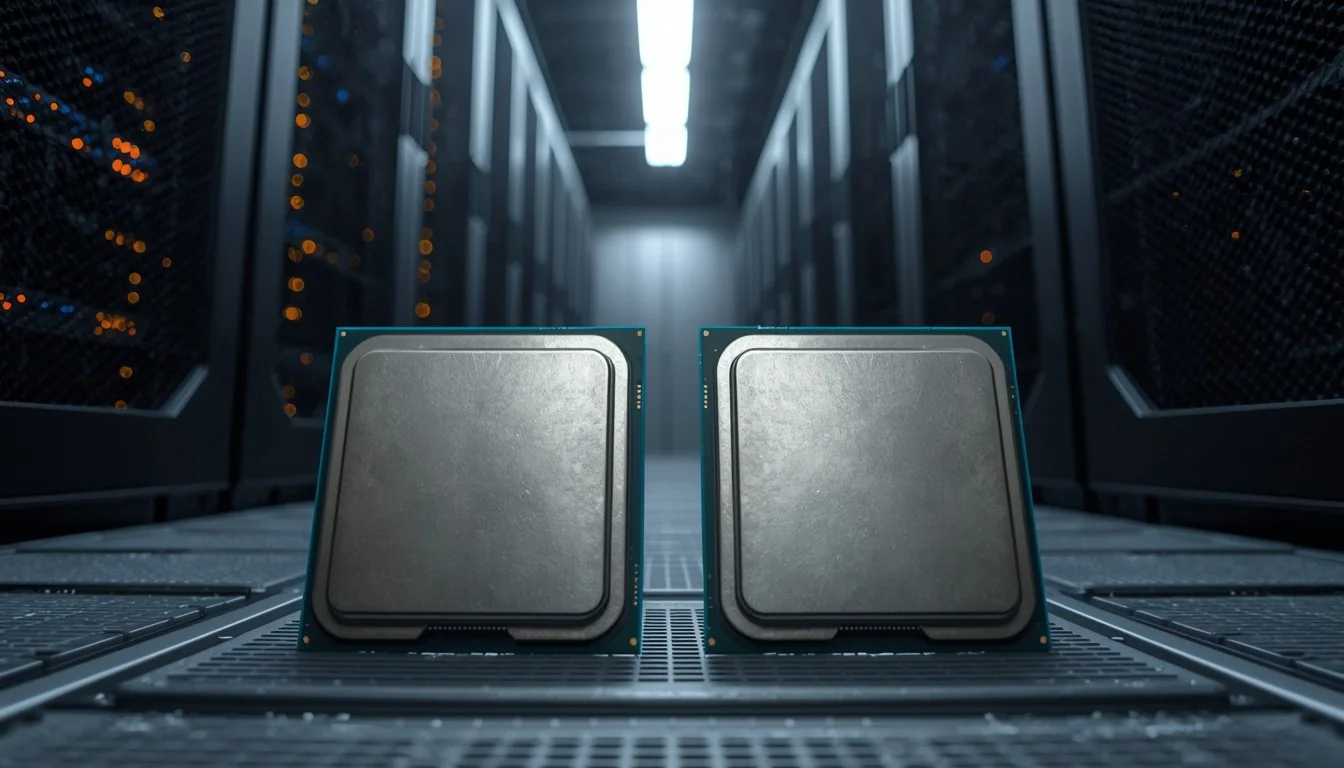
Arm says its data center chip can do twice the work of AMD’s best server processor, and it has an independent lab’s numbers to back up the claim. On October 13, 2026, Arm published results from a new study showing its Arm AGI CPU platform delivering an average of 1.99x the modeled performance per rack compared with AMD’s flagship EPYC 9755 processor across seven workloads built to mimic agentic AI tasks. The numbers come from Signal65, an outside benchmarking firm, and were presented publicly at the OCP Global Summit 2026 the following week.
The timing matters. Cloud providers and chipmakers are now competing less on raw clock speed and more on how much completed AI agent work a data center rack can produce per watt of power. Arm’s pitch, delivered through a chip platform it calls the AGI CPU, is that Arm’s Neoverse-based architecture handles that specific job better than x86 processors built for general-purpose computing. AMD has not issued a detailed rebuttal to the Signal65 findings as of October 20, 2026.
Don't miss new tech stories on Google
Add Shattered once in the Google app and our stories show up in your news suggestions.
What Arm Just Announced About Its AGI CPU #
Arm’s announcement, published on its newsroom site on October 13, 2026, frames the Arm AGI CPU not as a new retail product with a model number and a price tag, but as a data center CPU platform and reference design aimed squarely at agentic AI workloads. That distinction matters for anyone trying to shop for one: there is no public SKU list, no confirmed OEM partners, and no announced launch date for commercial availability. Arm is positioning this as a methodology and architecture story first, a product story second.
The core claim is that agentic AI software, meaning AI systems that call tools, write and execute code, search databases, and coordinate multi-step tasks, stresses a CPU differently than a single large language model inference pass does. Arm argues the industry has been measuring the wrong thing: raw chip throughput on isolated benchmarks, rather than how much actual agent work a fully loaded, power-constrained rack can finish in a given period. That reframing is the spine of the entire Arm AGI CPU argument, and it is why the company commissioned Signal65 to build a rack-level model instead of just running a single-chip benchmark suite.
Arm also used the moment to tie the announcement to a broader string of Neoverse-based server wins over the past two years, arguing that agentic AI gives Arm’s power-efficiency advantage a second, newly relevant selling point beyond the mobile and hyperscaler-custom-silicon markets where it has already made gains.
Inside the Signal65 Benchmark: Seven Workloads, One Rack #
Signal65, the firm Arm hired to run the comparison, built its test around seven workloads chosen to represent three categories of agentic AI infrastructure demand: tooling, agentic workflows, and reasoning and planning support. The seven tests were MySQL, NGINX, Terminal-Bench 2, SWE-bench replay, Milvus vector search, vLLM CPU overhead, and fastText. That spread covers database operations, web serving, autonomous coding and task execution, vector retrieval for AI memory, and the CPU-side overhead that model-serving frameworks generate even when the actual inference runs on a GPU.
Signal65 says it ran identical benchmark scripts on both the Arm AGI CPU and AMD EPYC 9755 platforms to get server-level measurements, then modeled how many of each server could fit inside a rack under a shared power budget. That two-step method, chip-level measurement followed by rack-level modeling, is what produced the headline 1.99x figure. It is worth repeating that this is a modeled estimate built from real chip benchmarks, not a literal physical rack-vs-rack test run side by side in a data center.
| Workload | Category | Per-chip result (Arm AGI CPU vs EPYC 9755) | Modeled rack-level result |
|---|---|---|---|
| Terminal-Bench 2 | Agentic workflow | ~9% faster | 1.93x |
| SWE-bench replay | Agentic workflow | ~13% faster | ~2.00x tasks per rack |
| fastText | Reasoning/planning support | ~97% faster | Highest of the seven tests |
| Milvus vector search | Reasoning/planning support | ~5% behind | Still favorable on rack density |
| MySQL | Tooling | ~12% behind | Lowest of the seven tests |
| NGINX | Tooling | Not separately broken out | Included in tooling average of 1.7x |
| vLLM CPU overhead | Reasoning/planning support | Not separately broken out | Included in category average of 2.2x |
Read that table carefully and a more nuanced picture appears than the “2x everywhere” headline suggests. Arm’s chip actually lost two of the seven individual per-chip comparisons, trailing AMD on MySQL by roughly 12% and on Milvus vector search by roughly 5%. The overall rack-level advantage comes from Arm winning the other five tests, in some cases by very wide margins, combined with the fact that Arm AGI CPU servers draw meaningfully less power, letting more of them fit into the same power envelope.
How the 1.99x Rack-Level Number Was Calculated #
The rack math is the part of this story that determines whether Arm’s claim is meaningful or misleading, so it is worth walking through directly. Signal65’s model used a 24 kW rack as the shared constraint for both platforms. Under that power budget, the model allowed up to 23 Arm AGI CPU servers into the rack. AMD’s EPYC 9755 configuration, rated at roughly 1,700 watts per two-socket server versus the Arm platform’s reported 950 to 1,050 watts per two-socket server, fit fewer units into the same 24 kW ceiling.
That gap, nearly 40% lower rated power per server, is really the engine driving the headline number. Even on workloads where the individual Arm chip was slower than the EPYC 9755, like MySQL and Milvus, a rack full of lower-power Arm servers can still edge out a rack of fewer, hungrier AMD servers once density is factored in. Category averages landed at 1.7x for tooling, 2.0x for agentic workflows, and 2.2x for reasoning and planning support, producing the blended 1.99x figure Arm promoted.
Arm also reported separate numbers for agent-runtime responsiveness rather than throughput: 45% faster cold starts, 27% faster warm starts, and 41% faster performance under a worst-case scenario involving fourfold oversubscription of compute resources. Those figures speak to how quickly a CPU can spin up an isolated environment for an AI agent to execute code in, a increasingly common pattern in agentic AI deployment where every tool call or code execution request may need its own sandboxed environment.
Arm AGI CPU vs AMD EPYC 9755: What Each Platform Actually Is #
AMD’s EPYC 9755 is part of the company’s 5th generation EPYC “Turin” lineup, a 128-core x86 processor that has been one of the default choices for general-purpose and AI-support data center computing throughout 2026. It follows the EPYC Venice generation AMD benchmarked against Xeon and Nvidia’s own CPU earlier this year, and it now finds itself on the other side of a vendor-commissioned comparison. It was the specific chip Arm chose as its benchmark target, likely because it represents one of AMD’s highest core-count, most broadly deployed server parts rather than a niche or outdated model.
The Arm AGI CPU, by contrast, is described in Arm’s own materials as a Neoverse-based data center CPU platform purpose-built around agentic AI support work, rather than a chip meant to replace x86 servers across every workload a data center runs. Arm has not published a full specification sheet alongside the benchmark release, meaning details like exact core count, clock speeds, cache size, and memory bandwidth for the AGI CPU were not made public alongside the Signal65 study. That gap makes it hard to fully independently audit the comparison, and it is a detail every reader evaluating this story should keep in mind.
What is public is the power delta: Arm’s platform runs at roughly 950 to 1,050 watts per two-socket server against AMD’s roughly 1,700 watts, a gap large enough on its own to explain much of the rack-density advantage even before accounting for the chip-level performance wins on five of the seven tested workloads.
Power Efficiency: The Real Story Behind the Rack Math #
Every major cloud operator building out AI infrastructure in 2026 is working against the same two constraints: available electrical power and the cooling capacity to dissipate the heat that power generates. Site selection for new data centers increasingly hinges on access to grid capacity rather than land or labor costs, and operators have been willing to pay premiums for lower-power silicon that lets them pack more compute into an already-approved power allocation.
That backdrop is exactly why Arm chose to frame its result around a fixed-power rack model rather than a simple chip-for-chip speed comparison, a framing similar to the one AMD used when it debuted its Helios GPU rack and argued against CPU-only claims for AI infrastructure. A processor that is slightly slower per chip but draws 40% less power can still win on the metric that actually constrains a data center operator’s real-world capacity: completed work per rack, per megawatt, per month. Futurum Group’s analysis of the Signal65 study echoed this framing, describing the result as evidence that rack-scale density and efficiency, not isolated chip benchmarks, should be the metric AI infrastructure buyers prioritize going forward.
TechRadar Pro’s coverage of the same study struck a more cautious tone, noting that Signal65 measured processor performance first and then estimated rack-level performance under a chosen set of power assumptions, and cautioning that the headline advantage depends heavily on the specific workloads, power budget, and server configurations selected for the test. That is a fair caveat: change the rack’s power ceiling, swap in a different AMD EPYC configuration, or pick a different set of seven workloads, and the ratio would almost certainly move.
Agentic AI Workloads: Why Old CPU Benchmarks Don’t Apply Anymore #
For most of the last decade, data center CPU comparisons centered on metrics like SPEC rate scores, memory bandwidth, and raw core counts, because the dominant workloads were databases, web serving, and virtualized enterprise applications. The rise of large language models shifted attention toward GPU throughput, since the heavy lifting of training and inference happens on accelerators, not CPUs. Agentic AI systems complicate that picture again. When an AI agent writes code, runs it in a sandbox, queries a vector database for context, and calls external tools before producing a final answer, much of that chain runs on the CPU, not the GPU. Model serving frameworks like vLLM also carry CPU-side overhead for request scheduling and orchestration that scales with the number of concurrent agent sessions a system is handling. Arm’s selection of Terminal-Bench 2 and SWE-bench replay, both benchmarks built around autonomous coding agents completing multi-step tasks, reflects a bet that this CPU-bound orchestration layer is about to become a much bigger slice of data center spending than it has been historically.
That bet is not unique to Arm. The entire premise of the Signal65 study, that CPU evaluation needs new benchmarks built around tool use, orchestration, and reasoning support rather than legacy enterprise workloads, is itself a signal that the industry’s measurement standards are catching up to how agentic AI systems actually consume compute.
Where Nvidia Grace, Intel Xeon 6, and the Rest of the Field Fit In #
The Signal65 study did not include Intel’s Xeon 6 line or Nvidia’s Grace CPU in its benchmark set, which narrows the scope of Arm’s claim considerably. Arm’s own comparison is specifically against AMD’s EPYC 9755, not a four-way field test against every major data center CPU vendor. That is an important distinction, because it means this result cannot be read as “Arm beats everyone,” only as “Arm beats this specific AMD chip on these specific tests under this specific power budget.”
Still, the announcement lands inside a broader four-way race for data center CPU relevance in the AI era. Nvidia’s Grace CPU, also Arm-based, has carved out a position tightly coupled to Nvidia’s own GPU platforms, selling the pairing as a unified CPU-GPU system rather than a standalone CPU choice. Intel’s Xeon 6 line, which Intel has previously pushed to 288 cores on its 18A process in a direct swing at AMD’s EPYC lineup, remains the default incumbent for enterprise and cloud deployments that are not yet fully re-architected around agentic AI, leaning on platform compatibility and an enormous existing software and hardware ecosystem. AMD’s EPYC family, including the Turin generation the EPYC 9755 belongs to, continues to compete on raw core counts and broad workload versatility. Arm’s Neoverse-based AGI CPU platform is making its case as the specialist: a chip designed from the ground up around the specific demands of agent orchestration, tool calling, and CPU-side AI support work, at a substantially lower power draw than any of the x86 alternatives.
| Platform | Architecture | Primary positioning | Tested in this Signal65 study? |
|---|---|---|---|
| Arm AGI CPU | Arm Neoverse-based | Specialist for agentic AI orchestration and tool-calling workloads | Yes, the lead platform |
| AMD EPYC 9755 (Turin) | x86, 128-core | High core-count general-purpose and AI-support server CPU | Yes, the comparison baseline |
| Intel Xeon 6 | x86 | Incumbent enterprise and cloud CPU, broad ecosystem compatibility | Not included |
| Nvidia Grace | Arm-based | CPU paired tightly with Nvidia GPU platforms for unified systems | Not included |
OCP Global Summit 2026: The Venue That Shaped the Announcement #
Arm chose to amplify the Signal65 findings at the Open Compute Project’s Global Summit 2026, an industry event where hyperscalers, chipmakers, and infrastructure vendors converge to discuss open hardware standards for data centers. That venue choice is itself a signal of intent: OCP attendees are disproportionately the exact buyers, hyperscale cloud providers and large enterprise data center operators, who make multi-year silicon procurement decisions based on rack-level efficiency math rather than consumer-facing spec sheets.
Arm used its OCP presence to reiterate a broader argument beyond the specific AMD comparison: that the industry’s entire approach to measuring AI infrastructure needs to shift toward counting completed agent tasks per rack rather than isolated inference latency or raw chip throughput. Framing the conversation that way benefits Arm regardless of how any single benchmark shakes out, because it pushes the entire industry toward a metric, power-constrained task completion, where Arm’s traditional efficiency advantage already applies.
Market Reaction and Analyst Commentary #
Industry analysis of the Signal65 study has generally accepted the technical methodology while flagging the same caveat: these are Arm-commissioned, Signal65-executed, independently verified results, not a neutral third-party benchmark campaign run without vendor involvement. Futurum Group’s writeup, published alongside the OCP summit coverage, characterized the outcome as roughly twice the agentic work per rack and emphasized that density and efficiency, not chip-only speed, are becoming the metrics that matter to buyers. The Outpost’s summary of the announcement similarly stressed that the 1.99x figure is an average across seven tests rather than a flat multiplier that applies to any single workload in isolation.
TechRadar Pro’s analysis took a similar position but pushed harder on the limitations, pointing out that the headline 2x figure is sensitive to the specific power budget, workload mix, and server configurations Signal65 selected, and that different assumptions could move the result meaningfully in either direction. Neither outlet characterized the result as proof that Arm’s AGI CPU is now the default choice for data center buyers across all workloads; both framed it as a meaningful data point in a still-developing category of agentic AI-specific CPU benchmarking.
Historical Context: Arm’s Decade-Long Push Into the Data Center #
Arm’s data center ambitions did not start with agentic AI. The company’s Neoverse server architecture has been building momentum for years through its role powering Amazon’s Graviton processors, Nvidia’s Grace CPU line, and a growing list of hyperscaler custom silicon programs, all of which lean on Arm’s licensing model to build power-efficient chips tailored to specific cloud workloads. That momentum shows up in investment flows too: a recent Korean CPU-focused ETF put 75% of its holdings into Intel, AMD, and Arm, treating Arm as a core data center bet rather than a mobile-only franchise. That history gives the AGI CPU announcement more credibility than it would carry from a newer entrant, since Arm already has a track record of translating its power-efficiency pitch into actual hyperscaler deployments rather than just benchmark slideware.
What is new in 2026 is the specific framing around agentic AI as a distinct CPU workload category deserving its own benchmark suite. Previous rounds of the Arm-versus-x86 data center debate centered on general cloud-native and virtualization workloads. The pivot to agent orchestration, tool calling, and code-execution sandboxing as headline benchmark categories reflects how quickly the AI industry’s compute demands have shifted even within 2026 alone, moving the conversation from “which chip trains the biggest model” to “which chip supports the most AI agents running in production simultaneously.”
What This Means for Cloud Providers and AI Infrastructure Spend #
For cloud providers currently planning 2027 data center capacity, the Arm AGI CPU study adds a new data point to an already complicated procurement calculus that already includes Nvidia’s own CPU push through its Vera platform and a recent Modal deal claiming 2x AI agent speed. Power availability has become the binding constraint on how fast hyperscalers can stand up new AI capacity, more so than chip supply or capital in many regions. A CPU platform that can credibly claim roughly 40% lower power draw per server while matching or beating AMD’s EPYC 9755 on five of seven agentic workloads gives infrastructure planners a genuine reason to run their own internal evaluations rather than defaulting to incumbent x86 purchasing patterns. That said, procurement decisions at hyperscaler scale rarely turn on a single benchmark study, however well-constructed. Software compatibility, existing fleet standardization, support contracts, and the sheer cost of requalifying an entire software stack for a new CPU architecture all weigh heavily against rapid platform switches, even when the raw efficiency math favors the new entrant. Expect any real-world Arm AGI CPU adoption driven by this study to show up first in new capacity builds rather than replacement of existing AMD or Intel fleets.
Predictions: Where the Agentic CPU Race Goes Next #
- AMD will likely respond with its own agentic-AI-specific benchmark data for a future EPYC generation, since ceding the “agentic workload” framing to Arm uncontested would be a strategic mistake.
- Expect Intel to eventually publish its own Xeon 6 agentic AI benchmarks now that Arm has effectively defined the category; Intel was notably absent from this particular comparison.
- More independent benchmarking firms beyond Signal65 will likely build agentic AI CPU test suites over the next 12 months, since the seven-workload taxonomy Arm used here will probably become a reference point other vendors are measured against.
- Hyperscalers already running Arm-based custom silicon, including Amazon’s Graviton line, are well positioned to move fastest on any Arm AGI CPU adoption, since their software stacks are already Arm-compatible.
- Watch for Arm to eventually publish fuller AGI CPU specifications, including core count and clock speed, once the platform moves closer to a commercial SKU rather than a reference design.
The Limits of This Claim #
It is worth stating plainly what this study does not show. It does not establish Arm’s AGI CPU as the universal leader for all agentic AI workloads, since the comparison covered only seven tests against one AMD chip. It does not include Intel Xeon 6 or Nvidia Grace, meaning any claim about Arm “winning” the broader data center CPU race is premature. And it reflects a vendor-commissioned study, independently verified by Signal65 but still initiated and funded through Arm’s cooperation, a detail every reader should weigh before treating 1.99x as an unqualified, universal performance multiplier.
None of that erases the underlying signal: a 128-core AMD EPYC 9755 losing five of seven agentic AI tests to an Arm chip running at roughly 40% lower power is a legitimate data point, not a marketing fabrication. It simply needs to be read as one study, with one sponsor, measuring one slice of a much larger and still-forming competitive field.
Frequently Asked Questions #
What is the Arm AGI CPU?
It is a Neoverse-based data center CPU platform and reference design that Arm has positioned specifically for agentic AI workloads, covering tasks like tool calling, code execution, and orchestration rather than general-purpose enterprise computing alone.
What does the 1.99x rack performance claim actually mean?
It means that under a shared 24 kW power budget, a rack filled with Arm AGI CPU servers could complete roughly twice the modeled agentic AI work of a rack filled with AMD EPYC 9755 servers, according to Signal65’s benchmark model across seven workloads.
Did Arm AGI CPU actually beat AMD EPYC 9755 on every individual test?
No. Arm’s chip lost two of the seven per-chip comparisons, trailing on MySQL by roughly 12% and on Milvus vector search by roughly 5%. The rack-level advantage comes from winning the other five tests plus a substantial power-efficiency edge.
Who conducted the benchmark, and is it neutral?
Signal65, an independent benchmarking firm, ran the tests and verified the server-level measurements. Arm commissioned and cooperated with the study, so it should be read as independently verified but vendor-initiated rather than a fully neutral third-party campaign.
Does this benchmark include Intel Xeon 6 or Nvidia Grace?
No. The Signal65 study compared only the Arm AGI CPU against AMD’s EPYC 9755. Intel’s Xeon 6 and Nvidia’s Grace CPU were not part of this specific comparison.
Can I buy an Arm AGI CPU server today?
Not yet in any clearly defined commercial form. Arm has described the AGI CPU as a platform or reference design and has not published a firm commercial launch date, OEM partner list, pricing, or broad availability schedule.
Why does power draw matter so much in this comparison?
Data center capacity is increasingly limited by available electrical power rather than floor space or chip supply. A server that uses roughly 40% less power lets operators fit more servers into the same power allocation, which is the main driver behind Arm’s rack-level performance claim.
What should AMD do in response?
Industry watchers expect AMD to eventually publish its own agentic AI benchmark results for a future EPYC generation, since allowing Arm to define the agentic AI CPU benchmarking category without a response would cede ground in a fast-growing segment of data center spending.