A gun store directory is the kind of site AI enrichment should be perfect for: 10,000 profiles of ranges, instructors, and gunsmiths, each needing verification against a public website. The work is legwork, not judgment. Nick Reese’s team had it running on OpenAI’s Luna 5.6, after a price cut made the cloud look like the obvious choice, and then the model started refusing the job itself: no identifying a licensed dealer because the holder might be an individual, no reading an ammo dealer’s website because it couldn’t assist in buying ammo, no range policies without more context. Things that had been working before stopped working, in his words, because “the model can change at any time.”
So he built out. Three servers, four AMD Radeon AI PRO R9700 cards each, $32,201.72 all in, documented in a 2 minute build video and a full parts list on his site. The line worth framing: “local AI is worth it if you value privacy, like control, or play in controversial spaces such as firearms.”
The build, and why the cards are the cheap part #
Each box: an EPYC 7452 (32 cores, bought used), an ASRock Rack ROMED8-2T/BCM with seven PCIe 4.0 x16 slots, 128 GB of DDR4 ECC across all eight memory channels, a SilverStone HELA 2050R platinum PSU with native 12V-2x6 outputs, and four R9700 Creator cards in a 4U RM44 chassis. The cards run the AI; the rest of the computer runs the company’s CI/CD, which killed a $300 to $450 a month rented-compute line item on the side.
Per computer: $10,733.91. The four cards are about two thirds of it. The lesson in the breakdown is the one our build pages keep teaching: in a production inference box, the accelerator dominates and everything else is trim, but the trim is where fleet-grade features live (IPMI remote management, ECC on every channel, seven slots so you can upgrade in place rather than forklift).
The numbers, held at arm’s length #
The honest asterisk first: Reese says his numbers favor the PC fleet partly because he spent two weeks and about 10 billion tokens trying to close the gap with MTP speculative decoding and other tricks, and the Mac fleet’s quality kept dropping on his real harness when pushed that way. The comparison is conservative, not a spec-sheet flex.
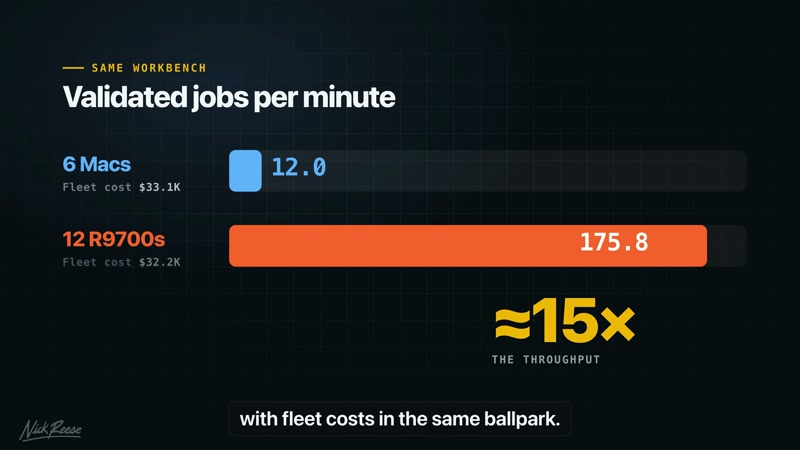
On the measured workbench: the six Macs (a $33.1k fleet: two 512 GB M3 Ultras, two 128 GB M4 Maxes, two others) validated 12 jobs per minute; the twelve R9700s validated 175.8. That is about 15 times the throughput for the same ballpark money. The figure that made him post: one PC server draws about the same power as all six Macs combined and does about five times the work of the whole Mac fleet.
The division of labor matters as much as the totals. The R9700s run Qwen 3.8 27B, a small dense model pushing enormous volume at what he calls really acceptable accuracy: the muscle. The 512 GB M3 Ultras run the huge models for auditing the smaller models’ work: the judge. The 128 GB M4 Maxes run GLM Flash for complex extractions, admin, and analyzing visitor email: the staff. Small model at volume, big model in the loop, and the harness (10 prior abandoned iterations, he says) catching what the cheap tier misses.
The actual argument #
Nobody in this story is price-wrong. Luna’s price cut was real, and the numbers were decent before the refusals started. The case for moving inference in-house here is not a per-token spreadsheet: it is that a cloud provider can change the model under your workload, and on a directory where the workload itself is legally sensitive, the refusal becomes a downtime event you do not control. USA Arms’ changelog shows the system shipping: “New Listings: 102 Pawn - Gun shop, Shawnee, OK” with a October 12, 2026 recent-listing date, the kind of steady enrichment output the whole stack exists to feed.
That is the refusal tax: not a line item, but a business-continuity risk measured in whatever your replacement stack costs - in this case $32.2k, one 15 amp circuit, and a parts list his site hands out for free.
Sources: Nick Reese: Why I Started Moving Inference In-House - The build video thread - USA Arms changelog Related on this site: The budget rig under $3,000 is a repurposed console - Twenty-one ways to run a model locally: the engine catalog - Hermes Agent ships on NVIDIA’s RTX Spark launch