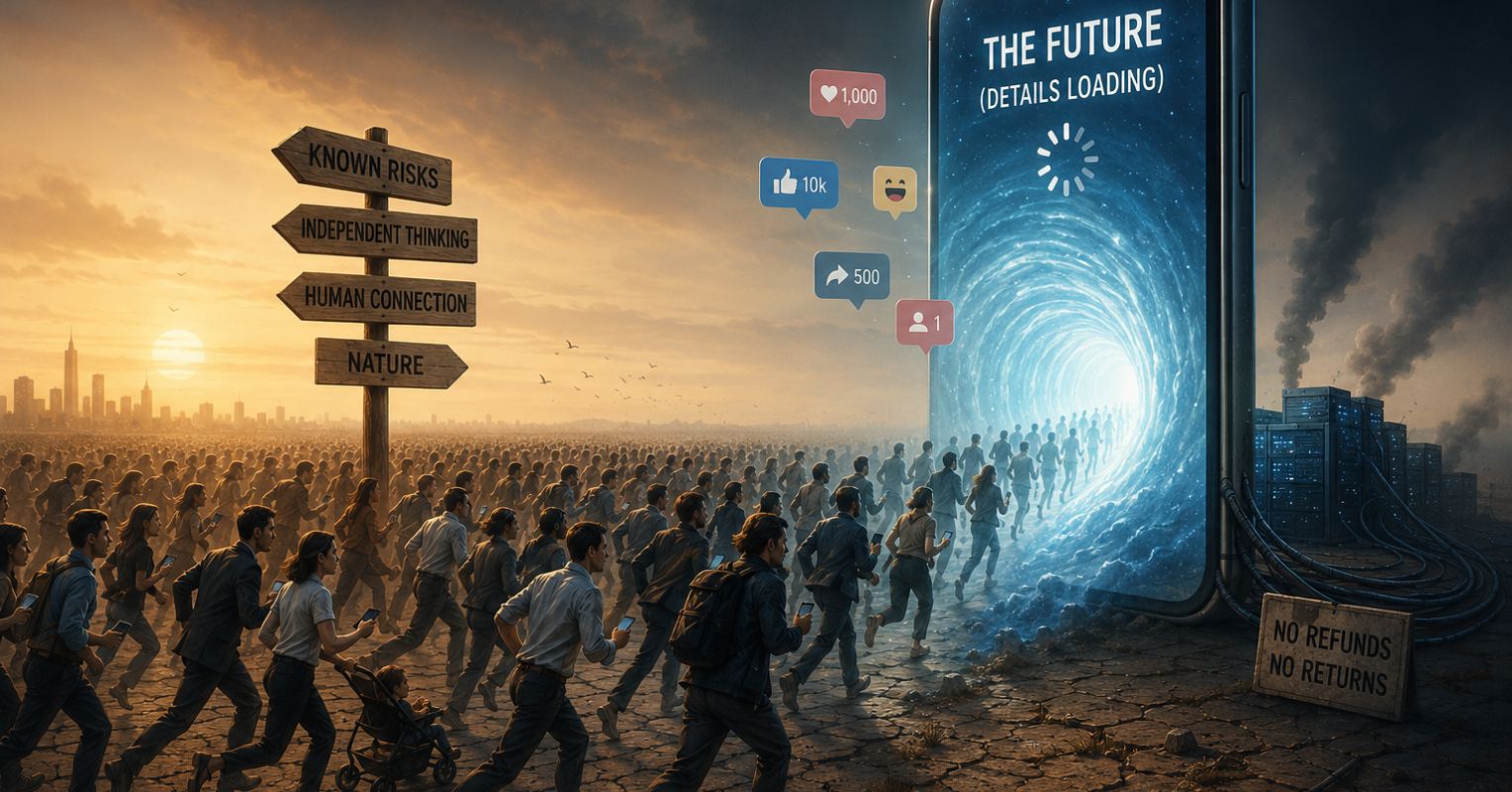
Why the ongoing race says more about humans than about technology. #
Posted July 11, 2026 [ Reviewed by Tyler Woods
](https://www.psychologytoday.com/us/docs/editorial-process) In early 2024, global investment in artificial intelligence surged past $90 billion, with projections continuing upward as companies, governments, and individuals reposition themselves around what many describe as the defining technology of our time. The scale is striking. The certainty behind it is far less so.
History offers a familiar pattern. During the dot-com boom, capital flooded into internet companies long before viable business models had emerged. The aftermath is well documented: a market correction that wiped out trillions in value, followed by a slower, more grounded integration of digital technologies into everyday life. Today’s AI landscape carries echoes of that moment, though the stakes extend further into labor markets, environmental systems, social structures – and into our individual minds...
The current wave differs in another important respect: the speed at which adoption is unfolding. Already, a 2023 McKinsey report estimated that generative AI could add between $2.6 trillion and $4.4 trillion annually to the global economy, a range so broad that it reveals as much uncertainty as opportunity. That number keeps rising. But when projections span trillions, precision gives way to speculation. We fall prey to wishful thinking when careful deliberation might be a better bet.
Financial Bets Without Foundation? #
Financial markets tend to reward momentum. Companies perceived as “AI leaders” have seen sharp increases in valuation, often disconnected from immediate revenue streams. At the same time, large financial institutions are investing heavily in AI infrastructure and tools, even as internal assessments remain cautious about near-term returns. Banks are under pressure to adopt AI technologies rapidly, despite unresolved questions about risk, governance, and long-term profitability.
This dynamic reflects a broader behavioral pattern: acute FOMO, fear of missing out. In economic terms, it resembles herd behavior, where actors follow collective trends rather than independent analysis. But when narratives drive financial markets, they amplify unhealthy cycles of boom and doom. AI has become such a narrative—powerful, persuasive, and hard to resist.
Amid all the frenzy, uncertainty about the benefit for humans remains the white elephant in the room, one that nobody dares to touch openly. The International Monetary Fund estimates that AI could affect nearly 40 percent of global jobs, with advanced economies facing even higher exposure. The range of possible outcomes spans from productivity gains via agency decay to ever sharper structural social inequality and an expanding environmental footprint. Financial investment continues to accelerate despite this wide spectrum of possibilities.
A Social Experiment Without a Control Group #
What makes the current moment unusual is the speed and scale of change, but also the absence of a clear reference point. AI is being integrated into personal use, education systems, healthcare services, finance infrastructure, and governance frameworks simultaneously. Each domain brings its own uncertainties for humanity, and their interaction creates additional layers of complexity and risk.
In clinical settings, AI shows promise in diagnostics and treatment planning, while raising questions about accountability and bias. In education, it expands access to information while altering how individuals engage with knowledge itself. In the workplace, it reshapes tasks and expectations, sometimes faster than institutions can adapt. We are moving toward a “skills-based economy,” where adaptability becomes more valuable than static expertise. Each of us is expected to evolve continuously alongside the technologies we use. It’s an opportunity for lifelong growth if we engage consciously in this journey. To benefit from it, double literacy is becoming a quintessential asset.
For now, the pace of evolution is uneven. Individual habits adjust quickly to convenience and sluggishly to new forms of effort. Institutions adapt slowly. Regulatory frameworks lag behind technical capabilities. Social norms take even longer to shift. The result is a global experiment in which billions of humans participate without a shared understanding of the rules and the risks.

[Intelligence](https://www.psychologytoday.com/us/basics/intelligence)Essential Reads
Why the Fear of Being Left Behind Feels So Strong #
Human behavior offers a lens through which to interpret this acceleration. The fear of missing out is not new, though technology amplifies it. Digital platforms make trends visible in real time, creating constant signals about what others are doing, investing in, or adopting.
Loss aversion, the tendency to weigh potential losses more heavily than gains, can drive individuals and organizations to act preemptively, even when the benefits are uncertain. In the context of AI, the perceived loss is relevance. The response is rapid adoption. At the same time, social comparison plays a role. When peers, competitors, or entire industries move in a particular direction, standing still can feel like falling behind. The decision to adopt technology becomes less about its intrinsic value and more about its perceived necessity.
This dynamic creates a feedback loop. Adoption signals legitimacy, which encourages further adoption, reinforcing the original signal. Over time, momentum replaces deliberation.
Reclaiming our unique human advantage #
Amid this acceleration, a cumbersome question emerges: what remains distinctly human in a world shaped by increasingly capable machines?
Artificial intelligence excels at pattern recognition, prediction, and scale. It processes vast amounts of data with speed and consistency. These capabilities expand the range of what is technically possible.
Natural intelligence operates differently. It integrates context, emotion, and meaning. It navigates ambiguity. It generates purpose. These qualities do not scale in the same way as algorithms, yet they shape the direction in which technology is applied.
A central challenge that arises from this distcinction lies in alignment. Technology amplifies intent. When aligned with thoughtful human judgment, it can extend capabilities in meaningful ways. When driven primarily by speed and competition, it can magnify existing biases and inefficiencies.
This is where the current trajectory invites reflection. The question is less about whether AI will transform society and more about how that transformation is guided.
A Moment for Deliberate Pace #
Slowing down does not imply resistance to innovation. It suggests a different relationship with it. A deliberate pace allows for evaluation, adjustment, and integration. It creates space to assess financial sustainability, environmental impact, and social consequences before they become entrenched.
The unfortunate alternative is a path shaped by momentum. History shows where that can lead: cycles of rapid growth followed by correction, with uneven distribution of both gains and losses.
Technology will continue to evolve. The question is how individuals, institutions, and societies choose to engage with it.
Participation in a global experiment does not require passive acceptance of its terms. For the time being, the setting still leaves space for human agency. We still have a choice about the path to take and the shoes to wear. We need to decide which direction to go while we still can.
In that sense, the most valuable capability today may not be the ability to keep up, but the ability to choose our own direction.