Apple's new Mac and iPad price increases are not a normal product-cycle adjustment. They are the consumer electronics bill for the AI data center boom.
When Apple raises the floor on a Mac mini from $599 to $799, you should pay attention. That is not a cosmetic tweak to a spec sheet. It is Apple admitting, in the one place companies are usually most reluctant to speak plainly, that the cost of memory has moved faster than even its supply chain can absorb.
The Wall Street Journal reported this week that Tim Cook told it Apple price increases were "unavoidable." That is unusually blunt language from a company that normally wraps hardware changes in talk about performance and design. The 256GB Mac mini tier is gone. The iPad Pro and iPad Air are also moving higher. According to the Journal, Apple is blaming memory costs, and this time the explanation is not a convenient excuse. It fits the market.
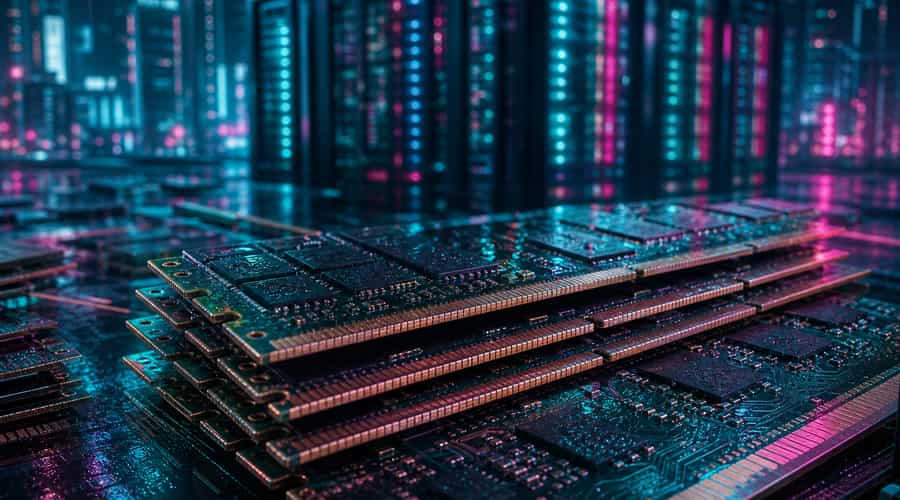
Samsung, SK Hynix and Micron dominate global DRAM supply, and the center of gravity has shifted toward high-bandwidth memory, the stacked memory used beside Nvidia accelerators in AI servers. TrendForce has been tracking the same pressure across DRAM and NAND pricing, while the Financial Times has reported that memory makers are prioritizing AI customers because HBM carries better margins and multi-year demand. The result is simple enough: the chips that used to sit quietly inside your laptop are now competing with the chips cloud companies need to train and run models.
That changes the bargaining table. Apple is one of the strongest buyers in consumer electronics, with volume, long supplier relationships and the cash to place orders early. If Apple is raising prices, smaller device makers have less room to hide. Xiaomi, Oppo and Vivo do not have Apple's gross margins, and they sell many phones in price bands where adding even a few dollars to the bill of materials can hurt. A customer choosing a mid-range Android handset notices that faster than a Mac buyer notices a $200 jump.
Samsung is the awkward exception, and it is worth saying plainly. Its device business sits beside one of the world's most important memory businesses. That does not make Samsung immune to the shortage, but it gives the company an internal supply position most rivals cannot copy. In a shortage, that kind of structure matters more than marketing. It can decide who keeps shipping and who starts cutting models.
The pressure is already showing up outside Apple's stores. Omdia has warned that memory constraints will weigh on smartphone shipments in 2026, and CNBC reported earlier this year that analysts were preparing for one of the sharpest shipment declines the industry has seen. Phison chief executive K.S. Pua has also warned that some consumer electronics companies may be forced to abandon lower-margin product lines if the squeeze lasts. Frankly, that is the part consumers will feel before they read a semiconductor earnings call. Fewer cheap configurations. Fewer entry-level products. More base models that quietly become mid-tier models.
This is not the same kind of chip shortage the industry lived through after the pandemic. That shortage was chaotic, broad and tied to a sudden shift in consumer demand. This one is more deliberate. Cloud companies including Microsoft, Google, Amazon and Meta are still spending heavily on AI infrastructure, and memory suppliers have every reason to follow that money. HBM takes more complex production and packaging than standard DRAM, so it does not simply add supply to the market. It pulls capacity, equipment and attention away from ordinary consumer memory.
For Apple, the immediate risk is not that a $799 Mac mini kills the Mac business. It won't. The risk is that Apple's entry points become less believable. The $599 Mac mini mattered because it let buyers enter the Mac ecosystem without pretending price did not matter. The base iPad played a similar role for schools, families and small businesses. When those steps move up, Apple's product ladder gets steeper. You can already see the tension in how Apple is likely to defend the increases. More memory, better chips and longer useful life are real benefits. Nobody should pretend the old 256GB starting point was generous. But the company's problem is that buyers do not experience component inflation as a supply chain story. They experience it as the moment the machine they planned to buy costs more than it did last year.
The broader question is how long the AI buildout keeps setting prices for ordinary devices. IDC and other market trackers do not expect fast relief, because new memory capacity takes years to plan, build and qualify. The capacity decisions made in 2024 and 2025 were tilted toward AI servers, not cheap tablets. So when Apple raises prices now, it is not just passing along one bad quarter of component costs. It is showing you what consumer hardware costs when the same factories needed for laptops and phones are also feeding the most expensive data center expansion in the world.
Also read: IBM's 0.7nm chip puts nearly 100 billion transistors on a fingernail and resets the AI silicon calculus • Amazon raises its India bet to $48 billion as Big Tech turns the subcontinent into an AI proving ground • OpenAI quietly upgraded every free ChatGPT user to a smarter model and the competition should be worried