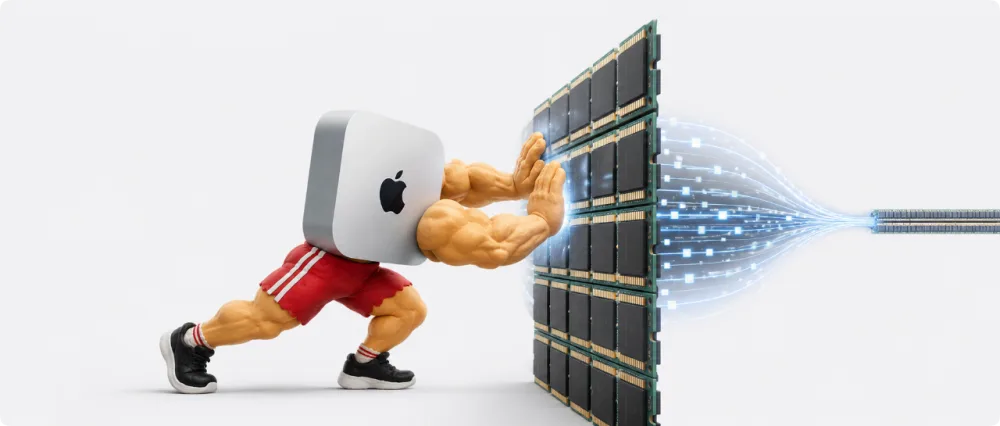
If you look at the latest hardware releases, everyone is obsessed with a metric that most casual users ignore: memory bandwidth. Apple’s recent Mac updates are a perfect case study. They aren't just marketing the Mac mini as a small desktop; they are positioning it as an all-day AI agent workstation. The professional-grade Mac Studio is now pushing up to 512GB of unified memory. But the real story is the bandwidth. The standard M6 hits 170GB/s, the M5 Pro jumps to 307GB/s, and the top-tier M5 Ultra blows past the terabyte mark at 1.2TB/s.
It’s not just Apple. Xiaomi’s new Xuanjie O100 edge AI chip hits 1.22TB/s, and NVIDIA’s upcoming RTX 5090 is aiming for nearly 1.8TB/s with its GDDR7 memory. Despite different architectures—desktop SoCs, dedicated NPUs, or discrete GPUs—the goal is identical: get data to the compute cores faster.
Why high compute power is useless if it's "starving" #
A common misconception is that memory is just about capacity. People think, "More GB equals better AI." That’s only half true. Capacity determines how large a model you can load, but bandwidth determines how fast those parameters can be fed to the processor.
When you see an LLM generating text word-by-word (the decode phase), the compute unit has to read billions of parameters from memory for every single token generated. Think of it like a world-class chef in a kitchen. The chef can cook a dish in two minutes, but if the prep cook takes twenty minutes to bring the ingredients, the chef spends most of their time standing around doing nothing.
In computer architecture, we call this being memory-bound. The compute power is skyrocketing, but the "delivery trucks" (the memory channels) can't keep up.
The high cost of speed #
Speeding up memory isn't as simple as adding more chips. It requires wider bit widths, higher frequencies, and incredibly complex advanced packaging like TSV (Through-Silicon Via) used in HBM (High Bandwidth Memory).
This demand is causing a massive shift in the global semiconductor supply chain. As data centers grab all the HBM and high-spec DDR5 capacity, consumer PC makers are getting squeezed. We're seeing major players like Micron pivot away from consumer-grade memory brands to focus on high-margin enterprise AI customers. When you're deciding whether to upgrade your RAM, you're essentially competing for the same silicon as a massive AI data center.
Four ways engineers are trying to break the wall #
To stop the "starvation" of compute cores, the industry is attacking the problem from four different angles:
-
Widening the lanes (GDDR7 and HBM): This is the brute force approach. Use massive bit widths and high-speed interfaces to push as much data as possible. It works, but it is extremely expensive.
-
Moving storage closer (3D Stacking): Xiaomi’s Xuanjie O100 uses Wafer-on-Wafer stacking to place DRAM directly on top of the NPU. By reducing the physical distance to the micron level, they achieve massive bandwidth without the long travel time across a circuit board.
-
Unified Architectures (Apple’s approach): In a traditional PC, the CPU and GPU have separate memory pools, requiring data to be copied back and forth. Apple Silicon uses a unified memory pool where all cores share the same data, eliminating redundant transfers. They also use Thunderbolt 5 (up to 120Gb/s) to allow multiple Macs to act as a distributed inference cluster.
-
Processing-in-Memory (PIM): The most radical approach. Instead of moving data to the processor, why not move the computation to the memory? PIM and Computation-in-Memory (CIM) try to perform basic math operations right inside the memory chips themselves.
We have been hitting this "memory wall" since the mid-90s, but the LLM explosion has turned a slow leak into a flood. We used to measure chip performance in TOPS or TFLOPS, but in the AI era, those numbers mean nothing if the data can't reach the engine. The "muscle" of the chip matters, but without a constant supply of "nutrients" (data), even the strongest processor is just idling.
Why data center hype is hitting a massive geopolitical wall 55m ago
Hardware lifecycles for AI chips are moving way faster than 13h ago
Nvidia's massive cash flow is basically the fuel for the entire 14h ago
Why is everyone suddenly terrified of the massive power demands 1d ago
Jensen Huang thinks we already hit AGI and it's basically 1d ago
Nvidia's $673B forecast reveals AI compute demand still 1d ago
Next Robot training is currently facing a massive reality gap problem. →