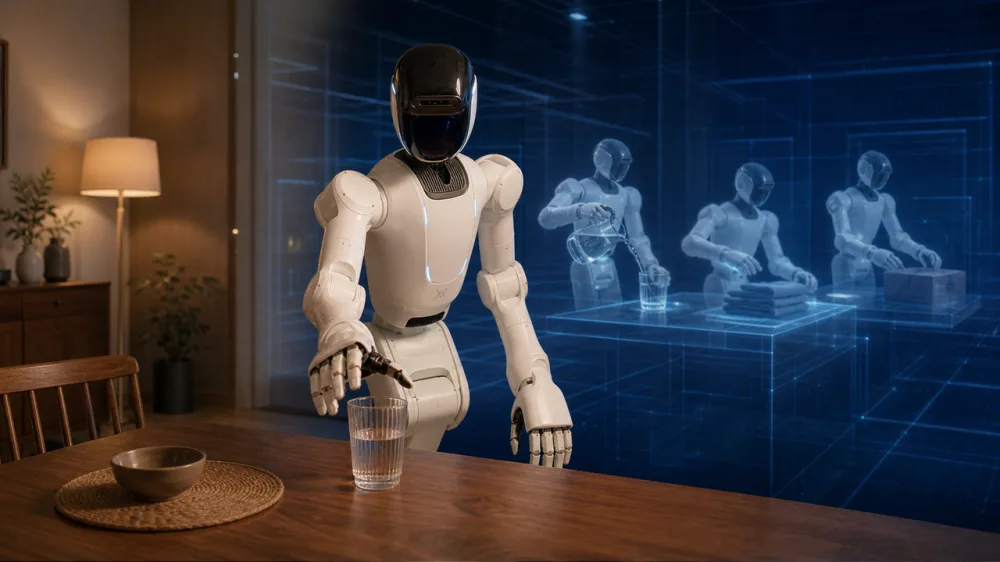
This is why "World Models" are the holy grail of embodied AI. The idea is to create a high-fidelity simulation where a robot can "dream" or rehearse actions before executing them in the physical world. However, most current world models fail the "reliability test." They are often too optimistic; they might understand the visual scene but fail to respect the actual physics of an action. You'll see "magnet-like grasping" where a gripper closes and the object magically teleports into the hand, even if they weren't touching. This lack of precision makes virtual training useless for real-world deployment.
X-Square Robot has just released WALL-SS, an autoregressive world model designed specifically to fix these simulation-to-reality gaps.
Breaking the "Optimistic Director" Trap #
Most world models act like overly optimistic movie directors. They see a command to "grab a cup" and generate a video of a successful grab, regardless of whether the gripper's trajectory was actually correct. WALL-SS solves this through a multi-scale approach.
Instead of jumping straight to a high-def video, the model first generates a "low-resolution preview" to establish the macro-movements (the general path of the arm and the direction of object movement). It then iteratively refines this into a high-definition layer, adding fine details like contact points and object contours. This is what they call Next-Scale Autoregression.
This hierarchical structure ensures that the physics actually follow the action. If the input command says the arm moves left, but the visual output shows it moving right, the model is penalized. In testing, WALL-SS scored 0.290 on action sensitivity, dwarfing Cosmos3 (0.044) and other models that scored zero. Essentially, WALL-SS actually "listens" to the robot's movements.
Solving the Long-Horizon Memory Problem #
If a robot is performing a 60-second task—like pouring water, which involves approaching, grasping, lifting, tilting, and replacing—it cannot simply memorize every pixel of the last minute. That would crash the memory and compute limits.
WALL-SS implements Scale-Compressed Long-term Memory. It functions like an organized work log:
-
Recent History: Retains high-precision details (e.g., exactly how the gripper touched the cup two seconds ago).
-
Distal History: Compresses older data into "summaries" (e.g., remembering that there is a cup on the table and the drawer is currently open, without needing the exact pixel coordinates from 30 seconds ago).
To prevent the "drift" that happens in long simulations, they use a technique called Per-Scale Dream Forcing. During training, they intentionally inject small errors/perturbations into the historical data and force the model to predict the correct future despite the noise. This teaches the robot how to recover from mistakes rather than letting a small error cascade into a total system failure.
From Virtual Dreams to Physical Reality #
The ultimate goal isn't just to make pretty videos; it's to filter robot strategies. The team tested several robot policies in both WALL-SS and the real world. Crucially, policies that performed well in the virtual "dream" environment translated effectively to the physical robot.
They achieve this through Online Policy Alignment of Visual Dynamics. They use two internal "judges":
Judge 1 (Action Consistency): Checks if the visual arm follows the specified trajectory.Judge 2 (Long-term Consistency): Ensures objects don't drift and the world remains coherent across different camera views.
By using these judges to refine the visual world, the model creates a training ground that is actually rigorous enough to prepare a robot for the messiness of a human home.
Project Page:
http://x2robot.com/pages/ss
Paper:
https://github.com/X-Square-Robot/wall-ss/blob/main/wall-ss-paper.pdf
Github:
https://github.com/X-Square-Robot/wall-ss
China is currently shipping nearly 90% of the world's bipedal 3d ago
Built a visual canvas that lets you branch AI conversations like 7d ago
Anthropic might be dropping $6 billion to acquire Decart 16d ago
The Qiyuan Q1 Explorer is basically a high-tech designer toy 21d ago
Next X says a Chinese bot farm is targeting AI data center sentiment →