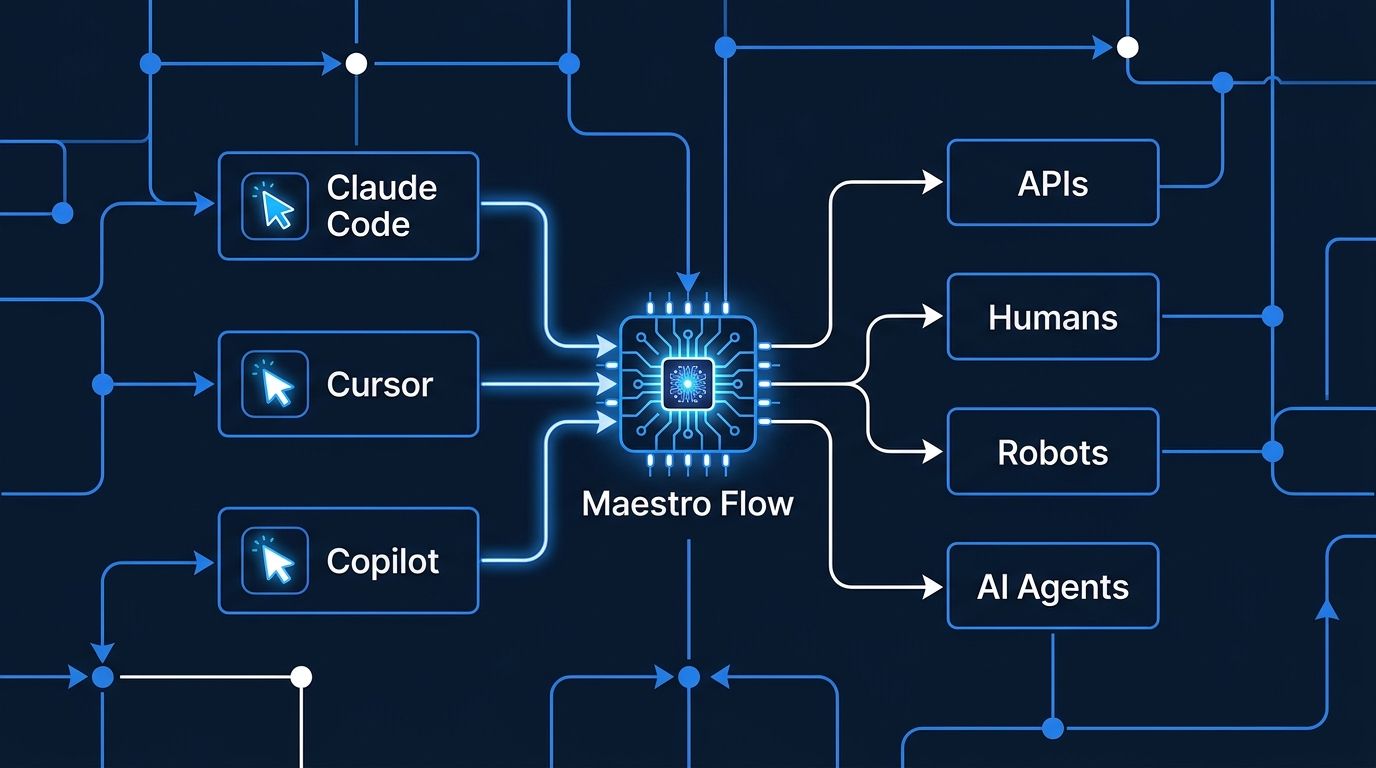
Seventy-eight percent of enterprise AI agent pilots never reach production. The agents demo well, the budgets get approved, and then the project quietly stalls somewhere between “it works on my machine” and “it needs an audit trail, role-based access, and a way to not fall over when the SAP API times out.” UiPath launched Maestro Flow on August 19 to attack that gap directly — a developer-first orchestration layer that lets your coding agent of choice build and ship production-grade business processes without a re-platforming pass.
What Maestro Flow Actually Is #
Maestro Flow is an orchestration canvas — not a new coding agent, not a replacement for Claude Code or Cursor, and not another low-code workflow builder. It sits one layer above the agent. Your coding agent, running in VS Code or Cursor, describes a business process in natural language. Maestro’s platform skills translate that into a .flow
artifact that already meets UiPath’s production standards: validated, versioned, and publishable to the cloud through a single command. The same file you authored in your IDE can be inspected and refined in a visual cloud canvas. Nothing has to be rewritten to go from prototype to production.
How Coding Agents Hook In #
The integration uses Model Context Protocol. UiPath exposes its CLI as an MCP server (uip mcp
), which means any MCP-aware client — Claude Desktop, Cursor, VS Code with an MCP host — can invoke UiPath CLI commands as tools. Practically speaking: your agent reads MCP tool descriptions, understands Maestro’s schema and validation rules from platform skills, generates the flow, runs local validation, and publishes. Claude Code, Cursor, Copilot, and Codex are all supported out of the box. A VS Code extension on GitHub brings Maestro Flow authoring, Agents, human-in-the-loop steps, and document processing directly into the IDE.
What a Single Flow Can Coordinate #
This is where it gets interesting. A Maestro Flow can chain together things that previously required separate orchestration glue code: REST API calls, AI agents from any vendor (Claude, OpenAI, Gemini, Copilot, LangChain agents, CrewAI crews, custom-coded agents), legacy UiPath RPA robots, human approval steps, document processing, scheduled triggers, and data pipelines. Identity, audit logging, and policy enforcement apply once across every participant in the flow, regardless of whether that participant is a large language model, a robot, or a human approver. For teams running in regulated industries or under EU AI Act requirements, that unified governance layer is not optional.
Versus Building It Yourself #
LangGraph and CrewAI are the current defaults for developers who want multi-agent coordination. Both are solid. Both leave governance, durability, access control, and observability as exercises for the team — which is fine for a prototype and a serious liability at production scale. Maestro Flow’s answer is to build all of that in: BPMN process modeling, DMN decision logic, RBAC, versioning, audit trail, and rollback are standard, not add-ons. The key distinction: Maestro doesn’t compete with LangChain or CrewAI. It can run them as steps inside a larger, governed flow.
The Honest Take #
UiPath is an RPA incumbent whose core market has been under sustained pressure as coding agents commoditize robotic automation. Maestro Flow looks like a smart repositioning: if coding agents are going to eat RPA, become the orchestration layer that sits above both. That creates a real question for development teams evaluating this — you’re getting enterprise-grade infrastructure, but you’re also getting UiPath’s pricing model (Platform Units, not available on the Basic tier) and vendor relationship. Teams that prefer to own their orchestration stack have Temporal, Prefect, or pure-code durable execution frameworks as alternatives. Maestro Flow’s edge is that those alternatives require your team to build the governance story themselves.
The CLI MCP documentation and the official launch announcement are the right places to evaluate fit. If your team is already shipping business processes with Claude Code or Cursor and hitting the enterprise requirements wall, this is worth a serious look now rather than after you’ve tried to bolt governance onto LangGraph for six months.