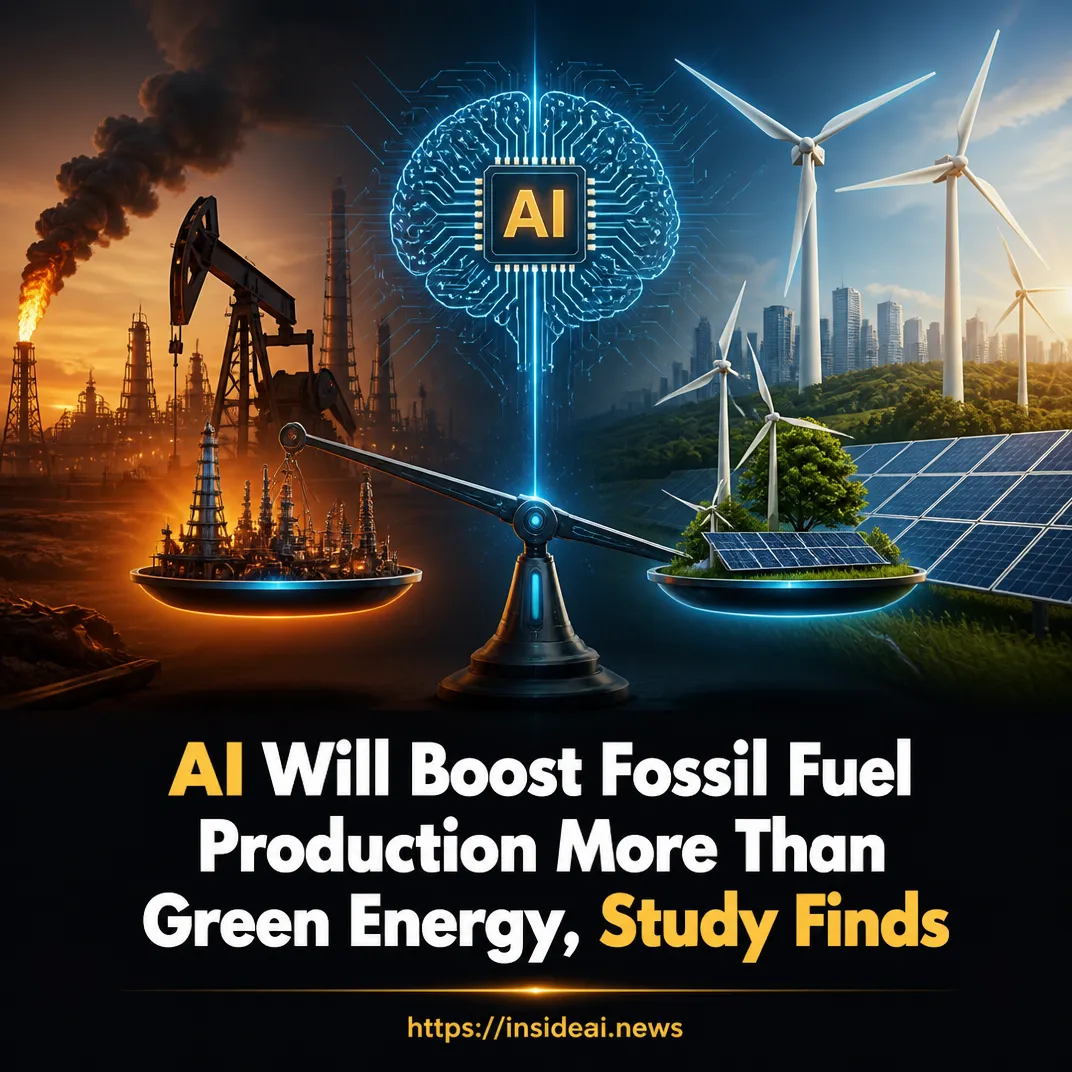
August 11, 2026, (Inside AI) — Artificial intelligence is poised to accelerate fossil fuel extraction far more than it helps expand renewable energy, resulting in a net increase in global carbon emissions, according to a first-of-its-kind study. Researchers found that AI-driven productivity gains in oil, gas, and coal operations would cause annual carbon pollution to rise by 0.47 to 1.8 gigatonnes, equivalent to 1% to 5% of the energy sector's yearly emissions.
The analysis, which modeled 64 scenarios, marks the first comprehensive quantification of AI's climate impact across the entire power sector. While previous work has focused on AI's potential to optimize renewable grids and reduce downtime, this study uniquely accounts for the technology's role in boosting fossil fuel output. The net emissions only declined in scenarios where AI did not increase productivity in the fossil fuel sector.
Holly Alpine, a co-author of the study and former Microsoft employee who now co-leads the Enabled Emissions campaign group, said the team used a conservative assumption that AI adoption would occur at the same pace for both fossil fuels and renewables.
"Fossil fuel applications are already happening at scale today - real contracts, real deployment, with evidence from industry operators and financial analysts," Alpine said. "Renewables applications are still largely at the pilot or academic-study stage - more speculative, more dependent on deployment barriers like permitting and interconnection getting resolved."
The findings challenge the narrative that AI's climate benefits from smarter grids will outweigh its downsides. Researchers concluded that if clean and dirty energy facilities adopt AI at similar rates, the productivity gains for renewables must outpace those for fossil fuels by at least four times just to break even on emissions.
Industry Already Sees AI as 'Next Fracking Boom' #
The International Energy Agency estimates that AI could increase technically recoverable oil and gas reserves by 5% and cut deepwater offshore project costs by 10%. Oil executives have embraced AI's potential, with some likening it to a new production revolution. Saudi Aramco disclosed last year that it had integrated AI "in everything," boosting productivity and well counts.
Equinor credited AI and new seismic technologies for 27 discoveries on the Norwegian continental shelf, including the Lofn and Langermann wells, which it called its largest operated find in 2025.
"AI was key, from automated data interpretation to efficient well planning," the company stated in a capital markets day video in June.
Rystad Energy, an Oslo-based research firm, projected in May that digitalization and AI would generate nearly $500 billion in cumulative value for fossil fuel exploration and production companies from 2026 to 2030, driven by operational efficiencies and faster development. Analysts cited hundreds of millions in reported AI-related savings from Equinor and Abu Dhabi's Adnoc.
The study did not factor in the direct energy consumption of AI data centers, which are often powered by natural gas. Yet it found that AI-enabled productivity gains in fossil fuels result in emissions at least three times current estimates for data center electricity use.
Lynn Kaack, an assistant professor of computer science and public policy at the Hertie School who reviewed the research, noted that most prior studies "completely omit this picture of AI causing increases in emissions."
Structural Bias Toward Fossil Fuel Expansion #
Ketan Joshi, an independent climate analyst not involved in the study, argued that the AI sector is "fundamentally hungry for fossil fuels" and that its climate impact extends far beyond data center power demand.
"Even within some parts of the climate movement, there is still a denial that an unchecked tech industry will inherently boost fossil fuels," Joshi said. "Simply asking companies to throw a few scraps of cash at renewable projects is not enough to ensure the industry operates safely."
The researchers cautioned that their results represent a "directional and structural finding, not a precise forecast," but the relationship held across every scenario and sensitivity test. The study underscores a fundamental tension: AI's efficiency gains are being deployed far more aggressively in the mature, capital-intensive fossil fuel industry than in the still-nascent renewable sector.
As tech giants pour billions into AI infrastructure, the climate implications of where and how that intelligence is applied may prove more consequential than the carbon footprint of the data centers themselves.