Aging doesn’t happen all at once. It unfolds quietly. Friends move away or pass on. Driving becomes difficult. Health problems make it harder to get out. Daily routines narrow, social circles shrink and conversations become less frequent. For millions of older Americans, loneliness isn’t triggered by a single event. It grows gradually, often unnoticed, until it begins affecting both emotional and physical health.
Loneliness has been difficult to identify before it becomes a serious problem. Caregivers and family members may notice when an older adult withdraws, but subtle changes often happen over weeks or months. Missing an exercise class, skipping lunch with friends or declining a favorite activity may seem insignificant on its own. Together, those changes can signal the beginning of social isolation.
AI is beginning to change that. Rather than replacing human interaction, a new generation of AI tools is helping caregivers recognize behavioral patterns that might otherwise go unnoticed. By analyzing daily engagement, routines and activity levels, AI can identify older adults who may be drifting toward loneliness, giving caregivers an opportunity to intervene before isolation takes a greater toll.
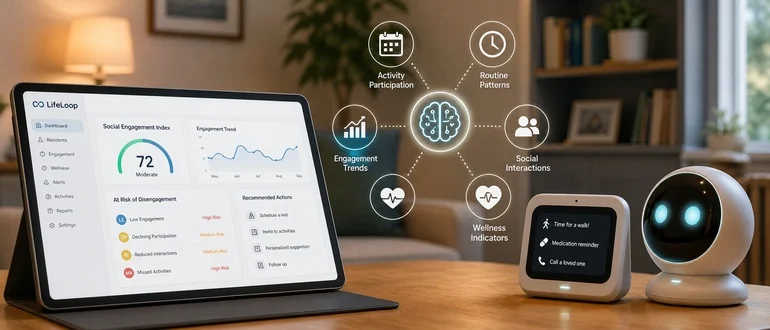
One of the companies leading that effort is LifeLoop, whose platform is used in more than 4,700 senior living communities across the U.S. Its AI-powered Wellness Navigator transforms everyday participation into measurable insights through what it calls a Social Engagement Index.
“Social isolation is one of the greatest risks for resident well-being,” LifeLoop states. “Yet in many senior living communities, the signs of disconnection—missed activities, fewer interactions, longer gaps between visits—are often scattered or lost in the shuffle. By bringing engagement signals into a clear, unified view, the Wellness Navigator empowers clinical and life enrichment teams to consistently identify residents at risk of disengagement—and respond with meaningful, timely support.”
The system analyzes how residents engage with community life, tracking participation in activities, changes in routines and other indicators of social connection. Instead of relying solely on observation, caregivers receive objective data showing whether a resident’s level of engagement is increasing, remaining stable or declining over time. The platform also incorporates validated loneliness assessments and recommends personalized activities based on individual interests, giving staff practical ways to reconnect residents with their communities.
The goal is not to diagnose loneliness. It is to identify the warning signs early enough that caregivers can respond with something no algorithm can provide, genuine human interaction.
That approach has resonated with senior living providers. LifeLoop says its partnerships with thousands of communities have shown that bringing engagement data together with clinical information gives care teams a more complete picture of residents’ overall well-being.
LifeLoop represents one approach to using AI in senior care. Others are taking a more direct role in combating loneliness.
ElliQ, developed by Intuition Robotics, functions as an AI companion for older adults living independently. The tabletop device initiates conversations, encourages physical activity, reminds users about medications and appointments, recommends brain games and suggests calling family or friends. Unlike LifeLoop, which works primarily behind the scenes for caregivers, ElliQ interacts directly with older adults throughout the day. Research on the system has found that regular users often report reduced loneliness, greater engagement and increased confidence using technology.
Researchers at the University of Houston are exploring what the next generation of AI companionship could look like.
At the university’s Empathetic Lifespan AI & Robotics for Aging, or ELARA, Lab, researchers are developing companion robots designed not only to provide emotional support for older adults but also to assist nurses, caregivers and family members. The project approaches aging not as a technology problem to solve but as a design challenge centered on dignity, trust and meaningful human connection.
“The more that older adults are excluded from technology development, the worse those technology gaps will become,” said Chorong Park, assistant professor and director of the ELARA Lab.
Rather than assuming older adults need simplified technology, Park’s team invites them to help design it. Seniors work alongside University of Houston students to evaluate existing companion robots, including Emo, Loona and Moflin, then build clay models of the features they would most value in future AI assistants.
Park’s studies found that many older adults worry AI systems could become intrusive or create a sense of constant surveillance. For companion robots to succeed, they must respect privacy, adapt to changing physical abilities and respond empathetically without making users feel monitored or diminished.
“Many technology designs are based on the assumption that older people can’t use them, but that’s not true,” Park said. “Aging is a global challenge, and we have things to learn from each other.”
None of these technologies claims to replace family, friendship or compassionate caregivers. AI can identify the quiet warning signs that people sometimes miss and encourage meaningful intervention before isolation becomes a serious health risk.