Most conversations about the cost of agentic AI begin with tokens. Teams compare model prices, monitor inference bills and look for opportunities to shorten prompts or route simple tasks to less expensive models.
But token consumption is only one part of the bill—and potentially not the most disruptive one.
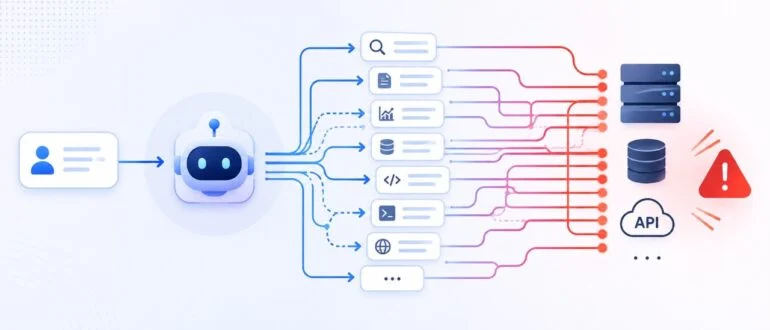
A single instruction given to an AI agent can generate dozens, hundreds or even thousands of downstream operations. The agent may query APIs, search telemetry, retrieve documents, test hypotheses and repeat unsuccessful steps. Every operation consumes infrastructure outside the model itself.
When those operations are not controlled, an agent can behave like an accidental application-layer denial-of-service attack. It does not need malicious intent. It only needs permission, speed and a poorly bounded objective.
An Agent Is Not Simply a Faster User
Most enterprise applications were designed around human behavior. A user opens a page, reviews the result and decides what to do next. Even a highly active user generally performs operations sequentially, with natural s between them.
Agents behave differently. They can break one objective into many subtasks, run those subtasks concurrently and continue iterating until they decide the objective has been met. If the first attempt fails, they may try a slightly different version without considering the cumulative demand placed on the underlying systems.
Consider an incident-investigation agent asked a seemingly simple question: “Why did checkout latency increase after the latest deployment?”
The agent might retrieve deployment metadata, query application logs, compare latency metrics, examine traces and inspect downstream services. It may then change the time window, query different service names, follow several possible causal paths and repeat the process for each affected region.
That behavior can be useful. Recursive investigation is one of the reasons agents are promising. But one human instruction has now become hundreds of machine-generated requests distributed across telemetry stores, deployment systems, source repositories and third-party APIs.
The cost of the workflow therefore depends not only on how many tokens the model consumes, but also on how the agent behaves.
The Hidden Infrastructure Bill
Organizations frequently monitor model spending without attributing the surrounding infrastructure consumption to individual agents. This leaves several costs hidden.
Every agent query consumes compute, storage I/O and network capacity. Requests to metered APIs may create additional charges. Large telemetry searches can scan significant volumes of data. Parallel operations can occupy connections and processing capacity needed by production users.
An agent stuck in a loop can amplify these effects quickly. A retry policy that looks reasonable for an ordinary application may become dangerous when combined with recursive planning. Five parallel tasks, each allowed five retries and several alternative queries, can multiply into substantial traffic before anyone notices.
Adding capacity may reduce the immediate pressure, but it does not correct the behavior. Scaling infrastructure to accommodate unnecessary operations simply makes the inefficiency more expensive.
This is why cost per token is an incomplete measure. Platform teams also need to understand cost per completed task, including every system the agent touches.
Legitimate Traffic Can Look Like an Attack
Uncontrolled agents can create an availability problem as well as a financial one.
A service that receives an unusual burst of requests may activate rate limits or automated defenses. From the service’s perspective, hundreds of parallel requests from an agent may be indistinguishable from abusive automation.
The result could be throttling, blocked access or degraded performance for other users. An internal agent can unintentionally overwhelm a shared database, saturate a telemetry backend or exhaust the quota for a business-critical external API.
This does not mean agents should avoid high-volume workflows. It means they need explicit operating boundaries. Infrastructure designed around human interaction cannot be expected to absorb machine-speed exploration safely without adaptation.
Observe Agent Behavior, Not Just Model Usage
The first step is to treat each agent as a distinct production workload.
Teams should be able to connect one user instruction to the complete chain of operations it produces. That includes model calls, tool invocations, API requests, database queries, retries and parallel branches.
Several measurements become especially important:
Request amplification: How many downstream operations does one instruction generate?
Concurrency: How many operations can the agent initiate simultaneously?
Retry behavior: Which failures cause another attempt, and how often?
Investigation depth: How many recursive steps occur before the agent stops?
Infrastructure consumption: What compute, storage, network and API capacity does each task use?
Task value: Did the agent’s activity produce a useful result?
A rise in any one metric is not necessarily a problem. A complex incident may justify hundreds of queries. The goal is to identify deviations: agents that suddenly make far more requests than usual, revisit the same resources or consume capacity without improving the outcome.
Traditional observability tells teams when an application is slow or unavailable. Agent-aware observability must also explain how autonomous systems are using that application.
Give Every Agent a Budget
Agent guardrails should cover infrastructure consumption as well as security permissions.
Each agent should have a request budget, concurrency limit and maximum investigation depth appropriate to its task. Expensive operations should require stronger justification or approval. Repeated queries with nearly identical parameters should trigger loop detection.
Tool interfaces can also reduce waste. Instead of giving an agent unrestricted access to a raw data store, teams can provide structured operations that return the context needed for a specific decision. Narrow tools make costs more predictable and reduce the likelihood that an agent will scan an unbounded dataset.
Retries require particular attention. They should use backoff, respect rate-limit responses and stop when the underlying failure is unlikely to be resolved by another attempt. A circuit breaker should halt an agent that repeatedly fails or exceeds its expected operating pattern.
Finally, organizations should separate investigation from action. Permission to examine a system should not automatically include permission to modify it. Actions that could affect availability need distinct authorization and, when the risk warrants it, human approval.
Optimize for Value, Not Activity
Agentic systems will generate more machine-to-machine traffic as they become part of software delivery, incident response and routine business operations. Infrastructure teams cannot manage that transition by watching inference prices alone.
The important unit is not the token or the request. It is the completed task and the value that task creates.
An agent that uses an expensive model but reaches a correct answer in a few disciplined steps may cost less than one using a cheaper model while issuing hundreds of unnecessary queries. Without visibility into the full workflow, that distinction remains hidden.
Before increasing capacity, teams should determine whether their agents are operating efficiently. Before granting broader access, they should understand how agents behave with the access they already have.
An AI agent is not just another user. It is an autonomous workload capable of turning one instruction into an infrastructure event. It should be monitored and bounded accordingly.