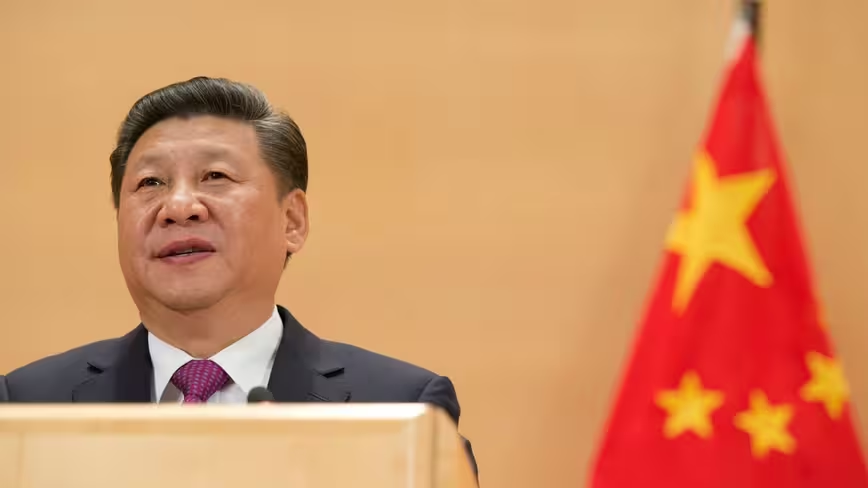
Xi Jinping told the World AI Conference in Shanghai on Friday that artificial intelligence “should not be a solo performance by a single country, but a symphony of international cooperation,” casting Beijing as the patron of open, shared technology.
The line, aimed at the developing world and, by implication, at Washington, set the tone for a speech heavy on governance and light on product.
His appearance had been flagged for days, the first time a Chinese president has addressed the summit in person. It came a day after 29 governments signed a China-led cooperation body in the same city, with foreign minister Wang Yi putting his name to the agreement.
Xi framed AI as a technology of “great opportunities and governance challenges,” according to the official Xinhua readout, and pressed for what he called a people-centred approach.
He warned that leaving poorer nations behind risked hardening the technology gap into “new historical injustices.”
The governance pitch doubled as a critique of US policy. “We should jointly oppose overstretching the national security concept in the field of AI or placing one country’s security over that of others,” Xi said, in remarks widely read as a swipe at American export controls.
Those controls are the backdrop to almost everything China now says about AI. Washington has spent two years restricting Chinese access to the most advanced chips, and Beijing has answered by weighing curbs of its own on who abroad can tap its leading models.
The timing is not incidental. China has narrowed the gap with American labs faster than many in Washington expected, and Xi arrived able to argue from something closer to parity than the summit’s early editions could muster.
The contrast Xi wanted was cooperation against containment. He promised capacity-building for partners across Africa, Latin America, Asia and the BRICS grouping, extending an earlier free-AI offer to the global south that undercuts the G7’s more guarded posture.
Safety still got its paragraph. Xi called for “laws and regulations, technological monitoring, early warning, and emergency response systems” to keep AI “always under human control,” language that would not sound out of place at a Western summit. The difference lies less in the words than in who gets to write the rulebook.
The new organisation is meant to give that rhetoric an address. Billed as an independent body promoting “beneficial, safe and fair” AI under UN Charter principles, it drew founding signatures from the likes of Russia, Kazakhstan, Pakistan, Indonesia and Laos, and will be headquartered in Shanghai.
Its stated remit is capacity-building rather than regulation, an offer of infrastructure, training and shared models to countries that have watched the AI boom mostly from the sidelines.
That is the constituency Xi spent the speech addressing, and the one Beijing hopes will find its terms more generous than the West’s.
What went unspoken mattered too. Major US technology firms were largely absent from the halls, while Huawei used the occasion to unveil its Atlas 950 SuperPoD, a computing cluster built to run without Nvidia’s top chips.
The diplomacy carried a UN gloss. Secretary-General António Guterres attended the launch of the cooperation organisation, lending the developing-world framing a measure of multilateral cover that a purely Chinese initiative would struggle to claim on its own.
For all the talk of symphony, the score is contested. Xi has likened AI’s arrival to the steam engine, a revolution he says will run through the whole economy, and he plainly wants Beijing holding the baton when the global south decides whose standards to follow. A symphony, after all, still needs a conductor. Whether the World AI Cooperation Organization becomes a genuine rival to Western governance forums or a well-attended symbol is the question the next conference will answer. For now, China has the venue, the guest list and, on Friday, the keynote.
Get the TNW newsletter #
Get the most important tech news in your inbox each week.