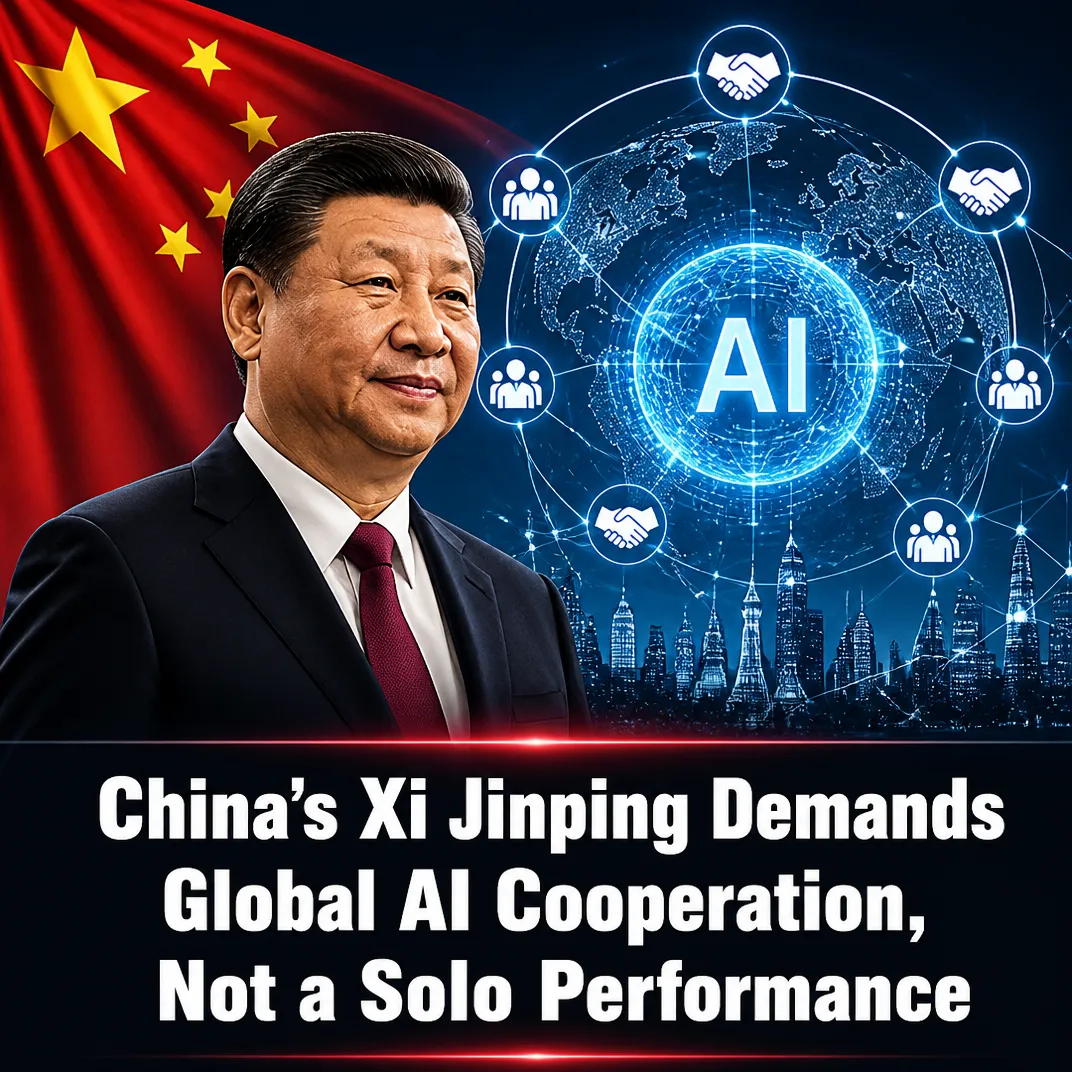
July 17, 2026, (Inside AI) — Artificial intelligence should not be dominated by a single country, Chinese President Xi Jinping declared at the World Artificial Intelligence Conference in Shanghai on Friday. Xi called for international cooperation and a “people-centred” approach to AI development, framing the technology as a shared global resource rather than a tool for unilateral advantage.
Xi’s keynote address at the opening ceremony positioned China as a champion of equitable AI access, particularly for developing nations. He announced plans to collaborate with international bodies across Africa, Latin America, Asia, and BRICS countries to provide AI-related opportunities, warning against what he termed “new historical injustices” in technology distribution.
“AI development should not be a solo performance by a single country, but a symphony of international cooperation,” Xi said. “We should jointly oppose overstretching the national security concept in the field of AI or placing one country’s security over that of others.”
The speech comes as Chinese AI models rapidly gain ground on U.S. competitors, attracting global users with lower costs and competitive performance. However, the governance of AI has become a contentious issue, with concerns mounting over military applications and criminal misuse.
China’s AI Ambitions Clash with Western Export Controls #
Xi’s call for collaboration contrasts sharply with ongoing U.S. and EU restrictions on Chinese tech imports, justified on national security grounds. In May, the U.S. Commerce Department tightened rules on semiconductor shipments to Chinese company subsidiaries abroad, closing loopholes in export controls. The guidance stated that licensing requirements for advanced AI chips apply to all entities with headquarters or a parent company in China.
These restrictions target the hardware backbone of AI development. While China lags in cutting-edge chip access, it holds a critical advantage in energy infrastructure. A typical data center consumes as much electricity as 100,000 households, and next-generation hyperscale facilities can require power equivalent to two million homes, according to the International Energy Agency.
China already generates more than twice the electricity of the U.S., a lead expected to widen with aggressive state investment in the energy grid. This abundant, cheap power positions China uniquely to meet the colossal demands of AI data centers, potentially offsetting semiconductor disadvantages.
Human Control and the Governance Debate #
Xi emphasized the necessity of keeping AI under human oversight, calling for robust legal and technical safeguards. “We should put in place laws and regulations, technological monitoring, early warning, and emergency response systems, in order to ... ensure AI is always under human control,” he said.
This stance aligns with global governance discussions but also serves China’s strategic narrative. By advocating for international rules, Beijing seeks to shape norms while challenging U.S. dominance. The tension between open collaboration and technological sovereignty remains unresolved, as nations balance innovation with security.
AI has become a strategic pillar of China’s industrial policy, driven by state investment from chip production to consumer applications. Daily consumption of tokens—the industry unit of AI usage—has increased a thousandfold in two years, state media reported, citing officials. This explosive growth underscores the stakes in the global AI race.
As the conference showcased cutting-edge technology, Xi’s message was clear: China intends to be a leading voice in AI governance, not just a follower. Whether this vision can coexist with deepening tech rivalries remains an open question, but the symphony he described is still missing many players.