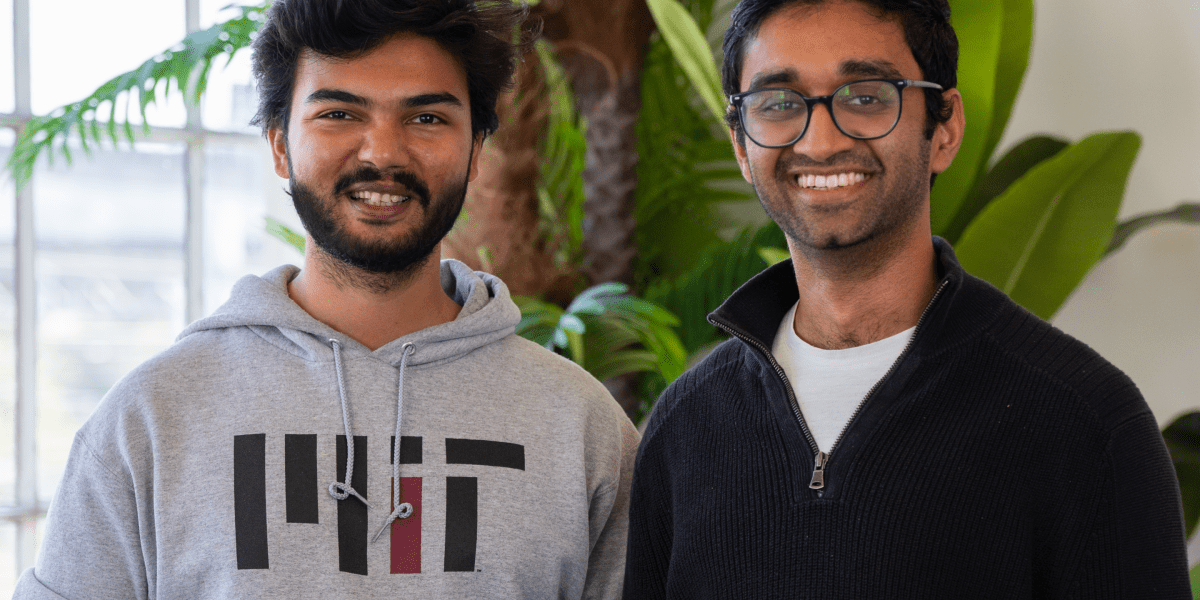
Tanay Kothari saw* Iron Man* when he was 10 years old.
It was 2008 and he wasn’t entranced with Tony Stark. It was chatty computer JARVIS that captured Kothari’s imagination as the voice assistant managed Stark’s sprawling home, maintained his Iron Man suit, and solved complex engineering problems. Kothari thought this could be possible in our universe, not just Marvel, at the time hacking together an early voice assistant. Years later, talking to Stanford classmate Sahaj Garg, he hadn’t let it go.
“When Sahaj and I were talking about the biggest problems we wanted to solve, one of the things that came up was what it means to have a world where AI is prevalent,” said Kothari. “What does interacting with technology look and feel like? It brought me back to when I wanted to build JARVIS. It’s less about what it looks like in the movies and more about a system that just gets you. It’s with you 24/7 and you trust it to do things on your behalf. It seemed like we’d gotten to the point where it was both technically possible and the world might be ready.”
Kothari and Garg—who met in a Stanford freshman dorm on their very first day of college—cofounded dictation and voice AI startup Wispr in 2021. And for a while, they wandered the entrepreneurship wilderness, focusing on wearables that never quite clicked and “silent speech,” an interface that allows computer control without audible sounds. Then, about two years ago, they landed on the product that sent their startup (and their lives) in a new direction: dictation software app Wispr Flow, which is now used by millions of consumers and 100,000 businesses. For the last four quarters in a row, Wispr says it’s seen revenue jump north of 150%.
Wispr raised capital just six months ago, but investors have already re-upped: The startup’s now raised its $280 million Series B, valuing Wispr at $2 billion, Fortune has exclusively learned. Menlo Ventures led, with participation from existing investors like Notable Capital, NEA, Neo Ventures, and 8VC. New names have entered the mix too—including venture firms like Acrew, Forerunner, Goodwater, Plus Capital, and Peak XV—along with marquee athletes like Joe Burrow, Shaun White, Klay Thompson, and Paul George, and more. The company has now raised $361 million so far, and dictation isn’t the end game.
“It isn’t a dictation market,” said Matt Kraning, Menlo Ventures partner, via email. “Dictation is how you get in the door. What people pay for is not having to type, which puts you up against workflow tools, meeting tools, and eventually the text box in front of every AI model. The labs have mostly solved intelligence. Nobody has solved how a normal person tells it what they want.”
Wispr faces serious competition from the biggest names in tech—Apple, Google, Microsoft, Anthropic, and OpenAI—who’ve all been chasing dictation and voice in some form. And it makes sense, because the use cases are varied and endless: Kothari and Garg know of at least a few people who’ve written novels with Wispr, and have found that it’s useful for those with everything from ADHD and dyslexia, to quadriplegia and blindness.
“There’s this whole class of people who are using Wispr to do things they wouldn’t have been able to do otherwise,” said Kothari. “I found out recently that my friend’s dad, who’s blind, has been using Wispr to send messages and do all sorts of things, because Siri would just make so many mistakes. He felt he could never trust any of those tools. It’s democratizing technology for a group of people who’ve felt left out for decades.”
Kothari and Garg know that, from a privacy standpoint, this all sounds potentially invasive. But, as Garg said, trust is essential for their business to exist: “Everything about these tools is about trust,” he told Fortune. “Privacy and security aren’t features for us: They’re the foundation for earning ambient access to your life.”
What’s our relationship then, to this tech that increasingly looks set to entwine with our lives and psyches? To Garg, much must remain human.
“These systems can consult for you, but you should still supply your intent,” said Garg. “I don’t want to be in the business of replacing people. I want to be in the business of helping people amplify their intent, allowing them to make their own decisions. It should be a system that manages you as much as you manage it. It’s about the person, and preserving their decision-making—but not making them have to think about how they do everything from scratch every time.”
See you tomorrow,
Allie GarfinkleX:
@agarfinks Email:
[alexandra.garfinkle@fortune.com](mailto:alexandra.garfinkle@fortune.com)

Submit a deal for the Term Sheet newsletter [here](mailto:termsheet@fortune.com).
Joey Abrams curated the deals section of today’s newsletter.Subscribe here.
VENTURE CAPITAL
- Sterling, an Auckland and Wellington, New Zealand-based developer of an AI autopilot designed for finance teams, raised $3.8 million (NZD) ($2.2 million USD) in funding.
Blackbird led the round.
PRIVATE EQUITY
-
Providence Equity Partners agreed to acquire Hometrack, a London, U.K.-based residential property data platform designed for financial services workers, investors, and insurers. Financial terms were not disclosed.
-
Wolf-Gordon, a portfolio company of Charger Investment Partners, acquired Andor Willow, a Toronto, Ontario-based wood wall panels and room dividers company, and
Look Walls & Interiors### OTHERS
- Metaview acquired Reval, a San Francisco-based AI-powered recruiting firm. Financial terms were not disclosed.
PEOPLE
- Vistara Growth, a Vancouver and Toronto, Canada-based growth equity firm, promoted John
O'Donoghue and
Neil
Kenley to Partners.
Sign upfor free.