The "Shiny Object" Tax #
We've all seen it: a dev needs to validate an email address, and instead of a regex, they implement a model call. Suddenly, you've got API latency, spinners, and a monthly bill for something that should take a microsecond. You've essentially traded a local CPU cycle for a round-trip to a data center.
Determinism vs. Probabilism #
The core difference is simple: an if
statement is deterministic. The same input always yields the same output. An LLM is probabilistic—it can give you a different answer based on the temperature setting or a model update.
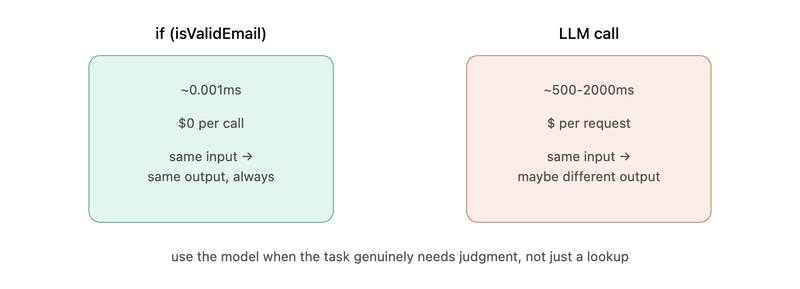
If-statement: Zero cost, millisecond execution, 100% predictable.LLM call: Per-token cost, seconds of latency, variable output.
When to actually use each #
If you're building an AI workflow, you need to be ruthless about where the model actually adds value.

**Stick to standard code (if/else, regex, lookups) when:**

- The rule is binary. (e.g., "Is the cart total over $50?")
- You need absolute consistency. (e.g., Billing logic, permission checks).
- Performance is critical and there's no ambiguity.
Deploy an LLM agent when:
- The task requires nuance or judgment. (e.g., Summarizing a transcript).
- The input is unpredictable free text. (e.g., "What is this customer actually upset about?").
- Variability is a feature, not a bug. (e.g., Creative copywriting).
Real-world examples #
Password strength: "8 characters and a symbol" is a rule. Don't use AI for this.Urgency detection: Checking if a ticket contains the word "urgent" is a keyword search. Understanding that a customer is subtly furious based on their tone is a language problem. Use AI here.Discount codes: Checking if a code is expired is a database lookup. Stop asking models to check your DB.Meeting notes: Condensing 200 pages of rambling into three bullet points? That's exactly what LLMs are for.
Choosing the wrong tool doesn't just look like over-engineering; it kills your UX with unnecessary latency and burns your budget on tasks that a junior dev could solve with three lines of JavaScript.
Next Vibe Coding: Why AI-Assisted Projects Fail →