Global Head of Public Sector & Workforce Intelligence
6 min read
Across the public sector, AI budgets have already been approved. Pilots are running, deployment pressure is growing, and expectations are high that AI will help organisations do more with fewer people, make faster decisions, and increase operational capability.
Where outcomes carry the highest consequence — emergency response, defence, healthcare, critical infrastructure — AI applied directly to fragmented workforce data produces well-written but incomplete answers at speeds faster than a human can catch them.
The limitation lies in the architecture beneath the model.
The US Department of Defense’s Data, Analytics, and AI Adoption Strategy is explicit about the sequence: quality data sits at the base of the hierarchy, insightful analytics build on that foundation, and responsible AI sits at the top.
The strategy states that “all analytic and AI capabilities require trusted, high-quality data.” One characteristic of that trusted data is that it is linked: data that lets users “exploit complementary data elements through innate relationships.”
This is an architectural requirement. Relationships are first-class data assets, and they need to be stored, governed, and queried accordingly.
The previous article showed why compound workforce questions fail across siloed systems. The missing layer is the knowledge layer: it connects workforce data into a coherent operational model that AI can actually reason over.
What the knowledge layer contains #
Compound questions are structural problems. The data already exists; it’s simply disconnected.
The workforce knowledge layer connects persistent facts about the workforce into a continuously maintained knowledge graph: people, roles, skills, certifications, clearances, contractors, suppliers, missions, and the relationships between them. As people transition into different roles, certifications expire, contractors enter or leave programmes, or missions change, the graph reflects operational reality rather than the last exported report.
The workforce knowledge layer also holds operational context: current assignments, active missions, emerging constraints, and recent decisions. Together, they give AI a connected, governed representation of operational reality instead of disconnected workforce records.
Without this shared representation, every AI application builds its own understanding of the workforce from fragmented systems. The result is inconsistent reasoning, duplicated logic and decisions that depend more on where the data happened to reside than on operational reality.
Operational questions in practice #
The compound questions from the previous article share one pattern: the answer requires following chains of relationships across entities that aren’t directly connected. Three common public sector scenarios illustrate why it matters.
Surge decisions
Who can deploy to this mission without creating a capability gap somewhere else?
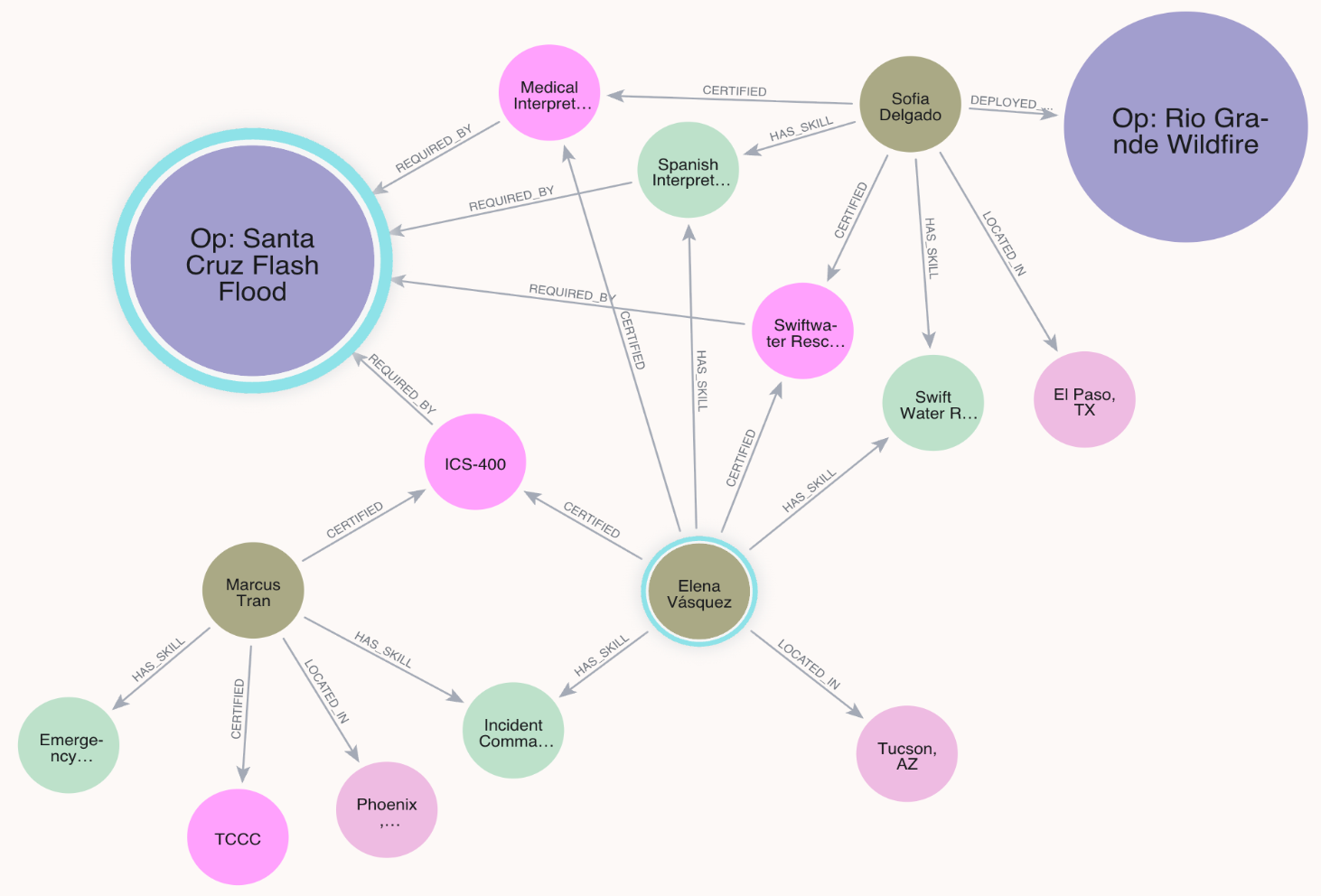
Take the fictitious example of a flash flood in Santa Cruz, which requires a team on-site within 24 hours. Personnel need to be ICS-400 and Swiftwater Rescue Tech certified, and also hold a medical interpreter certification. Additionally, they must be able to speak Spanish.
To answer this question, qualifications are only the starting point; the key question is whether moving that person breaks something else. In this example, both Elena and Sofia qualify. But Sofia is the only medical interpreter attached to an active wildfire response two counties away — redeploy her, and that mission loses a capability it can’t backfill. Elena’s role has coverage.
Only the relationships reveal the difference.
Answering compound questions such as this one across thousands of specialists during an active response, while conditions keep changing, is exactly the kind of reasoning the knowledge layer enables.
Contractor dependency
What’s the operational impact if this contractor exits tomorrow?
The traversal maps which programmes the contractor supports, which roles depend on them, where no internal capability exists, and what downstream missions become exposed. Then it goes further. Who owns the supplier? Who owns the parent company? Which subcontractors support critical programmes? Does any point in that ownership chain carry financial, geopolitical, regulatory, or operational risk that should already be understood?
This is a multi-hop traversal across people, organisations, programmes, ownership structures, and operational dependencies: the kind that siloed, record-based systems cannot answer efficiently.
Access and clearance alignment
Right now, are this person’s clearance, training, privileged access, and operational responsibilities still aligned?
The traversal connects formal records with operational reality, and it reveals something individual systems never capture. Where does this person sit inside the operational network? How many cross-agency relationships do they maintain? Which missions do they connect that no organisational chart reveals?
Network position changes risk. Cybersecurity Insiders’ 2025 Insider Risk Report, a survey of 635 security leaders, found that 93% consider insider threats as hard or harder to detect than external cyberattacks. They’re hard to detect because the signals are relational — who someone is connected to, what systems they can reach, which missions depend on them. But relational signals don’t live in a clearance database. The knowledge layer makes them visible.
By grounding every decision in explicit relationships, leaders can explain the reasoning path: they can see which relationships they traversed, what evidence they considered, and when they last validated each decision. For public sector AI governance, auditability is a requirement.
AI needs the right foundation #
With AI budgets approved and projects in their initial stages, one decision remains: build the knowledge layer before deploying AI, or after.
When organisations apply AI directly to fragmented workforce systems, they end up automating the wrong architecture. The model provides confident answers that don’t reflect operational reality because the necessary relationships were never exposed. Rebuilding that foundation after deployment is slower, more expensive, and significantly harder than building it from the start.
Build the knowledge layer first, and AI has something trustworthy to reason over from day one. A workforce facing structural challenges, such as an ageing population, budget restrictions, diminishing specialist pipelines, increasing operational demands, and a reliance on contractors, can achieve more when connected information replaces manual reconciliation.
The functions governments depend on stay fundamentally human: emergency coordination, cyber defence, combat medicine, disease surveillance, and intelligence analysis. AI augments that operational judgement rather than replacing it, helping leaders answer compound questions quickly enough for the answer to matter.
The force multiplier is connected intelligence, not more automation.
Connected or exposed #
The data needed to answer compound workforce questions already exists across public sector organisations. What’s missing is the architecture that connects it.
Neo4j’s Graph Intelligence Platform provides that architecture through a knowledge layer: connected, governed, traversable relationships that turn fragmented workforce records into operational workforce intelligence.
The organisations that benefit most from AI will not necessarily be those with the largest models.
They will be the ones with the strongest knowledge foundation.
Connected organisations discover critical dependencies before the crisis. Exposed organisations discover them during it.