I've watched three enterprises in the past year bolt LLMs onto legacy CRUD stacks and call it transformation. One added a chatbot to their support portal — same ticket volume, same resolution time, now with hallucinated policy quotes. Another wrapped GPT-4 around their BI dashboards; executives still export CSV to Excel because the natural-language layer can't handle "show me YoY growth excluding the acquisition quarter." The third built a RAG pipeline over 12 years of Confluence pages — retrieval works, but nobody trusts the answers because source metadata is garbage.
The pattern is clear: adding intelligence to dumb processes yields smart dumb processes.
An AI-native enterprise doesn't start with "where can we use LLMs?" It starts with "which decisions are currently made by heuristic, latency, or politics — and what would change if they were made by differentiable objectives with measurable loss functions?"
Take pricing. Traditional firms run quarterly reviews, spreadsheets, sales intuition. An AI-native version treats price as a continuous control variable, optimizing against real-time elasticity signals, inventory velocity, competitor scrapes, and customer lifetime value — all differentiable, all backpropagated through a single objective. The human role shifts from "set the number" to "design the reward function and constrain the guardrails." That's a different org chart, different KPIs, different hiring profile.
Or consider code review. Today it's a gate: human reads diff, leaves comments, approves. AI-native flips it: the model proposes the diff, predicts failure modes, writes the tests, simulates production load — the human only intervenes when uncertainty exceeds a calibrated threshold. The metric isn't "PRs merged per week" but "mean time to verified deployment with <0.1% rollback rate."
This requires rethinking data gravity. Most companies have data lakes that are actually swamps — schema-less, undocumented, access-controlled by politics. AI-native means treating data as a first-class differentiable asset: versioned, lineage-tracked, quality-scored, with explicit contracts between producers and consumers. You don't get there by hiring a "chief data officer." You get there by making data contracts a deployment blocker, same as failing tests.
The talent model breaks too. Prompt engineering isn't a role; it's a literacy. Every PM, designer, analyst, and engineer needs fluency in evaluation design, failure-mode taxonomy, and cost-latency-quality tradeoffs. The org that centralizes "AI expertise" in a CoE creates a bottleneck; the org that distributes it as baseline competence moves at model speed.
Risk posture shifts from "prevent errors" to "bound blast radius." You ship eval harnesses before features. You deploy canaries with synthetic adversarial traffic. You instrument every model call with latency, token cost, and confidence intervals — not just success/failure. Observability becomes the product, not an afterthought.
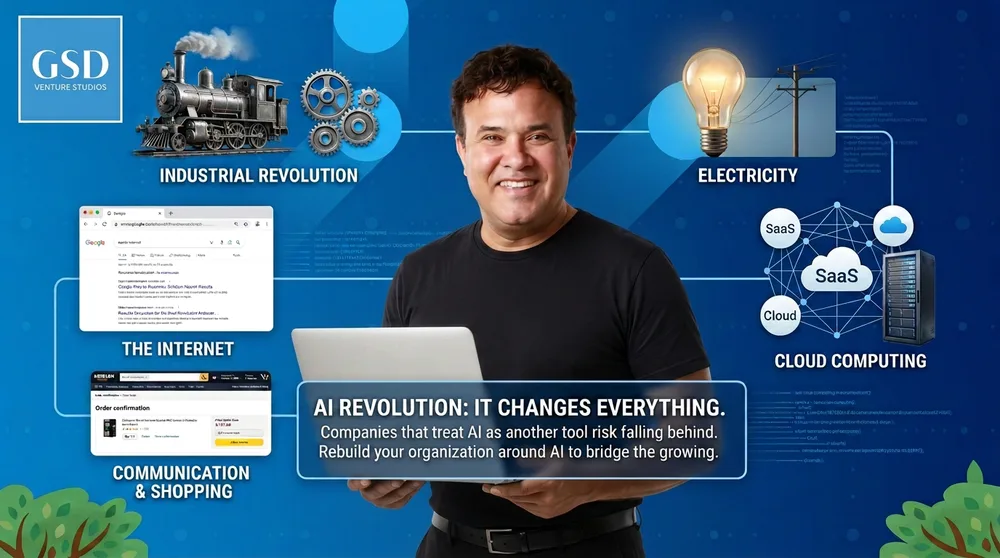
None of this is optional. The companies that figured out electricity in 1900 didn't just install bulbs — they redesigned factory layouts, shift schedules, supply chains. The ones that didn't ceased to exist by 1930. AI's half-cycle is measured in quarters, not decades.
The window to start the structural rewrite isn't "next planning cycle." It was six months ago. The second-best time is today — but only if you're willing to break the org chart, not just the build pipeline.
AI is making every side project feel like meaningless slop 1d ago
AI is killing the spirit of hackathons if we keep letting LLMs 2d ago
Is jailing anti-AI protesters actually a sign that we're losing 2d ago Mocktail v4 lets you spin up a mock API server in a 25MB binary 4d ago
Bullet is hitting 95.8% on SWE-bench Verified and it's way faster 5d ago AI is making code reviews the new bottleneck in the SDLC 6d ago
Next Voice cloning just turned grandparent scams into a nightmare →
a library of Claude prompt techniques, with plenty of directly applicable cases.