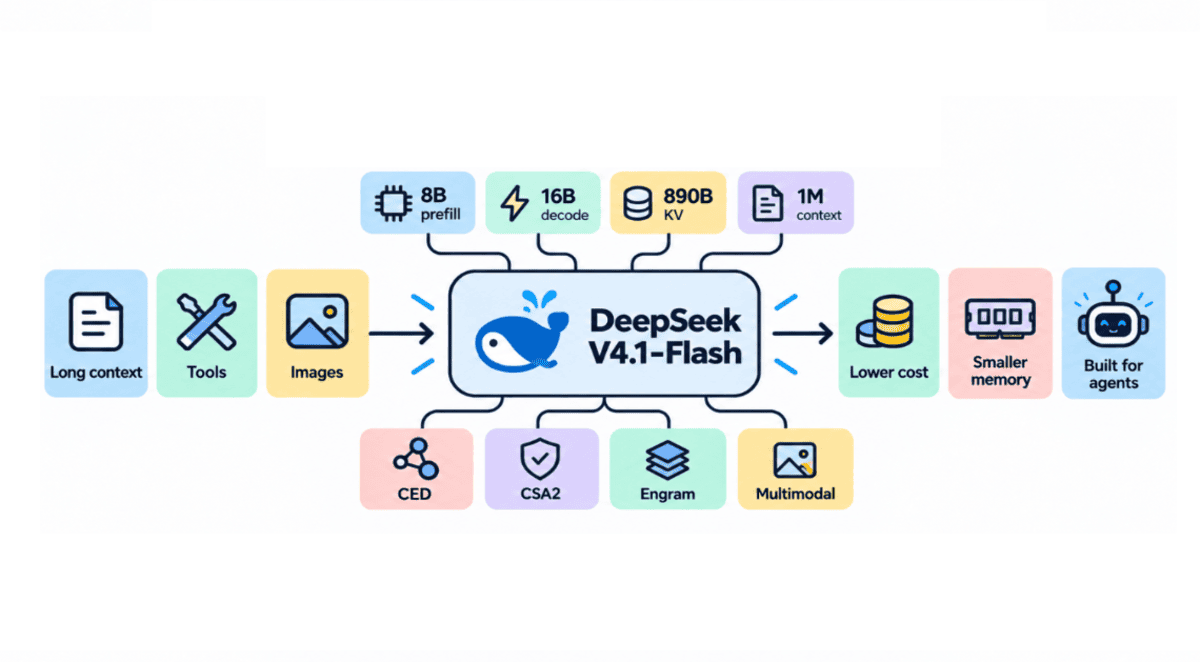
DeepSeek-V4.1-Flash shows how Causal Encoder-Decoder architecture, MoE, KV cache compression, CSA2, cheaper prefill, and efficient decoding can make powerful open-source AI models far more efficient to run.
DeepSeek has released DeepSeek-V4.1-Flash, and while the benchmark numbers are impressive, they are probably not the most interesting part of this release. The architecture is.
DeepSeek is tackling several problems that are becoming increasingly important as AI moves toward long-running agents: expensive prefill, huge KV caches, long contexts, memory bandwidth, and the cost of maintaining agent state across interactions.
Rather than simply making the model larger, DeepSeek has redesigned several parts of the architecture and inference stack to make long-context AI much cheaper to run.
In this article, we will break down what DeepSeek changed, how these changes make the model cheaper and more efficient to run, and why they matter for long-running AI agents.
DeepSeek-V4.1-Flash at a Glance #
DeepSeek-V4.1-Flash is a 552B-parameter Mixture-of-Experts model, but only 8B parameters are active per token during prefill and 16B during decoding.
It supports a 1-million-token context window, accepts both text and images, and reduces its global KV cache to just 890 bytes per token.
The model was trained from scratch on 45 trillion multimodal tokens and also includes a separate 196B-parameter Engram conditional-memory component, which is accessed sparsely rather than executed like ordinary backbone parameters.
| Attribute | Value |
|---|---|
| Backbone parameters | 552B |
| Active during prefill | 8B |
| Active during decode | 16B |
| Context window | 1M tokens |
| Global KV cache | 890 bytes/token |
| Architecture | Causal Encoder-Decoder + MoE |
| Input | Text + images |
| Training | 45T multimodal tokens |
| Conditional memory | 196B Engram |
| License | MIT |
The most important numbers here are probably 8B, 16B, and 890 bytes.
They show what DeepSeek is really optimizing for: cheaper input processing, more compute when generating, and a dramatically smaller memory footprint for long contexts.
The main architectural additions include Causal Encoder-Decoder (CED), Compressed Sparse Attention 2 (CSA2), FP4 KV caching, SWA Bounded Replay, Engram conditional memory, and Single-Pass mHC. Together, they are designed to reduce compute, memory use, storage, and generation cost.
DeepSeek Found a Cheaper Way to Read Long Prompts #
LLM inference has two very different stages.
First comes prefill, where the model reads and processes the prompt. Then comes decode, where it generates the response token by token.
This distinction matters because modern AI agents are becoming extremely input-heavy.
A coding agent might repeatedly read:
It could process hundreds of thousands of tokens before producing only a few thousand tokens of useful output.
Traditional decoder-only Transformers do not particularly optimize around that imbalance.
DeepSeek does.
V4.1-Flash introduces a Causal Encoder-Decoder (CED) architecture consisting of a 20-layer causal encoder followed by a 20-layer decoder.
The important difference is what happens to the KV representations.
Instead of every decoder layer independently generating another complete global KV representation during prefill, the decoder can obtain its global KV information from the encoder's final representation.
That produces an unusual compute profile:
Prefill → 8B active parameters per token
Decode → 16B active parameters per token
So this is not simply a case of routing fewer MoE experts during prefill.
DeepSeek has changed the architecture so that the model can spend less compute ingesting information and more compute when it actually needs to reason and generate an answer.
That is almost exactly the compute profile you want for AI agents.
If an agent needs to read 500,000 tokens before generating 5,000 tokens, reading and writing probably should not cost the same amount.
The KV Cache Got Dramatically Smaller #
The other major problem with long context is the KV cache.
During generation, the model stores representations of previous tokens so it does not have to repeatedly recompute the entire context.
As context windows grow toward one million tokens, that cache becomes a major infrastructure problem.
DeepSeek-V4.1-Flash brings its global KV cache down to just 890 bytes per token.
At one million tokens, that works out to roughly 890 MB of global KV data, before accounting for the rest of the memory needed to run the model.
Compared with V4-Flash, DeepSeek says V4.1-Flash needs roughly around one-quarter of the HBM for its global KV cache.
A major reason for this is Compressed Sparse Attention 2 (CSA2).
Normally, different attention layers may create their own KV information and then search through it again to decide which earlier tokens are important. That means several layers can end up storing and searching very similar information.
CSA2 reduces this duplication by allowing layers to share previous work.
It uses three modes:
| Mode | What Happens |
|---|---|
| Full | Creates new KV information and searches it for the most relevant tokens |
| Reindex | Reuses existing KV information, but performs a new search over it |
| Reuse | Reuses both the KV information and the previous search results |
The easiest way to think about it is:
- Full → create the memory and search it
- Reindex → reuse the memory, but search it again
- Reuse → reuse both the memory and the earlier search
This means every layer does not have to repeat the same expensive work from scratch.
DeepSeek also uses a Hierarchical Sparse Indexer.
Imagine the model has a context containing one million tokens. Instead of every later layer searching through all one million tokens again, an earlier stage can first narrow them down to a smaller set of likely useful tokens.
Later layers can then search within that smaller set. So the process becomes something like:
This means that even as the context becomes very large, every layer does not necessarily have to search through the full context.
DeepSeek then combines this with FP4 KV caching, which stores the KV information in a more compact format and reduces the memory requirement even further.
Together, CSA2, hierarchical indexing, cross-layer sharing, and FP4 KV caching bring the global KV cache down to just 890 bytes per token.
For long-running agents that may need to keep hundreds of thousands or even millions of tokens in context, that reduction in memory could matter just as much as the model's benchmark score.
A Few More Clever Architecture Tricks #
CED and CSA2 are the big changes, but DeepSeek has added several smaller ideas that improve memory use, storage, and generation speed.
SWA Bounded Replay
SWA Bounded Replay reduces how much recent attention state needs to stay stored.
Instead of keeping everything in memory, the model can discard some states and rebuild a small recent window when needed.
Store less → recompute a little → save memory
DeepSeek says this reduces persistent KV storage to around one-eighth of V4-Flash.
Engram Conditional Memory
V4.1-Flash also includes a 196B-parameter Engram memory component.
Instead of activating all of those parameters for every token, the model retrieves only the information it needs.
Think of it as:
Neural network → work something out
Engram → look something up
This gives the model more capacity without adding the same amount of compute to every token.
Mixture-of-Experts
The backbone remains a Mixture-of-Experts (MoE) model.
It has hundreds of billions of total parameters, but only a small group of experts is activated for each token.
Large model → fewer active parameters → lower compute
Single-Pass mHC
Single-Pass mHC makes data movement inside the model more efficient.
Instead of repeatedly reading and mixing the same activations, DeepSeek reorganizes the process so more of that work happens in a single pass.
Read less → move less data → faster inference
DeepSeek says this reduces memory traffic for the operation by roughly 50%.
DSpark Speculative Decoding
DSpark is designed to speed up token generation.
It first creates several draft tokens, and the main model then checks them. If they are correct, multiple tokens can be accepted together.
Draft → verify → accept
This helps the model generate responses faster.
Putting Everything Together
Each technique targets a different bottleneck:
- CED: cheaper prefill and lower input-processing cost
- CSA2: smaller KV cache and less repeated attention work
- FP4 KV caching: lower memory use for stored KV data
- SWA Bounded Replay: less persistent KV storage
- Engram: more memory capacity without activating everything
- MoE: fewer active parameters per token
- Single-Pass mHC: less memory traffic during inference
- DSpark: faster token generation through speculative decoding
The important part is that DeepSeek is not optimizing just one thing. It is trying to make the whole inference process cheaper and more efficient.
The Agent Benchmarks Are Where It Gets Interesting #
All of these architecture ideas would be much less interesting if the model got worse in practice.
But according to DeepSeek's reported results, that is not what happened.
V4.1-Flash not only becomes more efficient, it also performs strongly on the kinds of benchmarks that actually matter for agents — especially terminal use, coding, automation, and cybersecurity.
| Benchmark | V4-Flash | V4-Pro | V4.1-Flash |
|---|---|---|---|
| DeepSWE v1.1 | 54.4 | 62.7 | 74.2 |
| Terminal-Bench 2.1 | 82.7 | 87.9 | 90.6 |
| CyberGym | 76.7 | 83.3 | 88.1 |
| AutomationBench | 37.7 | 43.2 | 54.8 |
| Agent's Last Exam | 25.2 | 25.7 | 31.8 |
The broader comparison is also interesting.
In the chart above, DeepSeek-V4.1-Flash performs very competitively across agent-focused benchmarks, and in some cases leads the group. It reaches 74.2 on DeepSWE, 88.1 on CyberGym, and 54.8 on AutomationBench, while also staying strong on terminal tasks.
So the story here is not just:
DeepSeek made another model that scores well.
It is:
DeepSeek made a model that is cheaper to run, while still improving on the kinds of workloads that matter most for real AI agents.
That is what makes this release feel different.
DeepSeek is not only trying to improve model quality. It is also trying to reduce the cost of reading long prompts, storing context, retrieving information, using model capacity, and generating responses.
And that matters a lot for agents, because agents are usually not limited by just raw intelligence. They are limited by latency, memory, storage, and serving cost.
There is also an important open-model angle here.
Because V4.1-Flash is released under the MIT license, along with reference inference code and implementation details, these ideas can spread beyond DeepSeek itself.
Things like asymmetric prefill and decode compute, KV reuse across layers, sparse attention, FP4 KV caching, bounded replay, and conditional memory could influence future open models and inference engines as well.
Author's Opinion #
After trying the model myself and comparing it with the Artificial Analysis Intelligence Index and OpenRouter data, I do not think DeepSeek-V4.1-Flash is the best model in terms of raw intelligence or cost. Models like GLM-5.3-Flash can offer stronger overall performance at a lower price.
Where DeepSeek-V4.1-Flash does stand out is output speed, and that lines up well with the research behind the model. DeepSeek has clearly focused on making inference faster and more efficient, while reducing compute, memory usage, KV cache size, and storage overhead.
But that is also why this release matters.
The real value is the research behind the architecture. Over the coming weeks and months, I expect open-source developers, inference frameworks, and future models to experiment with many of these ideas.
So V4.1-Flash does not need to be the smartest or cheapest model to be important. Its biggest contribution may be showing the open-source community new ways to make powerful AI models faster and much more efficient to run.
[Abid Ali Awan](https://abid.work) (@1abidaliawan) is a certified data scientist professional who loves building machine learning models. Currently, he is focusing on content creation and writing technical blogs on machine learning and data science technologies. Abid holds a Master's degree in technology management and a bachelor's degree in telecommunication engineering. His vision is to build an AI product using a graph neural network for students struggling with mental illness.