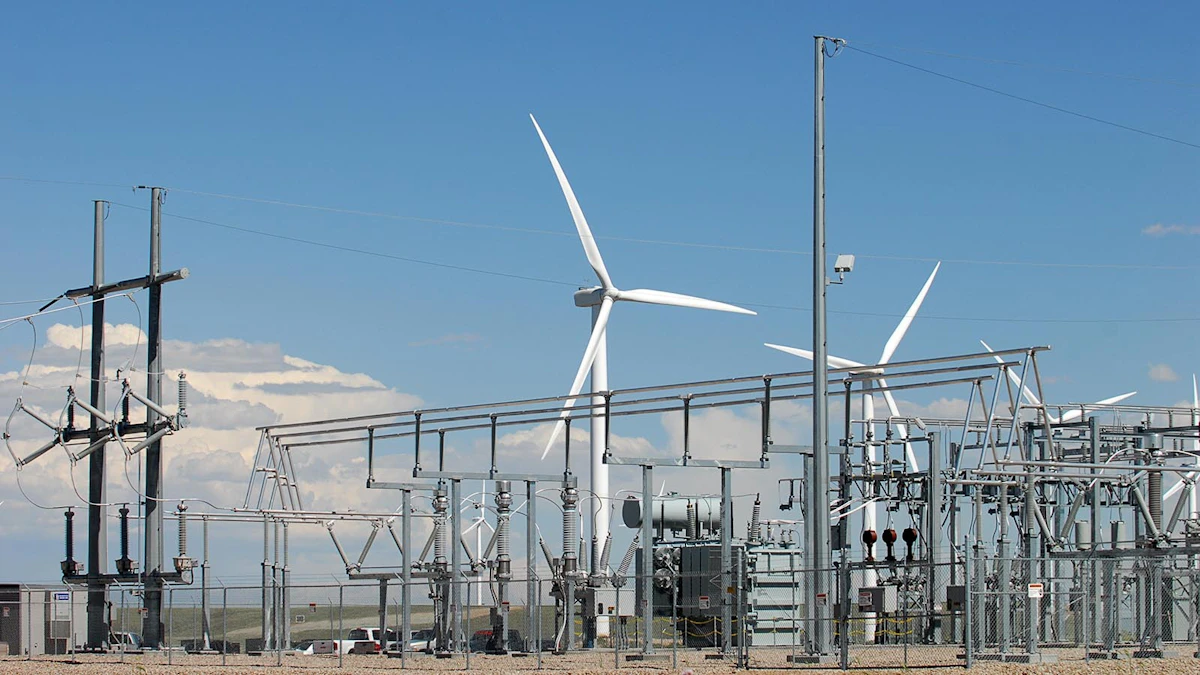
To the “tech bros,” the future is simple. Either America rebuilds its energy grid fast, or it will hand the coming AI revolution — and the billions in economic impact that comes with it — to foreign countries, some of whom aren’t America’s friends.
Ask around Wyoming coffee shops about AI, data centers, Bitcoin mines and the energy transformation all that’s going to require, and you’re more likely to hear grumbling about power bills than excitement about the future.
A quiet coalition of technologists, investors, and former internet builders is hoping to change all that.
Their ideas have been laid out in a limited edition hardcover book from American Transmission Leadership and Security, or ATLAS, a group that wants to rally thought leaders across the nation to rethink how America builds and regulates its power grid for the next century.
Copies were signed and handed out to a select group of tech movers and shakers at an after-hours private party during the Wyoming Blockchain Symposium.
Held at Jackson Hole’s Caldera House, the invitation-only gathering was a small affair with big ambitions, offering heavyweight ideas to heavy hitters invited to be part of the audience.
Cowboy State Daily was one of the only media outlets invited to attend the event, which included off-record presentations from HUT8Corp Founding Chairman and venture capitalist Bill Tai, Google Energy Market’s Kaitlin Savage, and Priority Power’s Kevin Young. Priority Power is a major energy solutions and transmission management provider in North America.
From Information To Knowledge
Tai is a heavy hitter in digital asset circles. He was a founding investor for several tech giants, including Zoom, Canva, Twitter (Tweetdeck), Wish.com and Coinbase.
More recently he’s backed several blockchain, AI, and deep-tech infrastructure projects.
Tai agreed to speak to Cowboy State Daily after the private party about what America’s energy grid needs in the next century to continue leading the world, as well as how a brave new digital asset world could benefit Wyoming.
“The American economy has gone through many transformational phases, dating back from an agricultural era and transforming to a mechanized Industrial Revolution to a second Industrial Revolution around information,” he said. “Now we are at the cusp of a new information economy, based on knowledge.”
This new knowledge-based economy is being layered on top of the information structure built into the Internet by companies such as Google, whose focus is easier access to information.
“With the advent of GPUs from NVIDIA or a handful of others, that information can be distilled into knowledge,” Tai said. “So you’re not just having to look at 50,000 articles and figure out what is most relevant to you. The machines basically sort things out and distill it into actions for you or things you can take actions on. The efficiency of that, I think, can unlock another layer of productivity that we haven’t seen before.”
The ‘Ma Bell’ Problem
The power needs for this next-era Information Age will be exponentially higher, Tai acknowledged, but he believes it doesn’t have to be done in a way that hurts the wallets of everyday citizens.
Behind the scenes, Tai and others talk about three big changes they believe are unavoidable if America is going to keep pace.
These are fixing interconnection bottlenecks, squeezing more power through lines we already have, and modernizing how we price and move electrons.
It’s basically the old “Ma Bell” problem, a reference to the 1990s breakup of Bell Telephone into multiple “Baby Bells” to more efficiently accommodate innovations in the telecommunications industry such as cell phones.
Right now, interconnection studies and transmission are still being controlled by incumbent monopolies, working under rules written for a much simpler grid.
That has developers waiting years and spending millions just to be told what it will cost them to connect — and those numbers can still change halfway through construction.
Tai and others want clearer, time-bound rules for grid studies, and more open-access-style markets that reward projects that actually relieve congestion and improve reliability, instead of just preserving old monopolies.
They’d also like to see the use of things like advanced conductors, which can make it possible for existing lines to safely carry more capacity than they do now.
Tech giants like Google are already quietly backing some of these “advanced” conductors companies.
Some in the Atlas circle also talk about treating electricity a little more like data.
That way, it could be broken into smaller “packets” that can be priced and steered in real time.
Blockchains, which are an indelible digital diary of transactions, could be used to track who used what and when, and reward people and communities that help balance the grid, instead of leaving all the decisions to complicated and time-consuming utility rate cases.
New Tools For Old Wires
The group also believes that cost efficiencies that kick in at larger sizes — so-called economy of scale — can be leveraged to keep costs lower for consumers.
That’s already worked in some communities to lower electric rates.
Indiana Michigan Power, for example, leveraged incoming data center revenue to offset infrastructure costs, executing a 3.6% rate reduction and saving average residential customers about $6 a month.
Georgia Power, after a multi-year rate freeze, has projected average residential savings of $102 annually in 2028, thanks to economies of scale from the buildout for massive industrial loads.
Pacific Gas & Electric in California has estimated system-wide rates are up to 11% lower than they would have been, thanks to fixed-grid maintenance costs being spread across more total megawatt hours sold.
“GPUs need electricity to run,” Tai said. “And while we can make all the GPUs you want, and we’re dominant in that industry, if you can’t plug them in, it doesn’t matter. America’s been in the lead in so many evolutions of this economy, and I’d like to see it stay that way. But, we’re at a point where we’re suffering from an inability to keep up with other countries in energy production.”
A New Kind Of Energy Export
In Wyoming, those kinds of arguments face a century or so of lived experience with coal, oil and gas.
People in the Cowboy State have some experience with what happens when far-off investors decide their energy is a commodity to be bought and sold.
As recent public meetings about data centers have shown, many are concerned that AI “gigafactories” and Bitcoin mines are just the next outsider bidding up a finite pool of energy molecules — and likely leaving locals holding the bag.
Tai doesn’t dismiss such worries. But he said he believes the risk of doing nothing is greater, and sees ways that Wyoming can leverage the influx to create new opportunities.
“More demand is better if it’s in concentrated chunks,” he explained. “Because you have to draw that capital investment. Because, if you have a little neighborhood that wants to increase energy by 10%, nobody cares, but if you have a big data center that wants to get set up and somebody can then draw the capital to fulfill that need, there will be excess energy.”
Such outsized demand will overcommit rather than undersize, Tai explained, leading to excess capacity.
That, in turn, helps boost the localized supply, helping to drive lower rates.
In his view, if Wyoming can attract large, long-term digital loads on the right terms — and pair them with smart grid upgrades — the state can both protect households and lock in a new export industry based on electrons for power, not just its raw commodities.
Wyoming’s Next Move
The ATLAS project, including the book it has recently produced, is intended to help start conversations with thought leaders in all industries about the changes this next-level information era is going to require.
“We need to make some fundamental changes to how we govern, how we regulate, and how we construct our next-generation (energy) production and grid,” Tai said.
For Wyoming, those conversations aren’t theoretical anymore. Cheyenne already has roughly 15 data centers either operating or under construction, and dozens more inquiries that range from serious to tire-kickers.
Casper, Evanston, and other areas of the state, meanwhile, also have one or more data centers knocking at their doorsteps.
The state is already feeling the pressure that comes with digital-age industries that might want anywhere from 1GW to 10GW for a single facility.
Tai’s argument is that, with the right rules and upgrades, Wyoming can turn the pressure into an advantage — using large, long-term power contracts to justify new infrastructure that ultimately lowers costs for everyone else.
Skeptics might not be so sure — as recent fights showing up in public hearings and neighborhood meetings across the state show.
But the race to rebuild America’s grid is already, in some respects, off to the races to capture their slice of this emerging new economy.
What Wyoming ultimately decides to do about that will determine how big its own slice of the new information age becomes — and likely will shape its economic opportunities for generations.
Contact Renee Jean at renee@cowboystatedaily.com
Renée Jean can be reached at renee@cowboystatedaily.com.