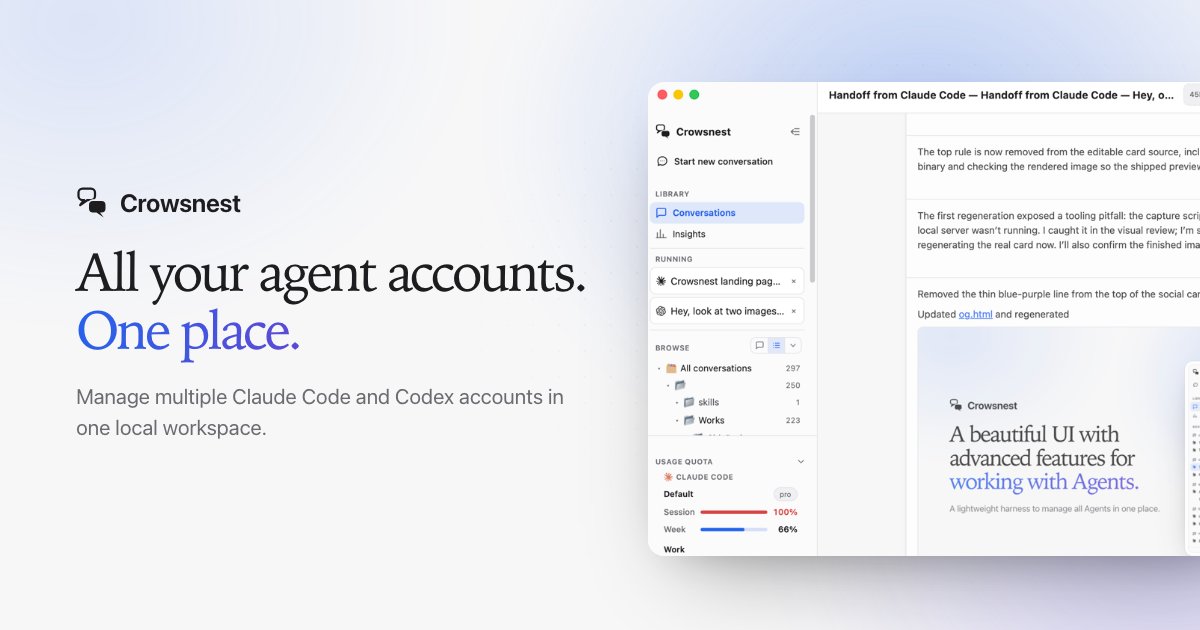
All your Claude Code and Codex accounts. One place.
The Crowsnest app is a private, local macOS workspace. Compare provider-reported usage across accounts, choose where new work starts, and continue on another when one reaches its limit — with a compact briefing and visible lineage.
Describe the task. In Crowsnest, it becomes a real Claude Code or Codex session—ready to resume, edit, or branch.
This preview uses a prepared response and sends nothing.
Try the launch-to-chat flow: enter any prompt and the preview will show a prepared response. Your text stays in this page—nothing is sent or saved. Multiple accounts
Hit a limit on one account. Keep going on another.
When a session runs out of provider quota, Crowsnest offers to continue on a second subscription account you are already signed into. It quotes a compact briefing into a fresh session under that account and keeps the lineage back to the original — an attributed fork, never a disguised native resume.
Claude Code and Codex alike; each account keeps its own config directory.
Fresh installs ask first; optional automatic continuation acts only with one unambiguous destination.
Opt-in routing uses readable allowance evidence; a missing reading never masquerades as zero.
The Accounts panel showing per-account provider logins, usage trend and remaining allowance, a second named account added and made default, and the policy that decides what happens when one account runs out. Click the video or press Enter or Space to or play it.
Agent Crew
Agent Crew turns one objective into a reviewed multi-agent plan.
Ask a read-only lead agent to turn an objective into an editable dependency graph. Review provider choice, prompts, file claims, and worktree paths before anything runs — it is a reviewed workflow, not a black box.
Research, synthesis, implementation, integration, and cross-review.
Steer, stop, retry, or reroute individual tasks as work proceeds.
No run reports Done without completed integration and cross-review.
Crew turning an objective into a reviewed multi-agent plan and starting the approved run. Click the video or press Enter or Space to or play it.
Remote Workspaces
Your agents do not have to live on this Mac.
Connect a machine you already reach over SSH and its Claude Code and Codex work joins the same workspace. Crowsnest sends a checksum-verified copy of its own helper down that connection, so there is nothing to install on the server.
One non-interactive SSH stream — no port forwarding, remote shell, or installer.
Remote conversations stay on the remote machine; nothing is copied here.
Remote projects and accounts join the ordinary launcher, tagged by location.
Point at the interface. Hand the change to an agent.
Open a live preview of an enabled project, select an element, and make reversible visual drafts — text, spacing, radius, size. Crowsnest turns the selection and your draft into a provider-neutral component brief and sends it to Claude Code, Codex, or both.
An accessible selection breadcrumb with bounded DOM and style context.
Drafts are reversible — nothing is written until an agent writes it.
Compare both providers against the same brief on the parallel board.
UI Studio selecting interface elements, drafting visual changes, and sending the review to an agent. Click the video or press Enter or Space to or play it.
Insights
Local usage summaries keep limits, activity, and cost evidence clear.
Explore usage across 7, 30, 90 or 365 days, or all recorded history, broken down by supported dimensions such as day, model, project, hour, cache behaviour, and conversation. It is built from the transcripts already on disk — producing it uploads nothing.
Claude values are local estimates; Codex cost is API-equivalent only when enough counters exist.
Unsupported dimensions are omitted rather than filled with invented zeroes.
An estimate or provider evidence as labeled — never a billing ledger.
Insights showing local usage summaries, spend over time, breakdowns by model and project, cache efficiency, working hours, and expensive conversations. Click the video or press Enter or Space to or play it.
Move work between agents as an explicit fork with visible lineage.
Local Insights
Usage summaries, cost, and cache behavior over time, with labeled provenance.
Loopback-only
No conversation upload or telemetry. Outbound calls are account sign-in, an update check you allow, and connections you start. What “local” means.
Try it for seven days. Then choose your workspace. Your first sign-in starts one fixed seven-day Standard trial. Then choose Standard for the one-agent workspace, Pro for the multi-agent layer, or Premium for every paid module with lifetime updates.
Standard$19.99 · one-time after the trial
The complete workspace for reading, repairing, and driving one agent.
The trial does not reset. It starts on the account's first sign-in and ends seven days later, even after another sign-in, refresh, or reinstall.
No model usage is included. Crowsnest coordinates the Claude Code and Codex runtimes already installed on your machine. You keep paying Anthropic and OpenAI directly under your own plans, and you need at least one of them for Crowsnest to be useful at all.
Payment follows your account. Use the same email at Polar checkout and Crowsnest sign-in. Refresh after payment obtains the signed Standard, Pro, or Premium plan; the client cannot edit it.
The available plans are one-time purchases. Standard is $19.99 and Pro is $69.99 in USD. Premium has a $99 launch price, 50% off $198. Polar displays the final amount at checkout.
No local data is removed when the trial ends. The workspace locks until Standard, Pro, or Premium is active, then opens the same files again.
A current signed access document works offline, with no background payment polling. Source-checkout and uvx crowsnest use remain account-free.
The questions a developer asks first.
Where does my data go?
Your conversations stay on your machine. The interface binds to 127.0.0.1, and transcripts, prompts, answers, project paths, and provider-native history are never uploaded by Crowsnest. The official app sends account credentials only for sign-in and session refresh, and, if you allow it, checks one signed update feed with no workspace or account data. On Pro or Premium, a Remote Workspace you connect yourself opens one OpenSSH session to your own server; that conversation stays on that machine and still reaches no third party. Optional connections you set up, such as a direct model endpoint or the TypeSafe plugin, send only the content of an action you start.
Does editing a past turn break claude --resume?
No. Editing rewrites one line in place while preserving its UUID and tool pairings and keeping every other JSONL line byte-for-byte identical, so resume retains the original surrounding context. Edits keep recoverable backups. For the native continuation paths, see how to resume or restore a Claude Code session.
Which agents does it work with?
Claude Code and Codex. Claude history is the deeply editable format; completed Codex history stays immutable and is changed through its native fork/retry operations instead.
Can I use Claude Code and Codex in the same app?
Yes. Both runtimes live in one workspace: Claude Code and Codex history is browsable and searchable side by side on every plan, including Standard, and you choose which provider a new conversation starts in. Standard drives one native Claude Code or Codex conversation at a time. Running several agents at once, handing work between them, and keeping multiple provider accounts separate are Pro or Premium. Crowsnest coordinates the runtimes already installed on your machine rather than replacing them. Using both agents in one app →
Can I move a task from Claude Code to Codex?
Yes, on Pro or Premium. Two agent runtimes cannot share one thread, so a handoff is an explicit, attributed fork rather than a native resume: Crowsnest writes a bounded briefing that quotes the work so far, starts the new provider-native conversation, and keeps the lineage visible on both sides. Quota is never pooled, and each side still bills to its own provider account. What a handoff briefing should quote →
Do I need an account or a license server?
The official macOS app requires a Google or GitHub account. The first sign-in starts one fixed seven-day trial. Standard, Pro, or Premium is required after it ends. Signed access is verified locally, and a current cached document works offline with no payment polling during ordinary use.
Does Crowsnest run the agents for me in the cloud?
No. Crowsnest coordinates the Claude Code and Codex runtimes installed on a machine you control; those providers still execute models under your own plans. There is no Crowsnest cloud and no queue: Pro or Premium can drive a server you already reach over SSH, but it is your server, not ours. Crew can provision detached local git worktrees under Crowsnest-owned storage, but it never removes, resets, or cleans them.
Can I run Claude Code or Codex on a remote server?
Yes, on Pro or Premium. Remote Workspaces connects to a machine you name by OpenSSH alias, hostname, or user@host and browses, reads, edits, and runs agents there. Crowsnest sends a checksum-verified copy of its own helper down that connection, so the server needs no Crowsnest install and no package manager. Remote conversations stay on the remote machine. Live chat needs the provider's runtime present there: Codex uses the installed Codex CLI, and Claude live chat requires the Claude Agent SDK for the remote Python. How the SSH boundary works →
Does Crowsnest show a Claude Code and Codex usage summary?
Yes. Every plan shows the current provider window's usage and spend. Pro and Premium Insights add local usage summaries across 7, 30, 90, or 365 days or all recorded history, with supported breakdowns by project, model, hour, cache behavior, and conversation. Unsupported dimensions are omitted, and values are labeled by provenance rather than presented as a billing ledger.
How are paid Crowsnest features unlocked?
Standard is a $19.99 one-time purchase, Pro is a $69.99 one-time purchase, and Premium has a $99 one-time launch price, 50% off $198. A successful Polar payment assigns the chosen plan to the same email used for Crowsnest sign-in. After checkout, Refresh now obtains a signed document that the local server verifies before opening the paid workspace boundaries.
Does the price include model usage?
No. A Crowsnest plan covers the local workspace only. Claude Code and Codex still execute models under your own provider plans, and you need at least one of those plans for Crowsnest to be useful.
How do I contact support?
Email support@crowsnest.app for help with installation, sign-in, or a purchase. Crowsnest still uploads nothing on its own, so include the Crowsnest and macOS versions and only the details you choose to send.
Put every agent in view.
Download the signed and notarized Crowsnest app for Apple silicon Macs. Start with a seven-day Standard trial.