What does it feel like to help build the technology that may eventually replace you?
A DeepSeek engineer who worked on the attention kernels behind the company’s latest model recently wrote a remarkably candid reflection on that question. He believes AI may soon become as good as he is at writing and optimizing kernels—perhaps within six months or a year. Yet he keeps making them faster, because if he slows down, someone else will not.
His essay is partly about the future of programming, but it is really about something much bigger: what happens when AI does not necessarily take away your job, but takes away the part of your job that you actually love—and why the people building these systems may feel they have little choice but to keep accelerating anyway.
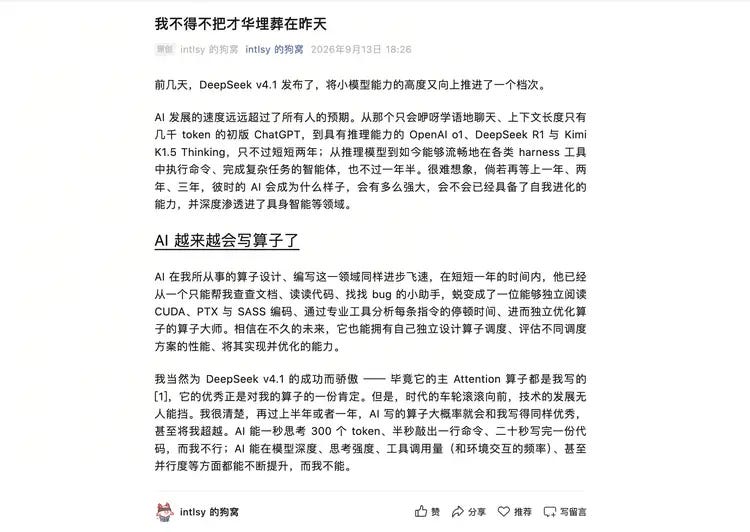
A few days ago, DeepSeek V4.1 was released, pushing the capabilities of smaller models to yet another level.
AI is advancing far faster than anyone expected. It took just two years to go from the first version of ChatGPT—a model that could barely hold a conversation and had a context window of only a few thousand tokens—to reasoning models such as OpenAI o1, DeepSeek R1, and Kimi K1.5 Thinking. And it has taken only another year and a half to move from reasoning models to agents that can now smoothly execute commands across different tool harnesses and complete complex tasks.
It is difficult to imagine what AI will look like another one, two, or three years from now—how powerful it will become, whether it will already be capable of improving itself, and how deeply it will have penetrated fields such as embodied intelligence.
AI Is Getting Really Good at Writing Kernels
AI has also progressed incredibly quickly in my own field: designing and writing kernels.
In just one year, it has gone from being a little assistant that could help me look up documentation, read code, and find bugs into something approaching a kernel expert—capable of independently reading CUDA, PTX, and SASS, using professional tools to analyze the stall time of individual instructions, and then optimizing kernels on its own.
I believe that, in the not-too-distant future, it will also be able to independently design kernel scheduling strategies, evaluate the performance of different scheduling approaches, implement them, and optimize them.
Of course I’m proud of DeepSeek V4.1’s success. After all, I wrote its main attention kernels [1], and the model’s strong performance is, in some sense, also a validation of my work.
But the wheels of history keep turning, and technological progress cannot be stopped. I know perfectly well that in another six months or a year, AI will probably be able to write kernels just as well as I can—and perhaps better.
AI can think through 300 tokens in a second, type a command in half a second, and write a piece of code in twenty seconds. I can’t. AI can continue scaling along multiple dimensions: model depth, reasoning effort, the number of tool calls it makes—the frequency with which it interacts with its environment—and even the degree of parallelism. I can’t.
Human beings have never shown much hesitation when it comes to destroying themselves.
So why, knowing perfectly well that “the better the kernels I write, the faster our new models can train and run inference; the faster the models improve, the sooner I will be replaced,” do I still try my hardest to optimize them?
Partly because writing kernels is like playing a game for me. I get enormous satisfaction from it. The excitement I feel when I invent a new technique or see the performance of one of my kernels improve is no less intense than what a speedrunner feels when breaking a personal record. And when I see one of my kernels dramatically outperform the hardware vendor’s official implementation, I feel an enormous sense of pride.
But there is another, more important reason. Even if I decided to slack off—or deliberately threw obstacles in the way to slow down model training—other companies would continue developing their models, and eventually I would be replaced anyway.
Of course I would rather not be revolutionized out of existence. But if a revolution is inevitable, I would rather be the one revolutionizing myself.
When everyone is this determined to destroy themselves, I have little choice but to join this brutal arms race.
What About Me?
So what happens to me when AI really does become better at writing kernels than I am?
My judgment is that I probably won’t become “unemployed,” but I will have to “change professions.”
I may still be able to make a living, but I may no longer have the opportunity to do the work I once loved.
I once came to a conclusion about the speed at which the world is changing and what that means for my own future. Things are changing so quickly—AI development is a perfect example—that I have absolutely no idea what the world will look like five or ten years from now.
But whatever happens, I believe that with my perspective, judgment, initiative, and intelligence, I can stay at the table and find my way back to the leading edge of the times.
The problem is that this only gives me confidence that I won’t become unemployed. It doesn’t mean I won’t have to change professions. If anything, the logic is precisely that changing professions may be how I avoid unemployment.
And what does changing professions actually mean?
It means giving up kernel design, writing, and optimization—a field I have spent years mastering and genuinely love—and becoming an “AI mecha pilot.”
Until recently, three things were largely aligned: what interested me, what I was good at, and what industry needed.
AI has broken that alignment. The thing I was good at is becoming something AI is even better at. And industry’s demand is shifting from “people who can write high-performance kernels” to “people who can use AI to produce high-performance kernels faster.”
To adapt, I will inevitably have to leave behind the field I loved and move into an unknown new one.
I believe that my understanding of engineering, the needs of higher-level models, and low-level hardware will still allow me to produce high-quality kernels efficiently. I also know that I might come to love this new direction—or I might not.
But having something you love taken away from you does not feel good.
Those quiet afternoons sitting at my desk, calmly writing kernels, may become a thing of the past this summer.
I have no choice but to bury my talents in yesterday and become a mecha pilot.
There are more gears in my hands now, but fewer rhythms in my heart.
Here is an analogy.
Imagine that you are an expert at knitting sweaters. You are particularly good at intricate patterns and combining different colors. Your sweaters are beautifully made and extremely durable, and wealthy people from towns and villages all around come to you to have sweaters made. You make a good living from it.
And you genuinely love the work.
You enjoy sitting beside the window, brewing a pot of tea, looking out at the green hills, rivers, cattle, sheep, and chimney smoke, and quietly spending an entire afternoon knitting.
Then one day, someone invents a magical machine.
All you have to do is give it some yarn and a pattern, and it automatically produces a sweater. Its quality and texture are every bit as good as something you could make by hand, except it is vastly faster.
You know perfectly well that your competitors can use this machine to reach the level that once took you years to achieve. So you have no choice but to use it too.
You also know that your twenty years of knitting experience still matter. Even when everyone has access to the same machine, your experience will probably allow you to produce sweaters faster and better than your competitors.
But the pleasure of sitting beside the window listening to the rain, guiding the needle through the yarn, and letting the afternoon slowly pass—that feeling has been crushed by the roar of the machine.
I know this is frustrating, but there is nothing I can do about it.
I may be able to keep my livelihood, but I will probably have to give up the work I once loved.
I tend to keep my rational and emotional sides fairly separate. When a problem needs to be approached rationally, I can be very rational. But sometimes I can also be sentimental.
I remember that when I moved out of an apartment I had lived in for only a year, I cried. I couldn’t bear to leave those memories behind.
Saying goodbye today to the era of writing kernels by hand and optimizing them with the human brain is undoubtedly much more painful.
I don’t know whether any readers feel the same way.
But I suppose this is simply how things are going to be.
What About Everyone Else?
As AI continues to improve, I also find myself worrying about several broader questions:
- Are students now overwhelmingly likely to use AI to complete their assignments, especially practical lab work? Imagine having two choices. One is to spend eight miserable hours completing a lab assignment and perhaps still not get full marks. The other is to launch an AI model, spend a few cents and a few minutes, and have it write code that gets full marks. Which option are most students going to choose?
- If so, a large number of students may end up with seriously underdeveloped engineering skills: organizing code, building systems, anticipating future requirements and designing around them in advance, abstraction, and so on. But as AI becomes increasingly capable, will these “engineering skills” still be necessary? Will they gradually become obsolete, like being highly proficient at writing x86 assembly? Or will they remain permanently valuable, like understanding the entire computing stack from software to systems to hardware? If it is the latter, then we may have a problem. Give someone with poor engineering skills an AI system and they can produce mountains of terrible code several times faster than before, burying all kinds of hidden problems inside systems and making the world even more amateurishly run.
- In the society of the future, will power matter more than technical ability or intelligence?
Perhaps only time itself can answer these questions.
Conclusion
As AI develops, the society of the future could move toward one of two extremes: communism or Cyberpunk 2077.
In the former, productive capacity is enormously expanded and people’s living standards improve substantially. (I’ll stop there, otherwise I’m worried this won’t get past the censors.)
In the latter, a small number of technology companies control most of society’s resources. Only a tiny minority have access to the most advanced AI and other technologies, allowing them to achieve something approaching “mechanical ascension,” while everyone else is left with much weaker AI.
Moving between social classes would become increasingly difficult. You would need access to the most powerful AI in order to move up in society—but you would need to have already moved up in society to gain access to the most powerful AI.
A vicious cycle.
Now imagine Anthropic permanently controls the most advanced AI in the world.
Which future do you think we get—communism or Cyberpunk 2077?
Take a guess.
That is why I still believe that frontier intelligence should be made available to everyone in an open and inexpensive way.
I don’t trust Anthropic or OpenAI to do that. In particular, I do not want Anthropic to control the world’s most advanced AI or AGI. To put it dramatically, I think the stakes would be comparable to Hitler acquiring the atomic bomb before the Allies.
That is also why I chose to stay at DeepSeek, and why I continue to stay.
We work on powerful, fast, broadly accessible AI and open-source it. Perhaps, in some small way, that can pull the world a little further away from the Cyberpunk 2077 end of the spectrum.
May the future world be well.
May all the beauty be blessed.